Get Full Government Meeting Transcripts, Videos, & Alerts Forever!
Get email alerts on the Demographics topic
No spam. Unsubscribe anytime.
State demographer: Minnesota had just under 1 million school‑age children in 2023; modest decline projected
Summary
Susan Brower, Minnesota’s state demographer, told the Senate Education Finance Committee on Jan. 21 that there were "just under 1,000,000 school age children in Minnesota in 2023," and that demographic shifts will change where student growth occurs in coming years.
Susan Brower, Minnesota’s state demographer, told the Senate Education Finance Committee on Jan. 21 that there were "just under 1,000,000 school age children in Minnesota in 2023," and that demographic shifts will change where student growth occurs in coming years.
Brower said the older adult population became more numerous than the school‑age population in 2023 and that, for the state as a whole, the demographer’s November forecast projects roughly a 5% reduction in school‑age residents over the next 15–20 years, driven primarily by lower birth rates.
The forecast matters because it informs education funding and district planning across Minnesota. Brower told the panel the decline is not uniform: "If we look region by region, we do see quite a bit of difference ... the northern part of the state seeing the largest declines and the most consistent declines," while the Twin Cities metro will continue to concentrate students.
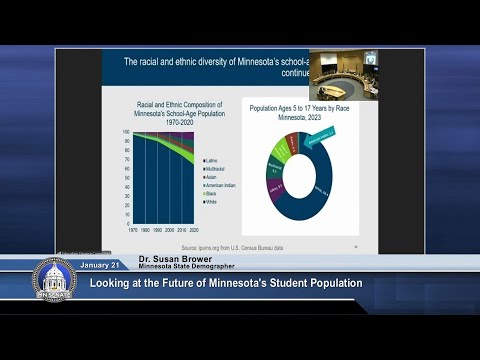
Key findings Brower gave the committee: - Residents ages 5–17 in 2023: just under 1,000,000 (the presentation defined “school age children” as residents, not enrollments). - Geography: about 56% of school‑age children live in the seven‑county Twin Cities metro. Other metropolitan areas (Duluth, St. Cloud, Rochester, Mankato, Moorhead) and some smaller regional clusters also concentrate children. - Regional projections: declines expected in many northern and southwest economic development regions; growth or stability in some central and I‑94 corridor counties (Anoka, Stearns, Sherburne, Lyon among the largest numeric gains). - Race/ethnicity and nativity: about 35% of school‑age residents are children of color; detailed 2020 Census estimates cited by Brower put Mexican ancestry at about 82,000 children, African American about 69,000, Somali about 42,000 and Hmong about 36,000. Approximately 20% of school‑age children have at least one parent born outside the United States (14% have two foreign‑born parents or an equivalent measure). - Language: Non‑English home languages among enrolled students (MDE enrollment data for 2023–24): about 18% of enrolled students (about 152,000) speak a language other than English at home; Spanish ~58,000, Somali ~26,000, Hmong ~20,000. - Child poverty: Brower said Minnesota’s child poverty rate is “just under 10%” of school‑age children (compared with 15% nationally), with higher rates concentrated in Minneapolis, St. Paul, some first‑ring suburbs and in parts of northern Minnesota (for example, districts serving larger Native populations such as Bagley/Leech Lake/Cass Lake area districts).
Committee members asked Brower about the role of migration and whether Minnesota’s quality‑of‑life rankings or new in‑migration could change the outlook. Senator Steve Swadzinski asked whether the forecast accounted for in‑migration by families choosing Minnesota as a place to raise children; Brower replied that the forecast incorporates recent migration patterns and that "historically we’re losing more people to other states than we gain," especially young adults in their late teens and early 20s who leave for college or jobs. She added: "The decline that we're seeing here really is being driven by lower birth rates and not having the level of in migration." She noted migration patterns can change, including because of broader factors such as climate or economic shifts.
The presentation emphasized that projections are for resident children (not school enrollment), that boundary changes and open enrollment can affect district‑level numbers, and that district patterns can differ sharply within the same county. Brower said the state’s student population will continue to become more diverse over time because the parent generation is becoming more diverse.
The committee followed Brower’s presentation with additional panels on the November fiscal forecast and special education funding. Brower’s slide deck and data tables were made available to committee members; she invited follow‑up questions about district‑level trends and geographic details.