Get Full Government Meeting Transcripts, Videos, & Alerts Forever!
Get email alerts on the Avian Influenza H5n1 topic
No spam. Unsubscribe anytime.
MDH: H5N1 remains low general risk but occupational threat to agricultural workers
Summary
The state public‑health veterinarian told the committee H5N1 is primarily an animal disease but has infected multiple mammalian species; Minnesota has monitored thousands of exposed people, supplied targeted clinics and is planning for vaccine distribution if needed.
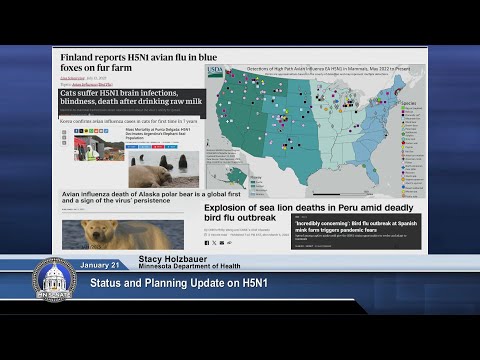
Stacy Holzbauer, state public‑health veterinarian at the Minnesota Department of Health, briefed the Senate Health and Human Services Committee on the status and planning for H5N1 avian influenza on Jan. 21.
Holzbauer said H5N1 is primarily an animal disease but has expanded its host range, infecting multiple mammalian species worldwide. She reported 182 affected poultry flocks in Minnesota—142 commercial operations and 40 backyard flocks—and detections in 10 livestock herds (one goat herd and nine dairy herds) and five cats in state investigations. Nationally she cited more than 1,400 confirmed poultry farms and 928 dairy herds affected.
Holzbauer said human infections in the U.S. are rare; the department has recorded no confirmed H5N1 human cases in Minnesota. She told the committee there have been 67 confirmed U.S. human H5N1 infections to date, most with mild symptoms and with conjunctivitis reported frequently. One U.S. death was noted after exposure to an infected backyard flock. She warned the primary concern is a co‑infection event that could produce reassortment and create a virus capable of sustained person‑to‑person transmission.
Holzbauer described Minnesota’s One Health response: coordinated surveillance among the Department of Health, the Minnesota Board of Animal Health and the Minnesota Department of Agriculture; enrollment and monitoring of exposed people; coordination of clinical testing and antivirals; multilingual outreach to farm workers; and distribution of personal protective equipment to affected industries. She said more than 24,100 exposed people and responders have been monitored in Minnesota since 2022 and that exposed individuals are monitored for 10 days after their last exposure.
She acknowledged PPE is challenging in farm settings—“dusty, wet, and hot”—and noted low compliance for some recommended equipment. Holzbauer said seasonal influenza vaccination is encouraged because it reduces the chance of dual infection, and outlined federal vaccine stockpile projections: about 5 million H5 vaccine doses in the federal stockpile now, 10 million more expected by spring and manufacturing capacity that could produce about 100 million doses within five months if needed. She also said Minnesota will receive federal funds through a response cooperative agreement to augment influenza surveillance and subtyping.
Committee members asked about vaccine ingredient disclosures and local vaccine planning; Holzbauer said MDH would follow up with vaccine technical colleagues and provide detailed information.