Get Full Government Meeting Transcripts, Videos, & Alerts Forever!
Get email alerts on the Eminent Domain Energy Collector Systems topic
No spam. Unsubscribe anytime.
Wyoming committee OKs bill limiting private condemnation for energy collector systems after contested hearing
Summary
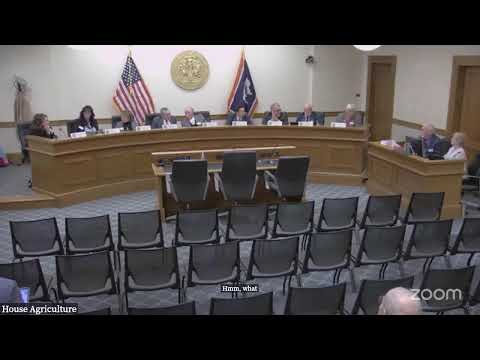
House Bill 91, which would bar private companies from using eminent domain to acquire rights for energy collector systems, advanced from the Agriculture, State & Public Lands & Water Resources Committee on a 6–3 vote.
House Bill 91, which would bar private companies from using eminent domain to obtain rights-of-way for energy collector systems, advanced from the Agriculture, State & Public Lands & Water Resources Committee on a 6-3 roll-call vote.
The bill was introduced by Representative Eklund as a response to local opposition to previous collector-line projects and a prior moratorium on collection lines that had expired. Committee members and multiple witnesses debated whether the measure protects private property or unduly restricts development.
Supporters, including several ranchers and the Wyoming Farm Bureau Federation, said the bill restores protections for landowners who do not want transmission or collector infrastructure crossing their property. Kelly Carpenter, policy advocacy director for the Wyoming Farm Bureau Federation, testified that her organization’s membership “supports limiting entities … from being able to use the power of eminent domain,” adding that the Farm Bureau was unaware of collector-line landowners receiving ongoing annual payments equal to those received by hosts of generation facilities.
Opponents, led by attorneys representing American Clean Power, said the bill would remove a rarely used but important tool that resolves holdout situations and can increase compensation to landowners. Jeff Pope of Holland & Hart, testifying for American Clean Power, told the committee he had not found evidence that renewable developers had used eminent domain for collector systems but warned that removing the tool would give single holdouts veto power over projects and over adjoining landowners who had negotiated easements. He also described how Wyoming law’s valuation rules can raise compensation during condemnation proceedings.
Industry witnesses and counsel also noted that several protections the bill seeks to restate — for example, that an easement cannot be used beyond its terms and that reclamation obligations exist under state statute — are already in Wyoming law. Cindy DeLancey of Holland & Hart said bonding and reclamation plans are reviewed by the Department of Environmental Quality and the Industrial Siting Council for projects such as wind farms.
Several witnesses suggested a narrower compromise that was discussed in committee previously: a requirement that developers secure voluntary agreements with a specified percentage of affected landowners (one draft used an 85% threshold) before exercising condemnation. Proponents of that approach said it balances private-property concerns with the rights of other landowners who want lease or easement revenue.
Committee discussion reflected the split testimony. Representative Davis said he intended to vote no because the bill did not cover all gathering and transmission types; Representative Eklund described the measure as a difficult tradeoff between protecting landowners and preserving a last-resort tool for development. The roll call on the motion to “do pass” produced six ayes (Representative Banks; Representative Johnson; Representative Otman; Representative Schmidt; Representative Struck; Chairman John Winter) and three noes (Representative Davis; Representative Eklund; Representative Provenza). The committee chair announced, “This bill would pass.”
The bill will now proceed to the next stage in the legislative process (the transcript records the committee vote and does not specify any additional committee directions or amendments at this hearing).
Votes at a glance
- House Bill 91 — Motion: do pass (mover/second not specified in transcript). Roll-call: Banks (Aye), Davis (No), Eklund (No), Johnson (Aye), Otman (Aye), Provenza (No), Schmidt (Aye), Struck (Aye), Chairman Winter (Aye). Tally: 6–3 in favor; outcome: passed by committee.