Get Full Government Meeting Transcripts, Videos, & Alerts Forever!
Get email alerts on the Legislative Joint Offices topic
No spam. Unsubscribe anytime.
Legislative joint offices brief State Government Finance Committee on roles, staffing and services
Summary
Directors from the Legislative Budget Office, Legislative Reference Library, Revisor of Statutes, Legislative Coordinating Commission and the Legislative Commission on Pensions and Retirement described their offices' duties, staffing levels and core services in a committee briefing.
Directors from the Legislative Budget Office, the Legislative Reference Library, the Revisor of Statutes office, the Legislative Commission on Pensions and Retirement, and the Legislative Coordinating Commission briefed the State Government Finance Committee on the services they provide to the legislature and the public.
Nut graf: Committee members heard overviews of each joint office’s core duties — fiscal analysis and fiscal notes, research and archives, legal drafting and publication, pensions oversight, and shared administrative and mapping services — and asked clarifying questions about staffing, workloads and how members can use those services.
Christian Larson, director of the Legislative Budget Office, summarized the LBO’s two statutory duties: provide nonpartisan fiscal estimates for proposed legislation and staff the Tax Expenditure Review Commission. He described the fiscal note and local impact note processes, said the office receives hundreds to more than a thousand fiscal note requests in budget years, and identified staffing at about 18 budgeted FTEs. “For fiscal notes, our role is to coordinate the process, working with committee staff and state entities to process and manage requests,” Larson said.
Elizabeth Lincoln, director of the Legislative Reference Library, told members the library answered roughly 6,000 reference questions last year, maintains state document depository and digital archives, manages the legislative website search engine and archives audio and video of House and Senate proceedings. She said the library staffs 16 people in 14 FTE positions and provides key electronic resources such as EBSCO, JSTOR, Westlaw and news archives to the Capitol network.
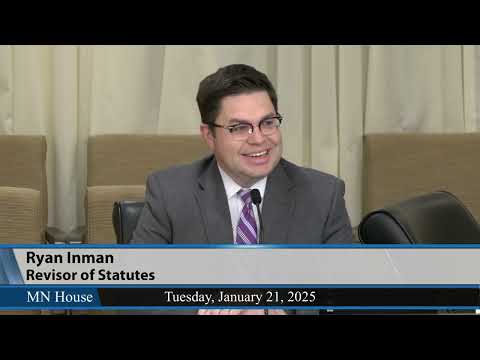
Ryan Inman, Revisor of Statutes, described the reviser’s duties under Minnesota Statutes chapter 3C: drafting bills, amendments and committee reports; enrolling and presenting bills to the governor; publishing Laws of Minnesota and Minnesota Statutes; and providing IT services for bill status and legal publications. He said the office employs about 60 permanent staff and performs quality control on introduced bills to ensure they can be compiled into the statutory code.
Susan Lincheski, executive director of the Legislative Commission on Pensions and Retirement, outlined the commission’s oversight of public pension systems and related plans. She said the funds overseen by the commission and related entities include about 330,000 active public employees and roughly $80 billion in assets invested by the State Board of Investment; volunteer firefighter relief associations are also under the commission’s oversight.
Michelle Yurek, executive director of the Legislative Coordinating Commission, explained the LCC’s administrative and fiscal-agent roles. She said the LCC provides fiscal and human resources services to joint offices, stores geographic boundary data used for district mapping and redistricting assistance, serves as fiscal agent for multijurisdictional contracts (for example, broadcast contracts), and coordinates accessibility and language translation services for the legislature. The LCC’s operating dollars were described as a portion of an overall base budget; staff at the LCC total about 18 permanent employees with additional limited-term staff depending on assignments.
Committee members asked practical questions about how to access services and how to join advisory commissions and task forces. Directors said members should contact caucus appointment staff or the offices directly to volunteer for working groups and task forces. Several members praised the nonpartisan services and noted the practical value of the offices during the session.
Ending: The committee thanked the directors for the overviews; members said they will consult the offices’ services as they prepare legislation and budgets this session.