Get Full Government Meeting Transcripts, Videos, & Alerts Forever!
Get email alerts on the Dnr Operations Deer Farm topic
No spam. Unsubscribe anytime.
DNR briefs Senate committee on operations, accessibility and deer‑farm fencing enforcement
Summary
The Department of Natural Resources presented an annual overview of operations, accessibility investments and a legal update on deer‑farm fencing enforcement, including inspections and active litigation.
The Department of Natural Resources told the Senate Environment, Climate and Legacy Committee it manages extensive public lands and services across Minnesota and is actively enforcing a state law that requires deer farms to prevent physical contact between captive and wild deer.
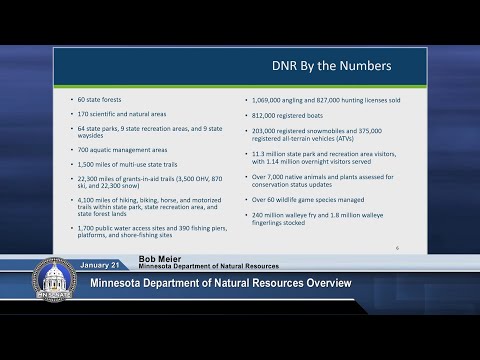
Assistant Commissioner Bob Meyer gave an agency overview that outlined DNR divisions, field presence and programs. Meyer said the DNR oversees state forests, scientific and natural areas, parks and trails, fisheries and wildlife programs, enforcement and operation services. He highlighted accessibility investments funded through the “Get Out More” appropriation, including a fleet of track chairs for visitors with mobility limitations and a recently completed campground upgrade at William O’Brien State Park with a lower campground that Meyer said will be fully accessible.
Meyer told the committee the department’s budget is spread across roughly 50 funds and that about 22% of its budget is passed through to nonstate entities. He gave operational totals including a statewide footprint of hundreds of work sites and a complex asset inventory of buildings, hatcheries and infrastructure.
During a question‑and‑answer segment lawmakers pressed the DNR about enforcement at deer farms. Meyer said a state law that went into effect Sept. 1 (year not specified in the presentation) requires deer farms to be enclosed in a manner that prevents physical contact between captive and wild deer; he said the statute did not define the term “physical contact,” and DNR is enforcing the requirement through inspections and compliance work. Meyer reported these enforcement tallies to the committee: 79 deer farms currently in operation, 19 deer farms closed during 2024, and 98 deer farm inspections conducted in 2024; 13 farms were being brought into compliance after inspections identified failures to meet exclusionary fence rules.
Meyer said DNR is pursuing enforcement actions when farms decline to take corrective steps and that deer farmers litigated with the department in district court; the district court decision favored the state and the case is on appeal to the Eighth Circuit. He outlined possible containment measures enforcement staff are discussing with farmers — examples included double 96‑inch high fencing, secondary mesh, solid attachments to existing fences, and electric fences — and said officers are working with farms that submit feasible plans to comply.
Why it matters: The DNR overview frames agency priorities for the session (public‑land management, recreation access and capital needs) and the deer‑farm update highlights an active enforcement program that involves regulatory interpretation, farmer compliance, and ongoing court proceedings. Lawmakers said they expect further briefings and may consider statutory clarification if needed.
Meyer and DNR staff offered to provide further detail on staffing location breakdowns, facility inventories and the legal status of ongoing cases.