Get Full Government Meeting Transcripts, Videos, & Alerts Forever!
Get email alerts on the Committee Jurisdiction And Funding topic
No spam. Unsubscribe anytime.
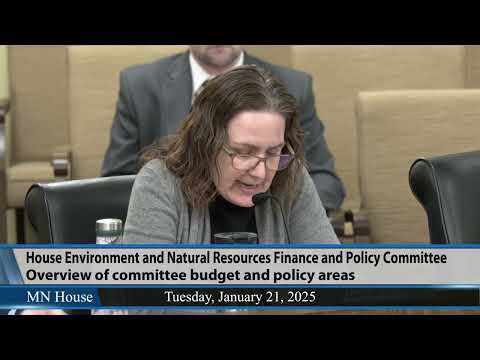
House Environment Committee opens session; staff outline agency jurisdictions, funds and upcoming permitting hearings
Summary
Chair Josh Heintzeman called the Environment and Natural Resources Policy and Finance Committee to order on Jan. 16, 2025, saying the panel had “a good opportunity to go ahead and get rolling” on issues affecting Minnesota.
Chair Josh Heintzeman called the Environment and Natural Resources Policy and Finance Committee to order on Jan. 16, 2025, saying the panel had “a good opportunity to go ahead and get rolling” on issues affecting Minnesota.
Nonpartisan House Research analyst Janelle Taylor and House Fiscal analyst Brad Hagemeyer gave an introductory briefing that mapped the agencies, chapters of Minnesota statute under the committee's jurisdiction and the major state funds the committee oversees. Members asked clarifying questions about overlapping agency responsibilities and specific fund histories, including the Volkswagen settlement account.
The briefing outlined core agency responsibilities. Taylor summarized the Department of Natural Resources (DNR) as responsible for conserving and managing the state's natural resources and for outdoor recreation programs, including wildlife management, state lands, timber, water-use and mining permits, and motorized-recreation regulation; she cited statutes such as Minnesota Statutes, chapters 84, 84D, 85, 86A–B, 88–90, 92–94 and portions of chapters 103F and 103G that commonly fall within the DNR's authority. Taylor described the Pollution Control Agency (PCA) as the primary state agency for implementing federal Clean Water and Clean Air laws, and identified air and water permitting, solid and hazardous waste, tank regulation and PFAS-related work as PCA responsibilities (noting chapters 114D, 115, 115B and 116 as relevant).
Taylor also reviewed the Environmental Quality Board (EQB) and its role in environmental review (Minn. Stat. chs. 116C, 116D); the Board of Water and Soil Resources (BWSR) and its work with local conservation units and wetland programs (Minn. Stat. chs. 103B–103E and portions of 103F); and other entities that receive committee attention including the Metropolitan Council (regional parks, Minn. Stat. ch. 473A), the Conservation Corps of Minnesota (Minn. Stat. §84.991), the Minnesota Zoological Board (ch. 85A), the Science Museum of Minnesota, and the Legislative-Citizen Commission on Minnesota Resources (LCCMR) and the Environment and Natural Resources Trust Fund (Minn. Stat. chs. 116P–116Q).
Hagemeyer walked members through the committee’s funding landscape and account types. He described three appropriation types: direct appropriations (typical omnibus appropriations), statutory/standing appropriations (ongoing, written in statute) and open appropriations (funding sufficient to meet obligations in a fiscal year). Key figures cited from the November 2024 forecast and FY24 actuals included:
- General fund appropriations to entities under this committee were about $1,030,000,000 in FY24–25; the base for the 2026–27 biennium shown in the session model was $423,000,000 (this figure excludes Payment in Lieu of Taxes, or PILT, of approximately $100,000,000, which is carried in the tax bill).
- The 2023 capital bonding package included about $316,000,000 in bonding and $63,000,000 in general fund cash for environment-related projects (acquisition, asset preservation, park and trail development, dam work, wetland replacement, etc.).
- The Environment and Natural Resources Trust Fund (constitutional, funded by lottery proceeds) had LCCMR recommendations for FY26 of about $103,300,000 across 124 projects; starting in FY26 an additional 1.5% of the corpus (about $28,000,000) was noted as available for a newly created DNR-run community grant program.
- Game and Fish Fund: FY24 expenditures were cited at roughly $133,000,000, with primary revenues from license fees (about $67,000,000) and federal excise grants (about $46,000,000). Hagemeyer listed numerous dedicated accounts within the Game and Fish Fund (for deer, pheasant habitat, trout/salmon, wild rice, walleye stamp, wolf management, lifetime license trust, peace officer training, and others).
- Natural Resources Fund: FY24 expenditures were cited at about $137,600,000, supported by departmental earnings (~$74,400,000), lottery-in-lieu receipts (~$22,000,000), and unrefunded gas tax receipts (~$20,000,000 for recreation vehicle accounts). Hagemeyer listed multiple subaccounts (state parks, trails, non-game wildlife, invasive species, forest and minerals management, etc.).
- Environmental Fund (PCA): FY24 expenditures about $93,000,000; major revenue sources include the solid waste management tax (70% allocated to the fund, roughly $85,000,000 cited) and the motor vehicle transfer fee (~$11,200,000), with program fees for air permits (~$17,800,000), hazardous waste (~$7,000,000) and water quality (~$4,400,000).
- Remediation Fund: FY24 expenditures just under $40,000,000; primary revenues include transfers from the Environmental Fund and the Petroleum Tank Release Cleanup Fund. Hagemeyer explained the dedicated balance for the 3M PFAS settlement (state share of an $850,000,000 settlement with $725,000,000 arriving in state accounts) is restricted to East Metro cleanup activities and is not interchangeable with general remediation dollars.
Hagemeyer also reviewed other funds that appear in committee budgets or agency operations, including the Coles Landfill Investment Fund (created 1999; invested balance noted at just under $160,000,000 as of Dec. 31, 2024; statutory appropriation that ends after the current fiscal year), the RIM (Reinvest in Minnesota) fund, the permanent school fund receipts from royalties and timber, the clean water revolving loan fund, federal grant flows and gift funds (for example Volkswagen settlement dollars that were run through gift accounts).
Members asked questions during and after the briefings. Representative Isaac Schultz asked whether overlap or conflict between chapters 103F and 103G (water statutes) and BWSR/DNR responsibilities was common; Taylor replied that responsibilities are usually clear in statute though conflicts can arise and are resolved through interagency work. Representative Don Gilman asked about the timing of Volkswagen settlement receipts; staff identified the state’s Volkswagen-related funds as originating from the federal settlement and noted Minnesota’s share began arriving in recent years (staff later identified 2017 as the settlement start for Minnesota’s shares).
Chair Heintzeman closed by previewing committee work: members were told the committee would hear permitting bills next Thursday (House File 8) and that the panel would seek overviews from agency commissioners (PCA, DNR, BWSR) in future meetings. He signaled a policy emphasis shift described by the chair as increasing attention to sportsmen's issues, outdoor access and job-creation concerns while limiting new regulatory mandates.
The committee adjourned after roughly a 43-minute organizational and informational session; no formal motions or votes were recorded at this meeting.