Get Full Government Meeting Transcripts, Videos, & Alerts Forever!
Get email alerts on the Energy Policy topic
No spam. Unsubscribe anytime.
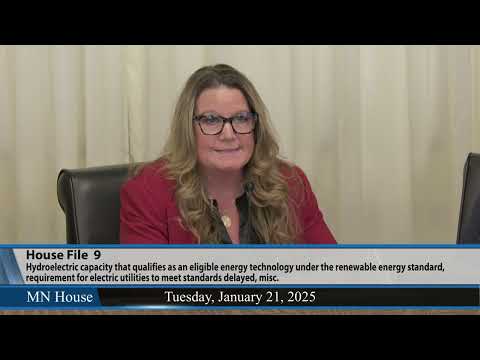
Committee advances House File 9 to taxes after discussion on nuclear, hydro and reliability
Summary
Rep. Swazinski, the author of House File 9, successfully moved that the bill be referred to the Committee on Taxes after committee discussion and public testimony on reliability, nuclear power, hydroelectric resources and tax exemptions.
Rep. Swazinski, the author of House File 9, successfully moved that the bill be referred to the Committee on Taxes after committee discussion and public testimony on reliability, nuclear power, hydroelectric resources and tax exemptions.
House File 9 would broaden what counts as eligible carbon‑free generation for Minnesota’s 2040 standard, lift the state’s moratorium on new nuclear construction, allow larger hydroelectric facilities to qualify regardless of capacity or date of operation, prohibit political subdivisions from permitting demolition of fossil fuel plants under a specified retail‑rate test, and expand a state sales‑tax exemption for natural gas and electricity used as primary residential heat to apply year‑round for sales after June 30, 2026.
The bill’s author, Rep. Swazinski, told the committee the measure seeks “off ramps” from parts of Minnesota’s 2023 clean energy law to protect reliability and affordability, arguing the changes would help utilities “ensure reliability, and lower rates” and would “end the moratorium on construction of new nuclear plants.”
Testimony at the hearing focused on grid reliability and options to meet increasing demand. Jenny Glumack, director of government affairs for the Minnesota Rural Electric Association, warned the MISO region faces capacity risk in the coming decade and said the association supports an “all‑tech on deck” approach that includes nuclear and carbon capture. Glumack provided a real‑time MISO output snapshot showing coal, natural gas and nuclear still supplying baseload power on a cold day and said, “NERC’s 2024 Long Term Reliability Assessment for the Midwest Independent Service Operator, which is MISO, is characterized as high risk.”
Business and utility witnesses echoed that view. Michelle Benson, director of energy policy for the Minnesota Chamber of Commerce, said Minnesota businesses need “affordable, reliable and cleaner energy” and noted commercial and industrial rates have risen relative to national averages. Rick Evans, government affairs at Xcel Energy, told members utilities plan and review resource choices through two‑year resource plans filed with the Public Utilities Commission and urged stakeholders to use that process when considering retirements or new builds.
Tribal concerns were raised by Blake Johnson, a government‑relations representative and member of the Prairie Island Indian Community, who described the community’s proximity to existing nuclear facilities and spent fuel. Johnson testified that tribal members “have lived next to spent nuclear waste for 30 years and next to a nuclear generating plant for 50 years,” and said the tribe opposes lifting the moratorium without a viable solution for long‑term waste disposal.
The committee adopted the author’s A1 amendment, which clarifies that language declaring a state policy to support carbon capture “does not obligate the state to provide funding.” The amendment passed by voice vote; no roll‑call tally was recorded in the transcript.
Rep. Swazinski explained specific bill provisions to the committee: removing the statutory capacity cap so larger hydroelectric projects qualify as eligible energy technology regardless of in‑service date; delaying application of the solar/carbon‑free standard for three years for any utility that does not meet a retail‑rate benchmark defined in section 216 (rate at least 5% below the national average); prohibiting political subdivisions from permitting demolition of fossil fuel generation if a utility fails to meet that section 216 retail rate goal; and expanding the state sales tax exemption for residential heating (natural gas and electricity) to be year‑round for purchases after June 30, 2026.
After testimony and brief member discussion, Chair Swazinski renewed the motion to refer House File 9 to the Committee on Taxes. The committee approved the referral by voice vote; the transcript records members responding “aye” and “no” when asked, but does not record a roll‑call or numeric tally.
Votes at a glance: - Approval of minutes from Jan. 16 — approved by voice vote. - Adoption of author’s A1 amendment to House File 9 (clarifies no state financial obligation for carbon capture language) — passed by voice vote. - Motion to refer House File 9 to the Committee on Taxes — passed by voice vote.
The committee hearing concluded after the referral motion passed. Further amendment, fiscal analysis and any future floor action will occur in subsequent committee stages and on the House floor.