Get Full Government Meeting Transcripts, Videos, & Alerts Forever!
Get email alerts on the Government Fraud Oversight topic
No spam. Unsubscribe anytime.
Minn. lawmakers introduce package to tighten fraud oversight, propose independent inspector general and mandatory reporting
Summary
Legislators introduced three House files proposing an independent state inspector general, mandatory fraud reporting for state employees, and an OLA-based matrix to track agency follow-through on audit recommendations.
Members of the Minnesota House outlined a package of bills to strengthen oversight of state spending and fraud detection, proposing an independent Office of Inspector General, mandatory reporting requirements for state employees, and a numeric matrix of Office of Legislative Auditor findings intended to help appropriators spot unaddressed risks.
Representative Nash said House File 3 would “take existing OLA reports” and create “a matrix or a numeric score” that shows whether agencies have implemented recommendations. “It would look back and say, we've had 20 recommendations made in the last 5 years. You've implemented 2 of them, and now we're making a... score,” Nash said.
The measures aim to consolidate audit follow‑up and add investigatory tools. Representative Patty Anderson, who said she serves on the Legislative Audit Commission, described House File 1 as creating “an independent office of inspector general” that would report to the bipartisan Legislative Audit Commission, have subpoena authority and the power to “tell the agency to stop payments” when suspected fraud is found. “This independent office will report to the bipartisan, legislative audit commission, just like the legislative auditor's office does,” Anderson said.
Representative Ben Davis said House File 2 would impose mandatory fraud-reporting duties on state employees and agencies, require unannounced, in-person site visits to grant recipients, and establish criminal penalties for neglecting reporting duties. “If an employee of a state agency has suspicion of fraud in a program administered by the agency, the employee or agency must immediately notify law enforcement,” Davis said.
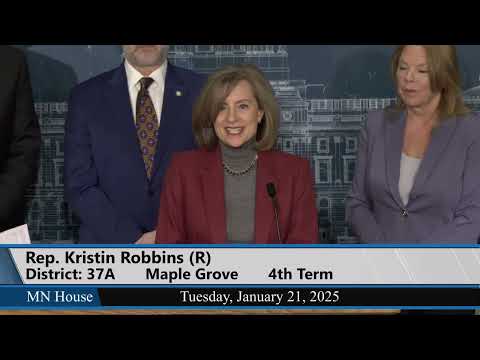
Kristen Robbins, chair of the new fraud and oversight committee, said the committee will meet weekly and plans to invite current Department of Human Services Commissioner Jodi Harpstead to testify before her Feb. 3 departure. “So I just wanted to kind of tie this all together and highlight our caucus's commitment to ending fraud and waste in Minnesota,” Robbins said. Robbins also said the committee will create a website to accept tips and whistleblower notices.
Speakers repeatedly cited recent high-profile investigations into programs such as Feeding Our Future as evidence for new measures. Several legislators referenced figures discussed in the meeting — “verified almost half a $1,000,000,000” and possibly “upwards of $1,000,000,000” in fraud — while acknowledging those totals vary by estimate.
Committee members discussed fiscal impacts. Nash said House File 3’s initial estimate is “240 some odd $1,000,” and that the cost would be carried in the state government finance bill. Anderson and others said fiscal notes are being prepared or amended for several bills and that some existing OIG positions could transfer into a new office.
On enforcement design, legislators said the new inspector general office would be intended to be nonpartisan, account for both investigative and audit functions, and cooperate with the Office of Legislative Auditor (OLA) rather than replace it. Questions at the meeting touched on whether the legislative auditor or the state auditor could absorb new duties; Anderson said the legislative auditor and the proposed OIG would perform different roles.
No formal votes or final committee actions were recorded in the transcript; sponsors described next steps as hearings and author’s amendments. The bills were introduced and routed to relevant committees for fiscal analysis and further consideration.
For background, speakers referenced the Office of Legislative Auditor, a Minnesota Management and Budget (MMB) report discussed in the meeting, Commissioner Jodi Harpstead, and recent criminal investigations that legislators said involve state contractors and vendors. The meeting included appeals to use modern tools such as AI to detect irregularities; Nash said he has raised using AI to flag anomalies and expects that idea to be part of state government finance hearings.
Looking ahead, committee chairs said hearings and additional fiscal notes are expected; sponsors urged bipartisan cooperation but acknowledged some members of the DFL caucus were not present at the time of the discussion.