Get Full Government Meeting Transcripts, Videos, & Alerts Forever!
Get email alerts on the Mhfa Funding Appropriations topic
No spam. Unsubscribe anytime.
House housing committee reviews Minnesota Housing appropriations, seeks accounting of $1 billion one‑time funds
Summary
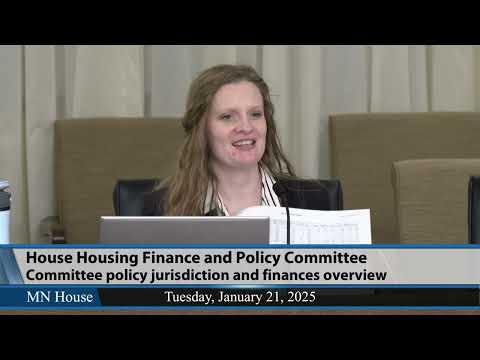
Representative Spencer Ego, chair of the Minnesota House Committee on Housing Finance and Policy, opened the meeting and staff from House Research and House Fiscal briefed the committee on Minnesota Housing Finance Agency (MHFA) funding levels and programs.
Representative Spencer Ego, chair of the Minnesota House Committee on Housing Finance and Policy, opened the committee’s organizational meeting and called for introductions before hearing staff briefings on housing finance and policy.
Mary Davis of the nonpartisan House Research Department outlined the range of laws and program areas that commonly come before the committee, including real estate and landlord–tenant law, manufactured‑home park rules, housing cooperatives, and statutes that govern the Minnesota Housing Finance Agency (MHFA).
Katrina Highmark, the committee’s House Fiscal analyst, provided a program‑level financial briefing on MHFA. Highmark said the agency’s typical biennial base appropriations historically have been about $120 million, but that fiscal 2024–25 included unusually large one‑time appropriations: “with the exception of fiscal year 24, 25 when the agency received approximately $1,000,000,000 in appropriations,” she said.
The briefing summarized ongoing base appropriations and the scale of one‑time spending across MHFA program areas. Highmark listed base funding levels and prior one‑time amounts for development and redevelopment (ongoing base $32,400,000; prior one‑time $457,200,000), housing stability (ongoing base $106,000,000; prior one‑time $169,200,000), homeownership assistance (ongoing base $1,800,000; prior one‑time $211,800,000), preservation (ongoing base $21,500,000; prior one‑time $146,000,000), and resident and organization support (ongoing base $4,000,000; prior one‑time $89,500,000). She also gave program‑level examples, such as the Affordable Rental Investment Fund (ARIF) base $8,400,000, owner‑occupied housing rehabilitation base $5,500,000, the Bridges program base $10,800,000, and the Housing Trust Fund base $23,300,000.
Members repeatedly pressed staff for more detail on how the large 2024–25 appropriations have been spent, timing windows for those expenditures, and the reporting or oversight requirements tied to transfers. Representative Jim Nash asked about unspent balances and return provisions; Highmark replied that transferred funds are allowed to be expended by the agency and that she had submitted a request to the agency for detailed expenditure information and would share responses with the committee when available. Nash characterized the earlier appropriation amount in colloquial terms: “I feel like it should be like doctor evil, but, it's a lot of money and I think that Minnesota taxpayers would like to know that it's been handled appropriately,” he said.
Members also asked how MHFA funds flow to owners, tenants and local entities. Mary Davis and Highmark explained program differences: preservation programs generally provide capital funds to owners (including cities, counties, housing and redevelopment authorities, nonprofits and sometimes tribes) to rehabilitate and stabilize rental housing; those recipients commonly must document and maintain tenant income‑eligibility levels for a set number of years. Housing stability programs and some housing assistance programs can provide direct rental assistance payments or vouchers to tenants. Highmark identified partnership links to USDA Rural Development for certain rental‑rehabilitation programs and said she would follow up with more specifics.
Highmark also reviewed a newly established non‑general‑fund revenue source: the metropolitan sales tax enacted in 2023. She said MHFA receives 25% of the 0.25% metro sales tax and reported deposits of $26,600,000 to the housing assistance fund in fiscal 2024 (covering five months), with projections of $41,900,000 in fiscal 2025 and $45,100,000 in fiscal 2027. Members asked what programs those receipts may be used for and what legislative reporting or oversight accompanies them; Highmark said she would follow up with details on permissible uses and reporting requirements.
Committee staff and members agreed to pursue follow‑up information from MHFA on expenditures, program eligibility, and any reporting or oversight tied both to the one‑time 2024–25 appropriations and the new metro sales tax receipts. No formal committee action or votes occurred at the meeting.
Ending: The chair closed the meeting after committee members reviewed rules and agreed to return when staff can provide the outstanding expenditure and program‑eligibility details requested during the briefing.