Get Full Government Meeting Transcripts, Videos, & Alerts Forever!
Get email alerts on the Sales Tax topic
No spam. Unsubscribe anytime.
Staff reviews sales and use tax base, local taxes and governor’s recommendation to tax professional services
Summary
House Research overviewed Minnesota sales and use tax rates and exemptions, local sales tax options, legacy amendment funds and noted the governor’s proposed expansion of the sales tax base to include some professional services.
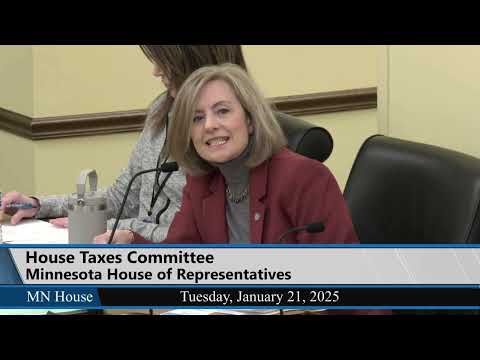
Alex Hagler of House Research explained sales and use taxes to the House Tax Committee, describing the state combined rate, the legacy amendment portion and common exemptions.
Hagler said the combined state sales tax is 6.85%, composed of a 6.5% base rate and a 0.375% legacy amendment rate (the legacy portion supports constitutionally dedicated funds and staff noted that the legacy portion sunsets in 2034). He described the tax base as generally including tangible personal property and some digital goods and said most services are excluded unless the Legislature enacts them into the base.
Hagler listed common exemptions for individuals (food, clothing, prescription drugs) and noted businesses receive exemptions for capital equipment and certain farm machinery; sales to federal and local governments and many nonprofits are exempt. He said Minnesota is a member of the Streamlined Sales Tax Agreement and that changes to the base can raise compliance questions.
On local taxes, Hagler explained the difference between general local sales taxes (which apply to the full state base and require statutory authorization and often a voter referendum), county transportation taxes (statutory, commonly capped at 0.5%), and special local taxes such as lodging (voter approval generally not required) or food and beverage taxes (require legislative authorization). The committee discussed a moratorium on some general local sales taxes that expires June 1.
Representative Rosemarie Robbins and others asked about the governor’s recent sales‑tax recommendation to expand the base to include professional services such as legal and accounting; Hagler and members said the exact bill language had not been released and the committee invited the Department of Revenue for a full hearing when details were available.
Hagler also said liquor is subject to a gross‑receipts tax (2.5% cited in the briefing) and cannabis products carry a 10% gross‑receipts tax; both are layered above or in addition to the state tax environment for those goods. Members asked staff to provide comparative modeling when the department releases final language.