Get Full Government Meeting Transcripts, Videos, & Alerts Forever!
Get email alerts on the Judiciary Budget topic
No spam. Unsubscribe anytime.
Minnesota courts ask Legislature for funding to close staffing, access and technology gaps
Summary
Minnesota Judicial Branch officials presented a biennial budget request focused on pay increases, digital accessibility, forensic examiner pay, juror per diems and cybersecurity, warning sustained demand for court-mandated services and interpreter events will require ongoing funding.
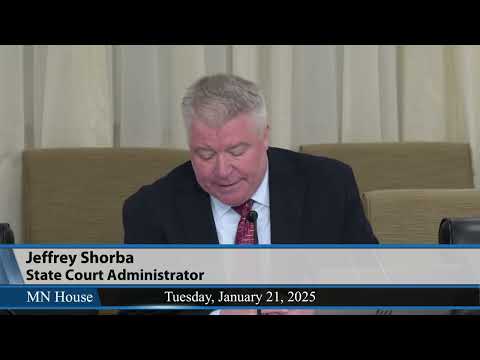
Jeff Shorba, Minnesota’s state court administrator, told the House Judiciary, Finance and Civil Law Committee that the judicial branch is seeking new funding to address staffing shortages, rising costs for court-mandated services and technology upgrades. The branch’s 2026–27 request includes multi-year and one-time asks to raise staff and judge compensation, meet new federal digital-accessibility rules, bolster cybersecurity and expand pay for contract forensic examiners and jurors.
Shorba said the courts handle roughly 1,000,000 cases filed each year across 103 court locations and described the 2026–27 request as necessary to “fulfill our constitutional obligation. Justice delayed is justice denied.” He told the committee the judicial branch’s current fiscal-year 2025 budget is about $479,000,000 and that the branch is funded almost entirely through legislative appropriation.
The largest personnel-related request calls for $77,300,000 in fiscal 2026–27 (and $104,000,000 in 2028–29) to address a pay gap identified in a market study and to fund employer share of health-care cost increases and rising lease costs. Shorba cited rising employee turnover and declining applicant pools as drivers of the proposal.
On digital accessibility, Shorba said the U.S. Department of Justice issued an administrative rule establishing specific digital-accessibility requirements that must be met by April 24, 2026. To remediate online content and court templates, the branch is seeking $5,100,000 in 2026–27 and $1,760,000 in 2028–29, with smaller ongoing funds for maintenance and licensing.
To modernize information sharing with justice partners, the branch requested $4,000,000 (one-time) in 2026–27 and $8,100,000 ongoing in 2028–29 to develop and maintain a new justice-partner access application. Shorba said vendor support for legacy applications ceased recently because of cybersecurity and maintenance concerns, and said the funding would implement recommendations from a statewide justice-partner work group.
The branch also asked for $7,200,000 in 2026–27 to raise contract forensic-examiner pay from $136 to $175 per hour, citing a 143% increase in the number of forensic medical evaluations between fiscal 2020 and fiscal 2023 and a continuing shortage of qualified examiners. Shorba said psychiatrists or licensed psychologists typically perform the evaluations and that staffing shortages have delayed evaluations needed to determine competency and other court-ordered findings.
On juror compensation, the request includes $18,000,000 in 2026–27 to raise the daily juror per diem from $20 to $100 and to increase mileage reimbursement to federal rates. Shorba and committee members framed the change as intended to reduce financial barriers that discourage participation and to improve representativeness in juries.
Shorba described sustained growth in court-mandated services as an ongoing budget pressure: interpreter events have nearly doubled since 2019 and now cover roughly 134 languages, and demand for psychological examinations has surged. He said temporary funding provided by the Legislature will expire in 2027 and the branch seeks permanent funding in the 2028–29 biennium to address the continuing deficits.
Shorba reviewed the branch’s pandemic-era changes and said the Minnesota Judicial Council recently adopted a district court hearing framework that will determine when in-person and remote hearings are appropriate; he said the framework will take effect Feb. 3 and that remote hearings are not appropriate for jury trials or evidentiary hearings. He reported that failures to appear have declined with expanded remote options.
On cybersecurity, Shorba said the branch received one-time funding in the prior session that expires in 2027 and warned that without continued investment the branch could face gaps in critical protections. He offered to brief the committee in more technical detail with court IT staff. Several members asked for trend data on interpreter events, mental-health-related caseloads and other mandated services; Shorba said the branch maintains extensive data and offered to provide trends and to invite members to public meetings of the mental-health advisory group.
Committee members asked follow-up questions about treatment courts funding, union negotiations for court employees (Shorba said the branch negotiates its own contracts), qualifications for forensic examiners (set by statute and typically psychiatrists or licensed psychologists) and availability of competency restoration resources. Shorba said capacity for treatment beds and community mental-health services is limited in some jurisdictions and that the branch is convening partner groups to explore options.
No formal votes or motions were recorded during the hearing. The presentation outlined the branch’s biennial budget ask and invited further committee follow-up on data and implementation details.