Get Full Government Meeting Transcripts, Videos, & Alerts Forever!
Get email alerts on the Energy Policy topic
No spam. Unsubscribe anytime.
House File 9 advances to taxes after committee debate on nuclear, hydro, carbon capture and sales-tax changes
Summary
A Minnesota House committee voted to refer House File 9 to the Taxes Committee after testimony and debate over reliability, the nuclear moratorium, qualifying hydroelectric power, carbon capture language and a year-round sales-tax exemption for residential heating fuels.
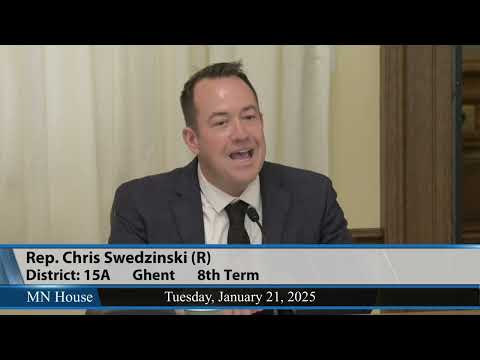
Representative Swazinski, the bill’s author, moved that House File 9 be referred to the Committee on Taxes after presenting a proposal that would lift Minnesota’s moratorium on new nuclear plants, expand the definition of eligible hydroelectric power under the state’s carbon-free standard, endorse carbon capture (while stating no state financial obligation), delay certain compliance deadlines for utilities that fail a rate test, prohibit demolition of fossil-fuel plants in some circumstances, and extend a sales-tax exemption for natural gas and electricity used as primary residential heat year-round beginning July 1, 2026.
The bill’s supporters told the committee the changes aim to shore up reliability and lower electric costs as coal plants retire and demand grows. Jenny Glumack, director of government affairs for the Minnesota Rural Electric Association, said the MISO region is “characterized as high risk” in the 2024 NERC long-term reliability assessment and argued that “we need base load energy, especially on these cold days and hot days.” Michelle Benson, director of energy policy for the Minnesota Chamber of Commerce, told the panel Minnesota needs “a low cost energy supply to support” businesses and said House File 9 would “reduce energy costs for Minnesotans, improve reliability and respect the goal of cleaner energy.”
Tribal and local concerns featured in testimony. Blake Johnson, who testified as a government relations representative for the Prairie Island community and identified himself as a tribal member, said the Prairie Island reservation sits “less than 700 yards away” from a nearby nuclear plant and noted decades of local experience with on-site spent nuclear fuel storage. He said the tribe has historically opposed lifting the moratorium without a viable waste solution and asked for more time and consultation.
Utility witnesses described technical and planning constraints. Rick Evans of Xcel Energy said decisions about retiring plants are made through biennial integrated resource plans filed with the Public Utilities Commission and cautioned that Section 4 of the bill—restricting demolition of fossil-fuel plants—could limit options communities want for reuse and could increase costs to customers. “The resource plan process is the best way to include regulators, policymakers, and our customers in the plant construction and retirement of new generation,” Evans said.
Other testifiers represented municipal utilities, investor-owned utilities and advocacy groups. Ken Stuilm (Minnesota Municipal Utilities Association) and Zach Martin (Minnesota Power) backed an “all-of-the-above” approach and said newer technologies such as small modular nuclear reactors and more hydroelectric capacity should be part of planning. Rachel Stuckey of the Minnesota Conservative Energy Forum urged caution about government mandates and supported market-based, technology-neutral policy.
Key bill provisions and details discussed in committee include: (1) lifting the statutory moratorium on new nuclear construction so nuclear could be considered as an eligible carbon-free resource, (2) changing the hydroelectric eligibility cap so that larger hydro could qualify under the carbon-free standard, (3) adding language declaring state support for carbon capture and sequestration while clarifying the language imposes no state financial obligation, (4) delaying application of certain carbon-free or solar standards for any electric utility that does not meet a rate test in section 216 requiring retail electricity rates for each customer class to be at least 5% below the national average, (5) a prohibition on political subdivisions issuing permits to demolish fossil-fuel electric generating plants when a utility fails to meet that rate goal, and (6) expanding a state sales-tax exemption for customers who use natural gas and electricity as primary residential heat from the November–April billing months to year-round, effective for sales after June 30, 2026.
Committee members raised affordability and public-safety concerns tied to extreme weather. Representative Baker said reliability can be “a life-or-death matter” in Minnesota’s winters and described instances when wind generation did not produce during extreme cold. Representative Anderson asked whether Xcel would distinguish between small modular reactors and large plants; Evans responded that tribal and site-specific issues would shape future discussions. Representative Weiner asked whether the hydro provisions would reach facilities inside Minnesota and neighboring jurisdictions; witnesses said some in-state hydro exists and that a significant amount of hydropower in the region originates on the Missouri River system and in Canada.
The committee voted by voice to adopt the bill’s A1 (author’s) amendment, which clarifies that the state’s stated policy supporting carbon capture does not create a state financial obligation. Representative Swazinski then renewed his motion to refer House File 9 to the Committee on Taxes; the committee approved the referral by voice vote. The author noted a fiscal note is pending and said, as reported to the committee, that some administration fiscal notes were withheld.