Get Full Government Meeting Transcripts, Videos, & Alerts Forever!
Get email alerts on the Public Safety topic
No spam. Unsubscribe anytime.
Minnesota law-enforcement groups urge funding for training, mental‑health beds and updates to drone, radio and hiring laws
Summary
Members of three statewide law‑enforcement associations told the Minnesota House Public Safety Committee that the Legislature should fund training, increase treatment‑bed capacity for people with mental illness, update drone and radio statutes, and tighten employer cooperation on background checks to address a growing recruitment and retention crisis.
Members of three statewide law‑enforcement associations told the Minnesota House Public Safety Committee that the Legislature should fund training, increase treatment‑bed capacity for people with mental illness, update drone and radio statutes, and tighten employer cooperation on background checks to address a growing recruitment and retention crisis.
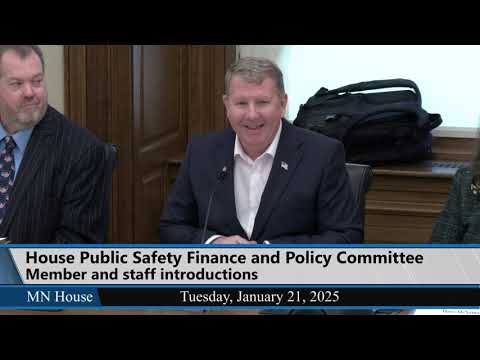
Chair Paul Novotny, chair of the Minnesota House Public Safety Committee, opened the committee by saying the panel’s primary focus will be victims and preventing further crime. He introduced law‑enforcement groups at the first committee hearing and gave them the first opportunity to present legislative priorities.
Shane Myrie, president of the Minnesota Police and Peace Officers Association (MPPOA) and a detective with the Hennepin County Sheriff’s Office, told the committee the profession faces a structural imbalance across recruiting, retention and retirement. “MPPOA’s 2024 member survey data shows that 80% of our members indicated that they were either unlikely or very unlikely to recommend the profession to a family member,” Myrie said. He cited post licensing numbers the association tracks — 623 post licenses granted in 2024, down from 670 in 2023 and 706 in 2022 — and said about 130 agencies statewide are hiring and the state is roughly 1,000 officers short.
Myrie and other presenters pointed to increasing assaults on officers. “BCA data showed that in 2017 there were 419 assaults on officers on the job. In 2020, 794 assaults on officers on the job. And in 2023, 1,179 assaults on law enforcement officers on the job,” Myrie said.
James Stewart, retired sheriff and executive director of the Minnesota Sheriffs Association (MSA), urged investment in mental‑health treatment capacity tied to the 48‑hour civil‑commitment timeline. Stewart said county jails are holding people who have been committed to the commissioner of human services because treatment beds are not available and urged the Legislature to increase bed capacity. “We need to stop criminalizing mental health issues by housing them in jails and institutions that cannot adequately meet their needs,” Stewart said. He told the committee that the priority admissions task force and multiple work groups since 2008 have repeatedly identified capacity as the primary challenge.
Stewart also listed other MSA priorities for the session, including: making permanent the post‑board training reimbursement allocation (often called the Philando Castile training fund), three updates to Minnesota Stat. 626.19 to clarify law enforcement use of unmanned aerial vehicles (UAVs), requiring permit‑to‑carry holders to report legal name changes under Minn. Stat. 624.714, subdivision 7a, and changes to Minn. Stat. 626.87 to require employers to respond to background‑check requests within 10 business days and expand remedies for willful noncompliance. He asked that penalties for noncompliance be dedicated to youth intervention program grants.
Brady Jewell, chief of the Savage Police Department and a representative of the Minnesota Chiefs of Police Association, reiterated recruitment and retention concerns and endorsed continuing the $6 million in post‑board training reimbursement funding that he said was cut from the governor’s budget. “This fund began in 2018 and has been extremely beneficial,” Jewell said, noting mandatory training areas such as crisis intervention, de‑escalation and cultural‑competency training. Jewell also cited statewide crime statistics the Chiefs track: 15,612 vehicles stolen in 2023 (he said that is roughly a 30% increase from 2019) and noted violent crime trends that remain above pre‑pandemic levels.
In Q&A, committee members pressed presenters on specifics. Representative Jeff Witty thanked MSA for its partnership on school resource officers and asked about the funding cut to the mandatory training program. Stewart told the committee the cut would transfer costs to local governments and said the training requirements are unlikely to be reduced absent funding. Representative Tina Weiss asked what would be needed to increase mental‑health capacity; Stewart replied that “we need beds and of course the beds would require doctors along with them and support system,” and suggested reopening or expanding existing facilities could be faster than new construction. Chief Jewell added that short‑term stabilization beds and staffing for embedded social workers and crisis counselors were priorities mentioned by local providers and NAMI.
Members also asked about proposed UAV changes. Stewart described the requested statutory changes as narrowly targeted to allow rapid UAV deployment in time‑sensitive missing‑person searches, permit training flights over private property with owner consent, and expand emergency uses to prevent imminent destruction of evidence. Jewell said some departments already operate drone teams under MOUs and that drones have aided several dementia patient recoveries.
Stewart urged statewide funding to replace aging radios that connect to the Allied Radio Matrix for Emergency Response (ARMOR) system, saying manufacturer support is ending for some equipment and statewide funding is needed to preserve interoperability.
The meeting was briefly disrupted by a public interruption; Chair Novotny later apologized to staff and the public and thanked sergeants and state patrol members who responded. Novotny closed the hearing without committee action. There were no motions or votes at the session.
This hearing was a presentation and discussion of legislative priorities; none of the items presented were adopted by the committee at this meeting. The proposals described would require further committee consideration, budget appropriation and, where applicable, statutory changes to take effect.