Get Full Government Meeting Transcripts, Videos, & Alerts Forever!
Get email alerts on the State Budget Forecast topic
No spam. Unsubscribe anytime.
Education Finance Committee reviews state budget forecast, formula allowance and aid-tracking spreadsheets
Summary
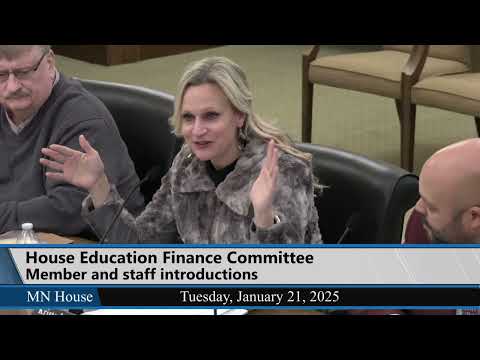
At its Jan. 21, 2025 organizational hearing the House Education Finance Committee received a briefing on the state general fund forecast, K–12 spending projections and how to read the committee’s aid-tracking spreadsheets, including per-pupil formula updates tied to inflation.
The House Education Finance Committee, chaired by Chair Acresha, opened its first 2025 hearing with a walkthrough of the state general fund forecast and the committee’s education aid tracking worksheets.
The briefing, led by Tim Strom of the Minnesota House Research Department and Solve (Ms.) Beckel of House Fiscal, showed Minnesota entering the 2026–27 budgeting window with a modest positive bottom line under the forecast but a substantial projected shortfall in the out years. "Minnesota's general fund budget is estimated 2 times a year through the forecast," Strom said while explaining the role of the November and February forecasts for the committee’s work.
Committee members were shown the forecast figures the nonpartisan staff are using to build the K–12 baseline. The presenters said the state would end the current biennium (2024–25) with a budgetary balance that, after reserves, leaves about $616 million available for 2026–27 under baseline assumptions. The same forecasting tables showed an expected shortfall of about $5.1 billion in fiscal years 2028–29 if no policy changes are made. Committee staff emphasized that the committee's appropriations will focus on fiscal years 2026–27 while the 2028–29 years are treated as the “tails” or out years for planning purposes.
Ms. Beckel led members through the committee’s education aid spreadsheet, explaining the columns (line number, program, end-of-session spending, FY24–25 estimates, FY26–27 planning years and FY28–29 tails) and why some lines change between forecasts. She explained that many education programs are "entitlement" or formula-driven items that change with pupil counts and enrollment data; those programs commonly appear in the spreadsheet’s forecast columns as underlined or otherwise highlighted when forecast-driven adjustments occur. "The programs that are underlined are shifted 90–10, generally speaking," Beckel said, referring to the standard state aid payment practice of paying 90% in the current year and reconciling 10% with the previous year.
Staff also reviewed the formula allowance per pupil that undergirds general education aid. The forecast shows the formula allowance rising from $7,281 per pupil in FY25 to $7,448 in FY26 (a $167 increase, 2.3%) and then to $7,636 in FY27 (a $188 increase, 2.5%). Staff noted the formula-allowance increases are tied to a 2023 law that indexes the allowance to inflation with a 2% minimum and a 3% maximum.
Nonprogram specifics were reviewed as well: staff explained how some targeted or one-time appropriations appear in 2024–25 but are not carried forward into the FY26–27 baseline unless the Legislature intends them to be ongoing. The presenters said they can reformat the worksheets to show explicitly which items are one-time and which are ongoing to help the committee set priorities.
The committee left the briefing with instructions that the nonpartisan staff will provide district-by-district printouts and alternative spreadsheet views on request and that members should submit particular line-item questions ahead of the next meeting. The committee scheduled follow-up sessions to dig into specific appropriations and levy interactions.