Get Full Government Meeting Transcripts, Videos, & Alerts Forever!
Get email alerts on the Minnesota Mayo Partnership topic
No spam. Unsubscribe anytime.
Minnesota–Mayo partnership: committee hears history, governance and a request for detailed accounting of state funds
Summary
University of Minnesota and Mayo Clinic officials summarized the Minnesota Partnership for Biotechnology and Medical Genomics, noting the program’s origin in a 2004 state gift, a current legislated biennial appropriation that provides roughly $8 million per year (with $500,000 earmarked for Alzheimer’s research), and that the partnership has funded dozens of translational projects.
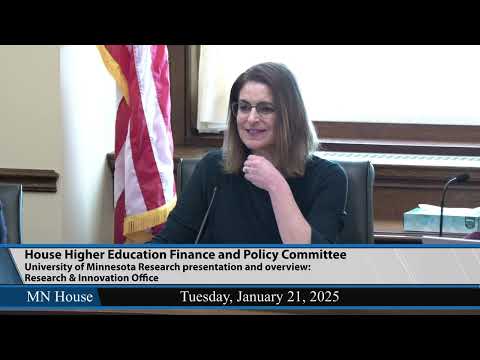
University of Minnesota and Mayo Clinic officials told the House Higher Education Finance and Policy Committee that the Minnesota Partnership for Biotechnology and Medical Genomics — a joint program that began in 2004 — has supported research, commercialization and workforce development through competitive awards and multi‑institution governance.
The partnership’s origin and funding: Peter Crawford, vice dean for research at the University of Minnesota Medical School, said the program began with a 2003–2004 state gift of $2 million that was matched by the university and Mayo Clinic. He told the committee that since fiscal year 2015 the program has been funded at nearly $8 million per year as a legislated biennial appropriation; $500,000 of that annual amount is earmarked for Alzheimer’s disease and related dementia research. Crawford said the partnership has distributed roughly $167 million to 279 research and infrastructure projects since inception (the committee requested official program accounting to confirm totals).
Governance and oversight: Nathan Wiedemann (director of translation at Mayo Clinic and Mayo’s administrative lead for the partnership) described a three-tier oversight structure — an executive committee, program leadership and a joint program management team — with scientific review, quarterly budget reviews and at least five years of post‑award tracking for outcomes (publications, follow‑on funding, commercialization, new companies). Wiedemann and Crawford said the partnership files an annual fiscal-year report to the governor’s office.
Examples and outcomes: The presenters cited multiple translational outcomes that advanced to clinical testing or commercial use. Examples named during testimony included: - VoxiHealth: miniaturized radiation-dosimetry sensors and a small-molecule profiling platform used in early cancer detection and partnered with device companies. - Numeric: a visualized needle‑thoracostomy aid intended to improve emergency management of tension pneumothorax in prehospital and transport settings. - Myogenica: an investigational product using induced pluripotent cell technology being advanced toward clinical trials for Duchenne muscular dystrophy. Crawford said the program also supports projects spanning obesity and dementia links, inflammation and cardiovascular disease, vaccine response, and pulmonary hypertension.
What Mayo contributes: Committee members asked whether Mayo provides direct cash in addition to administrative support. Dr. Y. S. Prakash, Mayo’s vice dean of research, said Mayo contributes substantial in‑kind resources — leadership time, staff, access to laboratories and Mayo Clinic Ventures for commercialization support — and that the institution’s primary contribution to the partnership is those resources rather than a specified direct cash match for every state dollar.
Lawmakers’ concerns and committee direction: Representative Robbins and other members told presenters they wanted more granular answers about what the state appropriation purchases — which projects and amounts — and asked for detailed reporting tied to the $16 million appropriated across the current biennium (the presenters confirmed they would provide greater detail and annual award accounting). Representative Scott asked whether Minnesota Partnership funds have been used for pediatric gender‑affirmation surgery research; Crawford and Wiedemann said the partnership has not funded such research and that they would follow up on any institution‑wide activity outside the partnership’s awards.
Next steps: The committee asked the University of Minnesota and Mayo Clinic to provide a more detailed fiscal accounting of state appropriations to the partnership, line‑item descriptions of award recipients and program outcomes, and any additional information elected members have requested for budget review.