Get Full Government Meeting Transcripts, Videos, & Alerts Forever!
Get email alerts on the Legislation Senate Floor topic
No spam. Unsubscribe anytime.
Senate Committee of the Whole advances tax, public-safety and governance bills; several measures fail
Summary
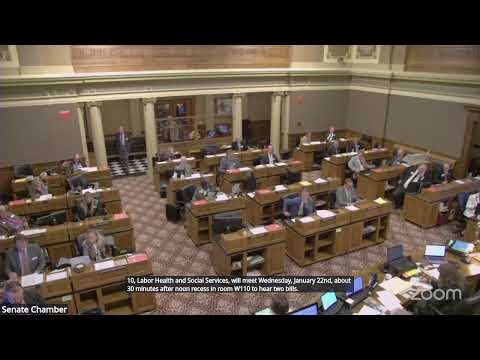
On Jan. 21 the Wyoming Senate’s Committee of the Whole advanced a package of bills on taxes, emergency reporting and agency rules while rejecting several high-profile proposals including a statewide preschool book program and a classroom cell-phone ban.
CHEYENNE, Wyo. — The Wyoming Senate’s Committee of the Whole on Jan. 21 moved forward a mix of tax, public-safety and administrative bills and rejected several measures after hours of debate.
Most consequential for businesses and local governments was passage of Senate File 49, a tangible personal property index and depreciation bill that removes a “trending” factor from how depreciated business equipment is valued for ad valorem taxation. The Senate rejected an amendment that would have allowed assets to depreciate to 0 percent; sponsors said that amendment would have cost the state substantially more than the compromise currently in the bill.
Why it matters: The changes affect how industrial equipment, pipelines and other business personal property are valued and taxed statewide, and industry representatives and rural senators argued over equity and the fiscal impact on local government budgets.
Senators also approved bills to tighten reporting and accountability for emergency 911 outages (Senate File 57), to expand due-process options for industrial siting impact assistance payments (Senate File 19), and to allow the secretary of state expanded authority to act on fraudulent business filings (Senate File 56) and to share certain registered-agent records with county officials for legitimate fraud or tax inquiries (Senate File 59). The Game and Fish Commission’s property-tax exemption measure (Senate File 99) also passed after debate about local revenue effects.
At the same time the Committee of the Whole declined to advance several high-profile proposals. Lawmakers voted to indefinitely postpone a statewide Imagination Library appropriation (Senate File 14), a firearm-hold agreement immunity measure (Senate File 29) and a bill directing school districts to adopt restrictions on student cell‑phone use during instructional time (Senate File 21). The veterans ex officio appointments bill for higher‑education boards (Senate File 31) also failed to clear the committee.
Discussion highlights
Senate File 49 — tangible personal property depreciation
Senate File 49 initially split the chamber, with a defeated amendment that would have allowed business equipment to depreciate from a 20 percent floor to 0 percent. Sponsor and floor managers said the bill’s primary change removes the “trending” adjustment that increases the assessed value of property over time; opponents warned that eliminating the 20 percent floor would remove tax on assets still in productive use. Senator McEwen and other proponents argued removing trending provides meaningful relief for industry while preserving taxation for items still in service.
Senator McEwen: "The bill itself gets rid of the trending…The cleanest way…would be just to defeat [the 0% amendment]…and come back with an amendment on the second part if they wish." (floor exchange)
Fiscal context: Committee members cited the bill’s fiscal notes during debate. At a 20% floor the fiscal note showed an annual reduction of roughly $34,000,000 statewide; a senator estimated that taking the floor to 0% would roughly double that reduction to about $60–65 million.
Outcome: The amendment to take the floor to 0% failed on division (7 in favor standing; 19 opposed standing). The bill itself later passed the Committee of the Whole (voice vote reported). Vote tally by roll call was not specified in the transcript for final passage.
Senate File 59 — registered agents and release of records (fraud response)
Senate File 59 authorizes the secretary of state to release certain confidential registered‑agent information to county assessors or treasurers and to law-enforcement entities under controlled circumstances to help address fraud and protect residents. Supporters said county officials have repeatedly encountered addresses or names used as purported business locations where no business actually operates, resulting in scams and nuisance mail against homeowners. Opponents raised privacy concerns and warned the change could erode Wyoming’s corporate-records protections that attract filings to the state.
Senator Case (floor manager) explained the policy as a targeted tool to help assessors and treasurers verify suspicious filings while keeping records confidential: "Any records obtained by a county assessor or county treasurer pursuant to this subsection shall be held confidential…release only pursuant to a court order subpoena or to a bona fide law enforcement agency for use in a criminal investigation." (floor explanation)
Outcome: The Committee of the Whole returned the bill with a favorable recommendation (voice vote reported); transcript records no roll-call tally for final passage in committee.
Senate File 99 — Game and Fish property-tax exemption
Senate File 99 would exempt much property owned by the Wyoming Game and Fish Department from local property taxes. Sponsors argued the agency’s work is funded in large part by hunting and fishing license revenue and that funds collected should go to wildlife management rather than local tax payments. Opponents, including some county and education advocates, said the exemption shifts costs away from the state to local governments and school districts and reduces local revenue for services.
Clarifying figures cited on the floor: Department payments in 2024 were described as roughly $859,000 in property taxes with regional offices and game warden stations accounting for major shares; the bill’s fiscal estimate indicated roughly $540,000 per year in reduced Game and Fish expenditures (sponsors sought further review in appropriations).
Outcome: The Committee of the Whole approved the bill (voice vote reported); committee re‑referenced it to appropriations for fiscal review and recorded passage in committee.
Bills that failed or were indefinitely postponed
Senate File 14 (Wyoming Imagination Library): After a lengthy public-policy discussion—supporters cited research on early literacy, opponents raised concerns about government‑funded partnerships with a 501(c)(3) and long-term budget commitments—the committee’s division vote failed and a roll call later recorded the bill as defeated in committee (roll-call result: 6 aye, 23 no, 2 excused). The presiding officer declared Senate File 14 indefinitely postponed.
Senate File 21 (restrictions on student cell-phone use): Sponsors proposed that districts adopt written policies restricting student cell-phone use during instructional time while allowing local flexibility and exemptions for health or safety needs. The committee split; after a standing division and required roll-call, the bill failed committee by roll call (result recorded: 7 aye, 21 no, 3 excused); it was deemed indefinitely postponed.
Senate File 29 (firearm-hold agreement immunity): The measure sought statutory protection for a private person who temporarily holds a firearm at an owner’s request and later returns it; supporters framed it as a tool to encourage temporary storage in crises, while opponents worried the provision could create broad immunity in violent situations. The committee failed the bill on roll call (result recorded: 2 aye, 26 no, 3 excused); it was indefinitely postponed.
Other notable actions
- Senate File 57 (911 service reporting) — Passed the Committee of the Whole after sponsors said the bill would require providers to report outages to the Wyoming Public Service Commission and require annual detailed financial reporting of 911 revenues; committee reported favorably (voice vote recorded).
- Senate File 19 (impact assistance payments, Industrial Siting) — Committee adopted an amendment creating a process for the State Loan and Investment Board (SLIB) to consider Industrial Siting Commission recommendations when a statutory cap on impact assistance is sought to be exceeded; sponsor stressed the change was meant to avoid reopening full industrial‑siting record testimony and to allow SLIB to act on the facts already in the record. Committee recommended passage (voice vote).
- Senate File 90 (youth organizations in schools) — Passed the Committee of the Whole after debate over whether the bill required in‑class presentations during instructional time; sponsors emphasized the bill is permissive and references organizations defined in Title 36 of the U.S. Code (examples cited: Boy Scouts, Girl Scouts, 4‑H). Committee recommended passage (voice vote).
- Senate File 56 (providing false information to registered agents) — Passed; sponsors said the bill gives the secretary of state expanded authority to administratively dissolve entities that file fraudulent registered‑agent information.
What’s next
Bills that the Committee of the Whole recommended will return to the Senate calendar for additional floor action and committee referrals where required (for example, appropriations for fiscal measures). Those deemed indefinitely postponed in the committee can be revived only under the Senate’s procedural rules.
Ending
Lawmakers debated a mix of policy tradeoffs: taxpayer fairness and local fiscal impacts on one side, consumer and public‑safety/accountability reforms on the other. Several proposals that drew the most public and floor attention were halted in committee, leaving those issues unresolved at the close of the Jan. 21 floor session.