Get Full Government Meeting Transcripts, Videos, & Alerts Forever!
Get email alerts on the Restoration Of Rights topic
No spam. Unsubscribe anytime.
Committee lays back restoration‑of‑rights bill after debate over out‑of‑state convictions and firearms
Summary
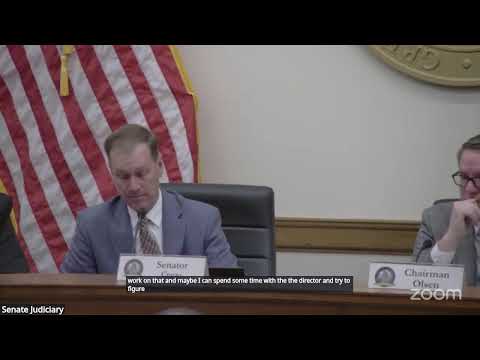
Senate File 9, proposing amendments to the restoration‑of‑rights law, was laid back after the Judiciary Committee raised concerns that changes targeting firearm restorations could inadvertently block voting restorations for people with out‑of‑state convictions.
Senate File 9, a package of cleanup amendments to Wyoming’s restoration‑of‑rights law, was discussed at length by the Judiciary Committee and then laid back for additional drafting after members voiced concern that changes intended to address firearm‑restoration issues could unintentionally block voting restorations tied to out‑of‑state convictions.
Senator Crago introduced the bill as cleanup following a 2023 restoration law. The Department of Corrections’ director, Dan Shannon, described operational concerns and provided statistics on certificates issued under the program. Shannon said the department has restored voting rights in large numbers since the automatic restoration change, and provided the committee with program counts: "Since such time, we have restored 4,000 454 rights to vote," he said, and noted that since July 1, 2023 roughly 1,060 individuals received other restored rights. Shannon also told the committee that 63 individuals were convicted in federal court within Wyoming, 67 were Wyoming residents without a Wyoming conviction, and 156 were living out of state with Wyoming convictions; he said three recipients were neither Wyoming convictions nor Wyoming citizens. On recidivism he reported that of roughly 1,070 certificates issued since July 1, 2023, only three individuals were rearrested.
The core policy debate centered on language in the draft that would remove a provision allowing restoration for convictions under ‘‘the laws of the states of the United States’’ (language cited in the draft as a repealer of a prior subsection). Director Shannon told the committee that removing that language would limit restorations to Wyoming‑only convictions and could create operational questions about residency and citizenship for applicants. Civic groups offered differing emphases: Tyler Lindholm of Americans for Prosperity said the committee should avoid an overly broad repeal because the current law helped some Wyoming residents who had convictions in neighboring states: "Only 63, I essentially was said, ... that Wyoming was able to essentially fix for Wyoming citizens," he said, urging the committee to find a narrower solution focused on firearms issues. Marguerite Herman of the League of Women Voters urged preserving automatic voting restoration and separating the firearms issue from voting rights policy: "The League of Women Voters firmly believes that, supports the decision for the automatic renewal of voting rights with the single felony, non violent," she told the committee.
Director Shannon and committee members agreed that voting restoration and restoration of other rights (including firearms restoration) are distinct issues; several members said the bill in its current form does not reflect the committee’s intent and could have unintended consequences for Wyoming residents with out‑of‑state convictions. Given those concerns, the chair laid the bill back for further work. The committee set the next consideration for its regularly scheduled meeting on Thursday, the 23rd.
Committee members asked staff and the sponsor to refine language so that the bill addresses firearms and federal‑conviction issues while preserving intended restoration pathways for voting rights for residents with qualifying out‑of‑state convictions.