Get Full Government Meeting Transcripts, Videos, & Alerts Forever!
Get email alerts on the Water Rights Abandonment topic
No spam. Unsubscribe anytime.
Committee approves temporary protection from abandonment for water rights tied to damaged dams and diversion systems
Summary
Senator Steinmetz presented Senate File 80 as a measure to let owners of lawful dams or diversion systems apply to the Board of Control for a time-limited extension to avoid abandonment of water rights when necessary repairs or replacement prevent beneficial use.
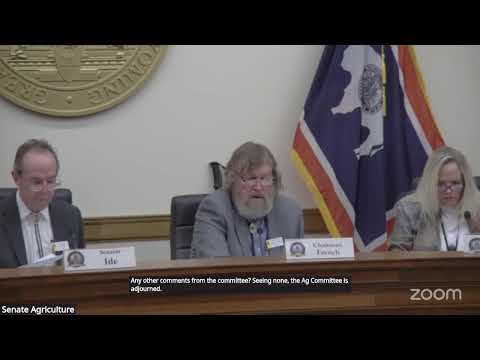
Senator Steinmetz presented Senate File 80 to the Agriculture, State & Public Lands & Water Resources Committee as a measure intended to protect water rights when infrastructure failures or necessary repairs make continued beneficial use infeasible. "If the holder of an appropriation of water from a surface, underground or reservoir water source fails ... to use the water ... during any five successive years he is considered as having abandoned the water right," the sponsor explained, introducing the bill's purpose.
The proposal allows the owner of a lawful dam or diversion system to apply to the Board of Control for an extension of up to five years to restore or reactivate use when nonuse is caused by necessary repairs or replacement. Supporters said the bill was prompted by the LaPrelle dam failure but is framed to address similar aging-infrastructure risks across the state.
Why it matters: State Engineer Brandon Gilbert and Chris Brown of the attorney general's water section clarified the abandonment process: a water right does not automatically vanish after five years of nonuse; rather, a party must file an abandonment action with the Board of Control and prove that the right-holder had the opportunity to use the water but failed to do so. Chris Brown told the committee there is precedent for partial abandonment of storage rights and that a junior or otherwise interested user could seek abandonment if they could show clear and convincing evidence of benefit.
Public comment: Irrigation and conservation groups strongly supported the bill. Keith Kennedy (Wyoming Association of Irrigation Districts and the Crop Improvement Association) and Holly Kennedy (Wyoming Association of Conservation Districts) urged the committee to approve language that would allow extensions when federal permitting, funding or construction timelines delay repairs. Witnesses noted a multi‑year permitting or funding timeline for large diversions on Forest Service or other federal lands could otherwise put underlying water rights at risk.
Committee action: The committee reviewed the bill language, heard agency and stakeholder testimony, and recorded a roll-call vote with five ayes; the measure was reported favorably. Sponsors and counsel emphasized that the statute already contemplates extensions where applicants can show due diligence and good reason, and this bill formalizes the path for obtaining one when infrastructure failures or long permitting processes create involuntary nonuse.