Get Full Government Meeting Transcripts, Videos, & Alerts Forever!
Get email alerts on the Fencing State Lands topic
No spam. Unsubscribe anytime.
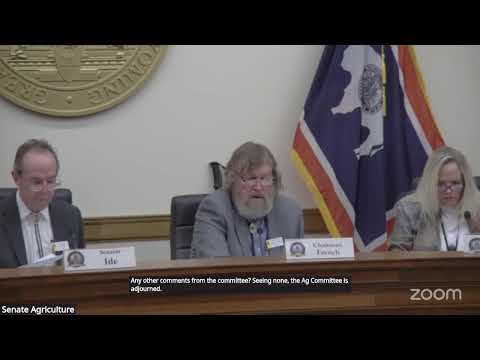
Committee approves bill treating state lands like private owners for boundary fences
Summary
The Agriculture, State & Public Lands & Water Resources Committee approved Senate File 63 after amending which state body will set rules; the bill aims to treat state lands the same as other landowners for boundary-fence construction and maintenance while leaving cost and rulemaking details to be clarified.
Senator Crago, sponsor of Senate File 63, told the Agriculture, State & Public Lands & Water Resources Committee that the bill would "for purposes of erecting boundary fences along state lands, state lands will be treated just like everybody else." The committee voted to amend the bill and approved it on a roll call vote.
The bill's sponsor said the draft is an attempt to resolve disputes that arise when state parcels are leased or re-leased and a new lessee or adjoining neighbor places a fence that changes long-standing use patterns. "This is strictly a boundary fence," Senator Crago said, adding the intent is not to allow lessees to use the statute to build management fences inside state parcels.
Why it matters: Proponents said the bill creates parity between private landowners and the state where boundary fences are concerned, while state lands officials warned the draft as written could obligate the Office of State Lands and Investments to pay substantial costs. Jason Crowder, interim director of the Office of State Lands and Investments (OSLI), told the committee the bill text currently reads that "the cost shall be borne by the Office of State Lands and Investments," and that the office estimates the fiscal exposure anywhere from about $100,000 a year to $1,000,000 a year depending on how many requests and how remote or complex sites are.
Committee discussion and amendment: Members questioned what types of fence would be required and how costs should be apportioned. Crowder said OSLI's appraisal staff estimates typical fence construction in Wyoming at about $5 to $7 per foot — roughly $26,400 to $36,960 per mile — and emphasized uncertainty in mileage and terrain-driven costs. Several committee members and public witnesses argued the statute should allow neighbors to split costs for a lawful boundary fence, similar to existing private-land statute language. The committee adopted an amendment replacing the phrase "Office of State Lands and Investments" with "Board of Land Commissioners" for rulemaking authority, as OSLI requested.
Public testimony: Representatives of producer and agricultural groups spoke in favor. Jim McGavin of the Weymouth Stockholders Association said the bill "creates some equality" because private neighbors now can require a cost split but do not have that same remedy when the neighboring parcel is state-owned. Ara Aronow of the Rocky Mountain Farmers Union and Kelly Carpenter of the Wyoming Farm Bureau Federation also voiced support for the bill's "good neighbor" approach.
Votes at committee: Senator Crago moved the bill as introduced and later moved the amendment to change rulemaking authority to the Board of Land Commissioners; Senator Pearson seconded the amendment. A roll call on the amended bill recorded five aye votes and the committee reported the bill as approved.
Next steps: With committee approval, the bill will proceed to the floor for consideration by the full chamber. The committee debate left unsettled the policy detail of whether and how fence construction costs will be passed to lessees or require legislative appropriation; OSLI recommended either an explicit ability to charge lessees or an appropriation to the office to cover costs.