Get Full Government Meeting Transcripts, Videos, & Alerts Forever!
Get email alerts on the Property Tax Refund topic
No spam. Unsubscribe anytime.
Committee clears property tax refund revisions to reflect governor's veto
Summary
The Revenue Committee approved House Bill 39 to conform refund provisions to a gubernatorial line-item veto that removed an upper refund tier; the Department provided 2023 refund statistics to the committee.
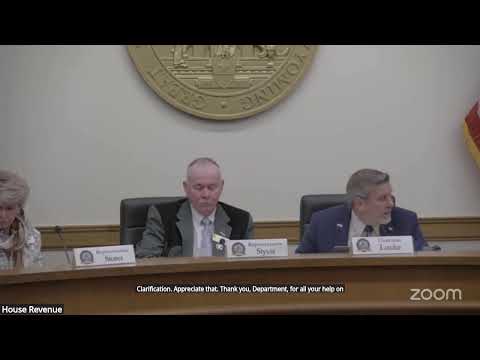
The Revenue Committee unanimously approved House Bill 39, Property Tax Refund Program Revisions, sending the bill to the House floor with an 8-0 roll call and one member excused.
The bill conforms state statute to a governor’s line‑item veto that removed the refund amount for taxpayers with incomes between 146% and 165% of the applicable median household income, Department of Revenue officials said.
Brenda Henson, director of the Department of Revenue, said last year’s statute added two higher-income tiers (145% and 165%) and reduced refund amounts for those tiers, but the governor’s veto struck language that provided refunds for the 146–165% band while leaving the 165% reference in statute. "He eliminated any refund for that between 146 and 165% income," Henson said, and the current bill simply conforms the text to that veto so the statute and administration match.
Henson told the committee there is no fiscal note for the conforming change and that administration of the program for the 2024 refunds will proceed as in prior years. She also reviewed 2023 program data: the department received 14,782 applications from households at or below 125% of median income and issued 12,406 refunds totaling "a little shy of $13,500,000." The second tier (126–145%) produced 1,079 approved refunds totaling about $790,000. Henson said the department’s total refunds for 2023 were $14,269,323.88 and the average refund was $1,058.16.
Representative Storer and others noted the policy rationale for the tiered design adopted in 2023: to smooth the cliff effect where a small income increase previously could eliminate eligibility. Henson suggested the committee review interim materials and the department’s November 2024 presentation for a full breakdown by county.
Representative Brown proposed an amendment to extend the time taxpayers could make payments before losing eligibility; after discussion the sponsor withdrew the amendment, with Henson noting the statutory application deadline (first Monday in June) and the program’s payment dates made a simple 60-day payment extension problematic without changing the application timeline.
The committee approved the bill by roll call and will send it to the House floor.