Get Full Government Meeting Transcripts, Videos, & Alerts Forever!
Get email alerts on the Sales And Use Tax topic
No spam. Unsubscribe anytime.
Revenue Committee approves sales and use tax revisions to align statutes
Summary
The Revenue Committee passed House Bill 40 to align use-tax language with sales-tax changes from last year, clarify vendor licensing and vendor compensation, and repeal several reporting requirements tied to exemptions.
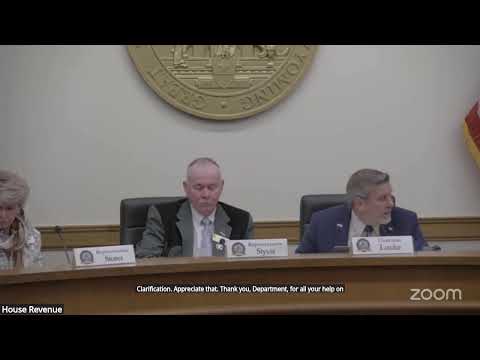
The Revenue Committee voted 7-1 to pass House Bill 40, Sales and Use Tax Revisions, moving the measure out of committee to the full House.
The bill makes the use-tax language match changes made last year to the sales-tax statutes, clarifies when a person must register as a vendor, standardizes vendor compensation calculations and clarifies sourcing rules for motor-vehicle sales tax, Department of Revenue officials told the committee.
Brenda Henson, director of the Department of Revenue, said House Bill 197 (passed in 2024) left parallel use-tax language in Title 39, chapter 16 inconsistent with the sales-tax provisions in chapter 15. "If you change anything in this bill, it would be important to note that we really need to then go back to what we did last year and update that as well," Henson said. She told members the current bill copies the chapter 15 language into chapter 16 to remove those inconsistencies.
Henson told the committee the bill clarifies when small, infrequent sellers are not treated as vendors. "My testimony as director of revenue is, no, we are not reading the newspaper. I am not sending my staff out to collect sales tax for lemonade stands and garage sales," she said, explaining the language is meant to explicitly exclude non-habitual sellers from vendor licensing obligations.
The bill also limits voluntary vendor licensing for out-of-state sellers: a person who is not located in Wyoming must have at least $100,000 in taxable sales in the state to qualify to register as a vendor for exemption-certificate purposes, Henson said. She said that change, effective July 1, 2024, prevented firms that never intended to collect Wyoming sales tax from registering solely to obtain resale exemption certificates.
On vendor compensation, the Department told the committee it removed a two-tier calculation that previously referenced a first benchmark of $6,250 and separate percentages, replacing it with a single calculation the Department already programmed into its systems on July 1. The committee also heard a clarification on sourcing motor-vehicle sales tax: in private transactions the tax is sourced to the county listed on the purchaser’s driver’s license or other government-issued identification, and the Department has a form for purchasers to state an office or home office location for commercial transactions.
Brett Fanning, excise tax staff at the Department of Revenue, explained the licensing language that distinguishes occasional sellers from persons who engage in "regular or systematic solicitation" and said licensing and collection are separate questions. "That's a whole different conversation than if you just have a couple advertisements here," Fanning told the committee.
The bill repeals several statutorily required reports the Department used to produce on exemptions for economic incentives (data centers, broadband, manufacturing exemptions and rolling stock for railcars). Henson said the repeal responds to consistently poor survey response rates from companies and that the committee could consider a better approach as an interim topic, including whether reporting requirements should be moved to another entity or include mandatory reporting for companies that receive exemptions.
Representative Ward and others urged that the committee consider consolidating or otherwise clarifying Title 39 chapters 15 and 16 as an interim study to avoid future oversights. The committee approved the bill by roll call: Representative Brown voted no; seven members voted aye; one member was excused.
The committee chairman said staff would coordinate a committee member to carry the bill to the House floor.