Get Full Government Meeting Transcripts, Videos, & Alerts Forever!
Get email alerts on the Real Estate Disclosure And Trust Accounts topic
No spam. Unsubscribe anytime.
Committee approves HB 1347 to clarify brokers' trust‑account duties, add local historic‑easement disclosure to sales form
Summary
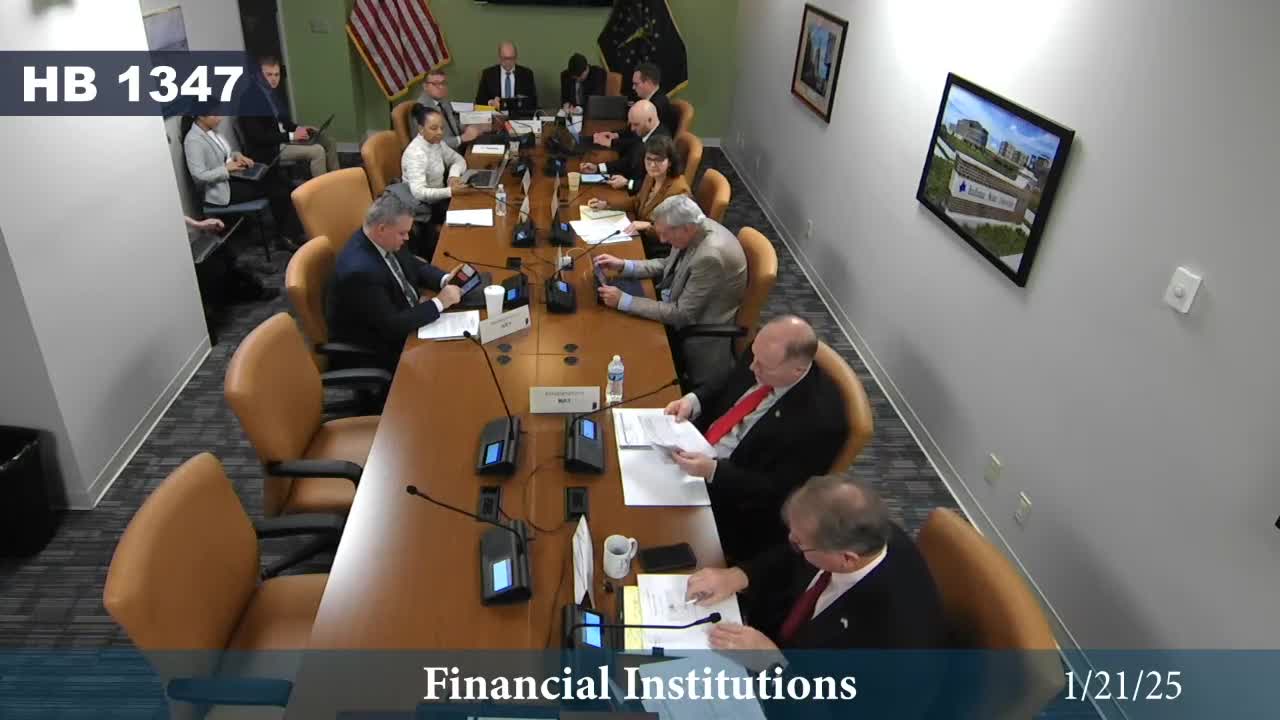
At a meeting of the Indiana House Financial Institutions Committee, members passed House Bill 1347 as amended to clarify a broker's duty to maintain a trust account and to add disclosure of locally binding historic‑district restrictions and preservation easements to the residential seller’s disclosure form.
At a meeting of the Indiana House Financial Institutions Committee, members passed House Bill 1347 as amended to clarify a broker's duty to maintain a trust account and to add disclosure of locally designated historic‑district restrictions and deed‑running preservation easements to the residential seller’s disclosure form.
Representative Ed Clere, the bill's presenter, said the bill has two parts: it clarifies that a real estate broker must maintain a trust account for earnest money and other transactional funds, and it adds two items to the residential sales disclosure to ensure buyers know of restrictions that "run with the deed," such as preservation easements or local historic‑district design guidelines. Clere said an amendment was adopted to remove language referencing National Register listing because that designation is largely honorific and typically does not carry use restrictions.
March Davis, president of Indiana Landmarks, testified in support, saying up‑front disclosure “eliminates misunderstanding, disappointments and bad surprises” and noting Indiana Landmarks manages or advises on local preservation matters and holds more than 100 easements in the state. Maggie McShane, senior vice president of government affairs for the Indiana Association of Realtors, also supported the bill, describing the trust‑account clarification as consistent with long‑standing license‑law practice and saying the seller’s disclosure is the appropriate place to surface restrictions that could limit future uses of a property.
Committee members asked whether the bill would prevent a buyer or seller from using a third party—such as a title company—to hold funds. Representative Hal Slager and Representative Ryan Lauer questioned whether the language was tight enough to preserve consumer choice to use a third party while keeping the broker’s statutory obligations clear. McShane and Clere said the intent is not to force funds to be held by the broker if the consumer chooses a third party, but to prevent some brokerages from entirely avoiding the statutory responsibility to maintain a trust account and to make consumers aware of differences in protection when a third party holds funds.
The committee adopted the amendment by consent and then voted to pass the bill as amended. The committee reported the bill with a roll call showing 11 yes votes, 0 no votes and 2 excused members.
The measure now moves on from the committee. Supporters said the combination of clearer trust‑account duties and added disclosure about locally binding historic restrictions will reduce later disputes in residential real‑estate transactions.