Get Full Government Meeting Transcripts, Videos, & Alerts Forever!
Get email alerts on the Religion And Democracy topic
No spam. Unsubscribe anytime.
Jonathan Rauch links U.S. decline in religious affiliation to polarization and mental-health trends
Summary
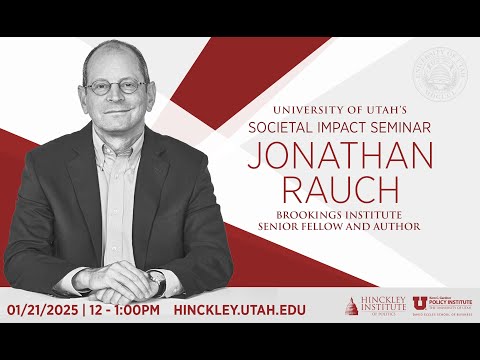
At a Hinckley Institute forum at the University of Utah, journalist and senior fellow Jonathan Rauch argued that rapid secularization has coincided with worsening mental-health indicators and rising political polarization, and called for renewed civic-minded religious practice and mutual accommodation.
Jonathan Rauch, a senior fellow in the governance studies program and the author of Cross Purposes, told a Hinckley Institute forum at the University of Utah that the recent, rapid decline in religious affiliation in the United States has coincided with growing social isolation, worsening mental-health indicators for young people and intensifying partisan hatred.
Rauch told the audience the changes are recent and dramatic: "Between 2008 and 2022 ... the number doubles," he said of adults who no longer attend religious services, and he described church membership falling from roughly 70% for most of the 20th century to "below half" as of 2020. He linked that decline to a rise in loneliness and mental-health problems among young people and to a form of "affective polarization" in which large majorities on both sides view the other party as dishonest and immoral.
Rauch framed the problem as civic as well as spiritual. He said the American founders expected a substrate of "republican virtue"—habits of civility, truthfulness and respect—that religion historically helped supply. "The constitution, our democracy, will not survive if religion does not do its job," he said, summarizing arguments he attributed to founders such as Adams and Madison. Rauch argued that when religious communities become indistinguishable from surrounding culture, or when they align tightly with partisan movements, they stop performing that civic function.
Using survey data and polls he presented, Rauch described two related trends: broad secularization and the politicization of parts of Christianity. He said mainline Protestant affiliation has fallen to roughly 13% by 2023 and that white evangelical Protestants—who earlier gained adherents as mainline attendance declined—are now also shrinking and becoming more politically aligned. He cited survey results showing self-identified evangelicals voting at rates above 80% for Republican presidential candidates in recent cycles and described a shift in how some self-described evangelicals engage with church life: "what appears to be happening is that evangelicals who are there primarily for the gospel of Jesus Christ are drifting away and other people are entering the church who are more interested in the gospel of the MAGA movement and the Republican Party."
Rauch also discussed public-health research and government reporting that, he said, coincide with these religious trends. Quoting the 2023 Surgeon General's report, he noted rapid increases in social isolation and mental-health issues among young adults and said social disconnection can be "as dangerous as smoking up to 15 cigarettes a day." He described pastors' burnout and turnover as additional evidence of strain in religious communities: he cited a Barna survey in which 42% of pastors reported having seriously considered quitting full-time ministry in the prior year.
Rauch offered examples of religious institutions aiming to reduce the culture wars rather than amplify them. He highlighted the 2015 "Utah Compromise," crediting the Church of Jesus Christ of Latter-day Saints, the Utah legislature and Equality Utah with an agreement that extended anti-discrimination protections to LGBT Utahns while including targeted exemptions for religious institutions. He also quoted remarks by Dallin H. Oaks describing patience, negotiation and mutual accommodation as central to civic life: "seeking harmony by finding practical solutions to our differences with love and respect to all people," Rauch quoted Oaks as saying.
Rauch urged Christians to recover three civic virtues he identified in the Gospels—"don't be afraid," imitate Jesus, and forgive one another—and said those overlap with the virtues that support liberal democratic institutions. He said secular people also have a role to play in making civic space hospitable: "secular liberals, people like me, can and should do more to make America not just tolerant of Christians and other people of faith, but positively welcoming," he said, urging inclusion of religion in diversity and inclusion conversations and targeted religious carve-outs where feasible.
In a question-and-answer period, students and attendees pressed Rauch on whether depoliticizing congregations would bring people back to church. Rauch said he did not know if membership would return but suggested that churches that model the gospel rather than partisan identity stand a better chance of renewal. Audience members who spoke included students and local attendees who described wanting community and spiritual resources outside partisan frames.
The forum combined a summary of survey and public-health data with theological and civic argumentation; Rauch said his conclusions are part of a broader project that informs his new book and urged both religious and nonreligious Americans to consider how civic virtue can be sustained in a time of rapid secularization and deep partisan division.