Get Full Government Meeting Transcripts, Videos, & Alerts Forever!
Get email alerts on the Urban Growth Boundary topic
No spam. Unsubscribe anytime.
Bradley County commissioners keep urban growth boundary unchanged, send proposal to coordinating committee
Summary
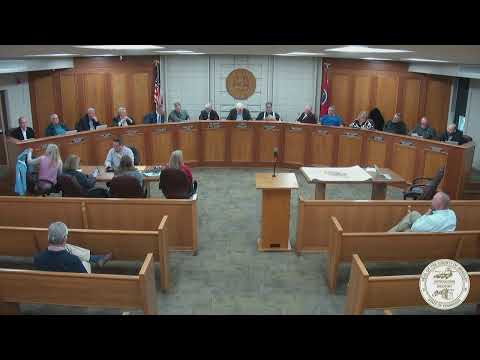
After a public hearing with developers, residents and planning staff, the Bradley County Commission voted 13–1 to approve the ad hoc committee recommendation to leave the county’s urban growth boundary unchanged and send the county map to the coordinating committee for reconciliation with city and Charleston proposals.
The Bradley County Board of Commissioners voted to approve the ad hoc committee recommendation to leave the county’s urban growth boundary (UGB) unchanged and forward the county’s map to the regional coordinating committee for reconciliation with maps submitted by the City of Cleveland and Charleston.
Commissioner Slater moved the county’s recommendation; Commissioner Goins seconded. The motion carried 13–1, with Commissioner Rogers voting no.
The vote followed a public hearing during which builders, developers and residents urged the commission to update the UGB to reflect rapid local growth, while other speakers urged caution and greater coordination with the city and Charleston. Developer Blake Allison of Epperson Allison Homes told commissioners, “This plan is going to probably follow sewer. … A developer or an industry is not gonna go where they don't have, a place for their waste to leave,” arguing that sewer and utility capacity will drive where growth happens. Charlotte Peak of Case Construction and Developments emphasized, “Annexation is not forced anymore,” and urged the county to work with the city to shape the boundary rather than leaving the process to the state.
Planning staff and commissioners clarified the process and timeline. County staff member Bentley Thomas said the existing UGB map dates to 2010 and reported that about “21% of it's been annexed since 2010.” Staff explained the coordinating committee will take the county’s, Cleveland’s and Charleston’s proposals, attempt to reconcile differences and return a recommendation to each governing body; if the three bodies cannot agree after two iterations, state review is the statutory backstop. A staff timeline mentioned a target of late April (April 27) for completing the local process.
Opponents of an expanded UGB voiced concerns about islanded county pockets that are surrounded by city limits but lack city services. Commissioner Thompson and others cited examples where city annexations left roads or services unresolved; Thompson said he will “never” like annexation when the city does not assume full responsibility for roads and services. Supporters of updating the UGB said failing to act risks having the state set a 20-year plan based on projected growth without county input.
The board’s motion to leave the county’s UGB unchanged sends the county’s proposal to the coordinating committee, which will meet with the city and Charleston to seek compromise. Commissioners who serve on the coordinating committee were urged to remain open to negotiations; the county mayor asked all members to work toward a compromise so the state does not impose a map.
Practical points discussed during the hearing included the 20-year planning horizon for the UGB, the role of sewer and utilities in directing growth, the presence of islanded parcels created by past annexations, and that county zoning and annexation processes remain separate (rezoning can still be considered even if a parcel is outside the 20-year UGB).
Next steps: the county map will go to the coordinating committee for reconciliation with city and Charleston proposals; the committee’s recommendation will return to each legislative body for additional votes. If the three bodies cannot agree, state review may result in a state-determined UGB for the next 20 years.