Get Full Government Meeting Transcripts, Videos, & Alerts Forever!
Get email alerts on the Grid Interconnection topic
No spam. Unsubscribe anytime.
Indiana committee backs resolution urging FERC to ease interconnection backlog; critics warn it favors incumbent utilities
Summary
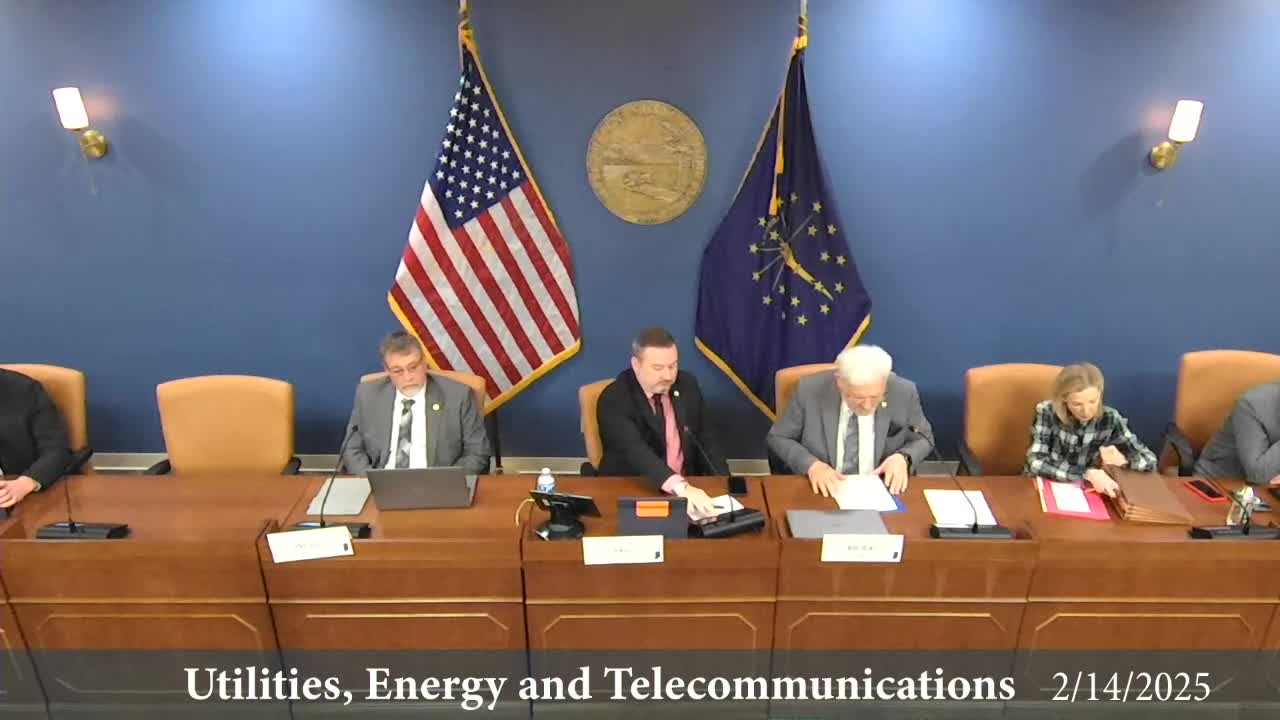
The House Utilities, Energy and Telecommunications Committee voted 10-2 to pass House Concurrent Resolution 3 on a message to federal regulators that would urge the Federal Energy Regulatory Commission to approve changes aimed at speeding approval of large generation and transmission projects.
The House Utilities, Energy and Telecommunications Committee voted 10-2 to pass House Concurrent Resolution 3 on a message to federal regulators that would urge the Federal Energy Regulatory Commission to approve changes aimed at speeding approval of large generation and transmission projects.
The resolution, introduced by Chairman Ed Soliday, asks FERC and RTOs such as MISO and PJM to adopt procedures that reduce the current interconnection backlog and to prioritize certain large or dispatchable projects. Committee supporters framed HCR 3 as a nonprescriptive appeal to federal regulators; dissenting members said some language in the resolution would effectively favor incumbent, investor-owned utilities over independent developers.
Chairman Ed Soliday, presenting the measure, said the interconnection backlog can be lengthy and harms projects waiting to connect to the grid. “Right now, the backlog for new construction energy is as long as 4 years,” Soliday said, adding the resolution asks for “some sort of priority system” rather than the current strictly first-come, first-served approach. Soliday said the measure does not tell FERC how to fix the queue but asks that the backlog be addressed so needed projects can move forward.
Supporters from state and industry groups told the committee the backlog is harming reliability and economic development. Suzanne Javeroski, the state’s newly appointed secretary of energy and natural resources, said Indiana is at heightened risk of supply shortfalls and praised the resolution’s nonprescriptive language: “I very much applaud the approach here to not subscribe for a solution but rather to acknowledge the challenge and to support all the different entities that can address this challenge.”
Industry and customer groups— including the Indiana Chamber of Commerce, Indiana Energy Association, Indiana Manufacturers Association, Indiana Municipal Power Agency, Indiana Electric Cooperatives and trade groups representing large industrial energy users— testified in favor. David Ober of the Indiana Chamber said the volume of interconnection requests is driven in part by rapid economic development and recommended federal and congressional attention. Matt Long of the Indiana Energy Association said queue cycles can take “3 to 4 years” and that the goal is to reduce processing to about one year.
Opponents and consumer advocates cautioned the resolution’s text goes beyond urging action by making determinations about what reforms “must include.” Representative Matt Pierce questioned whether the measure’s references to “expedited review” would mean some applicants could “jump the queue,” putting independent developers at a disadvantage. Pierce said: “It seems to be saying that the investor owned utilities for their base load generation, they get to jump the queue and go up front, and that's gonna push further back other alternative forms of energy and more independent companies.”
Kerwin Olson of Citizens Action Coalition said the resolution appears to “speak to the monopoly utilities” and to “large deep pocketed data centers,” and urged nondiscriminatory language that also encourages customer self-generation and other alternatives. Soliday and several witnesses countered that the state has territorial utilities with a statutory obligation to serve customers and that the resolution is intended to secure faster federal action rather than to write federal policy.
Committee discussion also addressed details raised during testimony: speakers noted RTO filings being prepared by MISO and PJM, referenced a recent NERC reliability assessment that flagged elevated near-term risk for the region, and said some proposed RTO reforms include sunset clauses. Witnesses told the committee the backlog is causing long study cycles (commonly cited as 2–4 years or more), that MISO and PJM are working on filings (a MISO filing was described as expected in February), and that proponents expect any expedited processes to be temporary; several witnesses said they understood proposed sunset periods could be on the order of a few years.
After debate, Representative Pierce spoke against the measure, saying sections of the resolution move from urging action to making factual determinations and effectively directing specific remedies. Chairman Soliday urged passage, saying the resolution is a narrow request to federal actors: “We are saying FERC and whomsoever, please address,” he said.
The committee adopted the resolution on a roll call vote of 10 in favor and 2 opposed. The committee recorded the vote in open session and forwarded HCR 3 to the full House for further consideration.
Votes at a glance: - House Concurrent Resolution 3 (HCR 3) — message urging FERC/RTO reforms to interconnection processes; passed committee 10–2.
Outlook: If approved on the House floor and the Senate, the resolution would be a formal state message to federal regulators and Indiana’s congressional delegation requesting expedited approval of reforms to interconnection and queue processes. It does not change state law or FERC regulations and, by supporters’ description, is intended to be nonprescriptive and to encourage federal and regional RTO action rather than to specify technical rules or timelines.
(Reporting based on committee hearing testimony and the committee’s roll call.)