Get Full Government Meeting Transcripts, Videos, & Alerts Forever!
Get email alerts on the Hb581 Homestead Exemption topic
No spam. Unsubscribe anytime.
Carroll County board holds final public hearing on HB 581 homestead exemption, schedules special meeting to vote
Summary
At a packed public hearing, Carroll County School System officials outlined potential budget impacts of House Bill 581’s new homestead exemption. Public commenters gave mixed testimony on taxes, school performance and district spending. The board did not vote and scheduled a special called meeting at 7 p.m. to decide whether to opt out.
The Carroll County Board of Education held its third and final public hearing on House Bill 581 on the evening of the hearing to review how the new statewide homestead exemption could affect local school funding. Assistant Superintendent for Business and Finance Deline Wolf told the audience the new exemption — referred to in state law as the statewide adjusted base year ad valorem homestead exemption (HB 581) — would “stack on top of the current exemptions” and that the board has one opportunity to opt out.
The hearing matters because, Wolf said, the exemption would be controlled by the state and could reduce state funding for schools as local fair values rise; under one five‑year model provided to Georgia districts, she said the aggregate impact could be about $21,000,000 (which she said would equate to “over 200 teaching positions”) and an average of roughly $4,000,000 per year if it had been in effect over the prior five years. Wolf added that current rules cap districts’ millage rates and that ESPLOST (the Education Special Purpose Local Option Sales Tax) funds cannot be used for general fund expenses such as teacher salaries under present state law.
Superintendent Scott Cowart and district staff also emphasized that existing homestead exemptions and the local senior exemption would not be affected by the board’s decision to opt in or opt out. Cowart said Carroll County has lowered its millage rate three consecutive years and cited a longer-term reduction of 17% in the district’s millage rate since 2016.
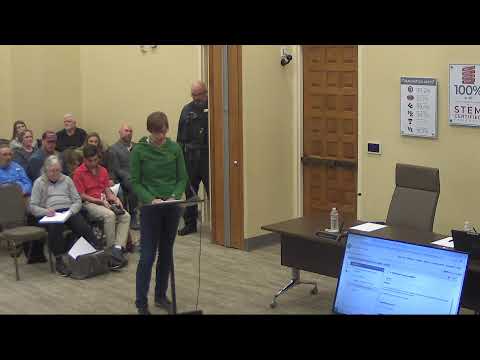
Public comment ran for roughly an hour and included a mix of residents who opposed and supported using additional local revenue if the district remains in HB 581. Elizabeth Ennie, of 867 Wayside Road, said she was concerned about academic outcomes and questioned whether additional money would be spent to raise student proficiency. “We’re graduating 99% of them, sending them out into the world when more than half of them can’t pass the test,” Ennie said, citing a 36% math proficiency and 48% reading proficiency rate she found in public data for Central High School and noting district per‑pupil spending figures she had compared to another district.
Other speakers urged different choices. Brian Preston, who identified himself as a local entrepreneur and parent, said he experienced substantial tax increases but that he supported additional funding for schools if taxes increased: “I’m not for our property taxes increasing, but if they are going to increase, I’m 1,000 percent for this,” Preston said. Several speakers argued the burden should not fall disproportionately on homeowners. Sean Waldrop, who said he recently bought his first home in Carroll County and was expecting to qualify for a homestead exemption, said he opposes the board opting out because he expects it would reduce relief for middle‑class homeowners.
Comments also criticized district compensation and internal spending. Tommy Morrow questioned the superintendent’s salary and the number of senior staff, saying, “How come we’re paying him $266,000 for 15 assistants?” (The $266,615.83 figure was cited by a member of the public during testimony.) Other residents pushed the board to find savings rather than raise taxes; some asked the board to revisit what ESPLOST funds can be used for.
Board members did not take a final position at the hearing. After public comment, a motion to adjourn was made and seconded and the board announced it would reconvene in about 20 minutes for a special called meeting at 7 p.m. to vote on whether to opt out of HB 581. The board did not vote on HB 581 during the public hearing; any formal action on HB 581 was deferred to the special called meeting.
The hearing followed earlier district discussion: board members said they have examined HB 581 since August and sought to clear up public confusion that existing homestead and senior exemptions would remain in place regardless of the board’s opt‑in/opt‑out choice. Assistant Superintendent Wolf repeatedly described the statute as complex but maintained the local effect would be “less funding for schools as well as less local control and flexibility” over time if the exemption takes effect and the district does not opt out.
The board accepted public testimony and will meet again in a special called session at 7 p.m. to consider a formal motion on whether to opt out of the statewide adjusted base year homestead exemption created by HB 581.