Get Full Government Meeting Transcripts, Videos, & Alerts Forever!
Get email alerts on the Open Meetings Act topic
No spam. Unsubscribe anytime.
Morgan County commissioners receive Open Meetings Act training and vote to enter closed session on litigation
Summary
At a Morgan County Commission meeting, staff presented highlights of Utah’s Open and Public Meetings Act including rules on electronic communication, consent agendas and closed sessions; commissioners then approved a brief closed session to discuss pending or reasonably imminent litigation.
Morgan County commissioners received a presentation on the Utah Open and Public Meetings Act and related transparency requirements during a county meeting, then voted to move into a closed session to discuss pending or reasonably imminent litigation.
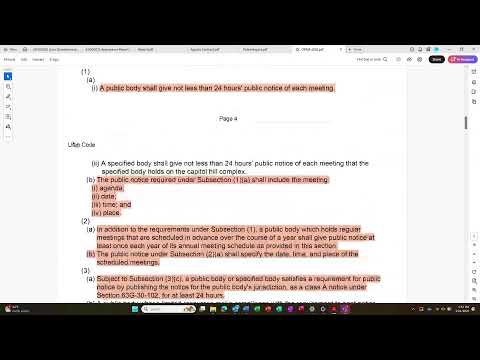
The presentation, delivered by Garrett Smith, covered statutory requirements including annual training expectations (citing 52-4-104), public notice standards, minutes and recording rules, limits on deliberation outside noticed meetings and the distinctions between managerial discussions and deliberations that trigger the Open Meetings Act. Smith summarized the law’s ban on members of a quorum “acting together outside a meeting in a concerted and deliberate way to predetermine an action,” and advised commissioners that electronic messages sent when the public body is not convened may be permissible provided they do not predetermine a vote. As Smith put it, “you’re not supposed to go and count your votes.”
Why it matters: The training addressed practices commissioners raised as concerns — large consent agendas, whether routine appointments should appear in consent items, how much agenda detail the public needs, and how to handle public comment requests for remote participation. Commissioners pressed staff on whether the county should require more specific agenda descriptions than the statute’s minimum and on the process for posting remote-participation links. Smith noted the statute sets a 24-hour minimum notice and that local bodies may choose to provide more specificity or more advance publicity.
Key details highlighted in the presentation included: - Scope: A public body is broadly defined; most agenda items fall within “relevant matter.” Managerial or operational matters for bodies with both executive and legislative roles may be excluded when they are managerial, not deliberative. - Electronic communication: “Nothing in this chapter may be construed to prohibit a member … from transmitting an electronic message to other members … at a time when the public body is not convened,” Smith said, adding the restriction applies when messages attempt to predetermine votes. - Minutes and voting records: For elected bodies the minutes must list each member’s name and vote rather than only “unanimous.” - Closed sessions: The presentation explained thresholds for closing meetings (two‑thirds vs. majority depending on the reason), the permitted topics for closed sessions (personnel character/competence, collective bargaining, reasonably imminent litigation, real property negotiations, security matters, etc.), and limits on actions while in closed session. Smith warned that failure to comply with notice rules could render decisions voidable and expose the county to attorney-fee awards and other remedies.
Commissioners used the training to raise specific transparency concerns. One commissioner asked for routine resolutions and appointments to be pulled from the consent agenda into open action items so the public hears names and details without having to consult the packet. Commissioners also asked staff about the county’s notice practice for remote participation and whether the commission’s policies require 48 hours for public electronic comment; staff and Smith said the statute’s minimum is 24 hours and that the commission’s policy language should be reviewed for consistency.
After the training, a commissioner moved that the commission enter a closed session “to discuss possible pending or reasonably imminent litigation.” A second was made, and the motion was approved by voice vote with no named roll-call recorded. The meeting then recessed into the closed session.
The presentation and ensuing discussion focused on statutory compliance and internal practice changes commissioners may adopt to increase transparency; no final policy changes were adopted during the open portion of the meeting.