Get Full Government Meeting Transcripts, Videos, & Alerts Forever!
Get email alerts on the Workforce Development topic
No spam. Unsubscribe anytime.
Pacific Mountain report outlines regional workforce goals, reentry services and 21,100-placement target
Summary
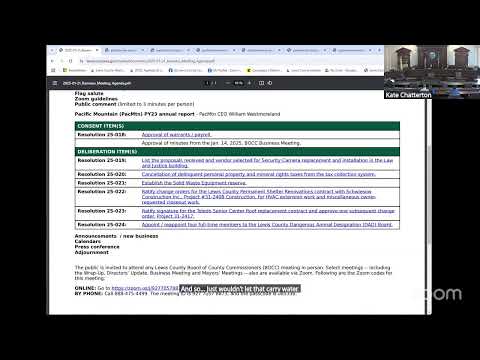
Pacific Mountain Workforce Development Council presented an annual report to the Lewis County Board of County Commissioners on Jan. 21, 2025, reviewing program-year results, sector priorities, a reentry initiative and a goal to place 21,100 disconnected workers into high-demand jobs by 2028.
Pacific Mountain Workforce Development Council representative Mr. Westmoreland presented the council’s annual report Tuesday to the Lewis County Board of County Commissioners, describing regional sector priorities, funding trends and a multi-year placement goal.
The report matters because Pacific Mountain steers federal and state workforce resources across five counties and that allocation affects local training, employer partnerships and reentry services for people leaving incarceration.
Mr. Westmoreland said the report covers program year 2023 (ending June 2024) and that the council will align future reporting to a new state four-year “talent and prosperity” plan. He described six primary regional sectors—hospitality and tourism, health care, food production, forest and wood products, specialty manufacturing and IT/telecom—and said the board uses those sectors to direct employer-focused investments. "The sector strategy informs us where we make our investments as a board," he said.
He told commissioners the region saw a roughly 15% reduction in formula (WIOA) funding over the past three years and flagged uncertainty in youth funding while adult and dislocated-worker funding remained relatively stable. The presentation outlined locally run programs including WorkX (a program that brings talent from Joint Base Lewis–McChord into the five-county region) and a reentry effort funded under Pathways Home 3 that provides case management for people leaving jail.
Westmoreland described a centerpiece target the council calls the "big, hairy, audacious goal": to place 21,100 people into high-demand, higher-wage occupations by 2028. "We're trying to place 21,100 people into these high demand wage opportunities," he said, adding that the strategy emphasizes connecting people who have disengaged from the labor market and expanding credential and apprenticeship access.
Commissioner Swope asked about coordination with unions and training pathways. Westmoreland said staff have met regularly with local labor representatives and noted pilot efforts such as a "try a trade" program; he also said the council plans to sign a memorandum of understanding with labor partners to sustain those efforts.
Bob Gunther and Pete Lamond, local participants in Pac Mountain activities, described local successes including CTE summer scholarships, discovery teams placing youth with the U.S. Forest Service, and portable lab training at Chehalis Middle School. Mr. Gunther also noted state legislation on PFAS and biosolids he is tracking and provided a previously filed case number to county staff.
The report included budget and monitoring notes: Pac Mountain reported a clean state audit and routine program monitoring by Employment Security with recommendations on case management. Westmoreland said diversification away from federal funding is under way but that continued state programs (for example, the governor’s economic-security investments) are important to sustain services for the working poor (ALICE households).
The commissioners did not take formal action on the Pac Mountain report; staff said information and recruitment for a Lewis County seat on the council will be circulated to encourage a local employer representative to apply.
Page references in the printed report were noted for commissioners who want a deeper read of sector data, top occupations and the detailed budget overview.