Get Full Government Meeting Transcripts, Videos, & Alerts Forever!
Get email alerts on the Bail Bonds topic
No spam. Unsubscribe anytime.
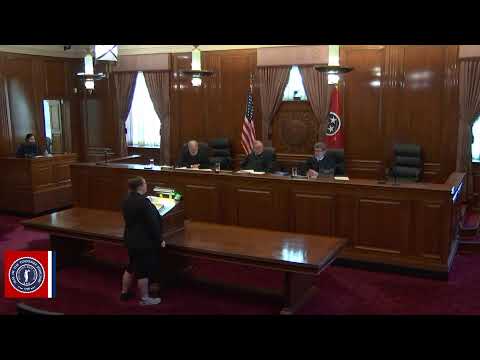
Appeals court hears challenge to Hickman County suspension of bonding company
Summary
Attorneys argued whether a Hickman County local rule requiring notice for bonds of $100,000 or more conflicts with Tennessee Code Annotated 40-11-126.5 and whether a trial court exceeded its authority when it suspended a bonding company for 30 days and required court approval for bonds.
The Tennessee Court of Appeals heard arguments over an appeal of a trial-court order that suspended a bonding company and required court approval before the company could write certain bonds. Defense counsel for the bonding company argued the local rule conflicts with state law and that court procedures denied the company a fair hearing; the state countered that the local rule is a notice requirement that does not make a bonding agent act as an attorney.
The dispute centers on Local Rule 12/2 for Hickman (and related counties), which requires any bonding entity desiring to write a bond of $100,000 or more "shall provide notice to the court and the district attorney general, whereupon hearing will be set by the court," and Tennessee Code Annotated 40-11-126.5, which prohibits a bonding agent from "participat[ing] in the capacity of an attorney at a trial or hearing of one on whose bond the person is a surety." Defense counsel (representing the bonding company) told the court that the company was suspended for violating the local rule after it provided proof of funds in what the defense describes as a source hearing and that the trial court improperly relied on statements made by the district attorney in opening argument.
"We would argue that the court should not have been allowed to take statements from the district attorney," defense counsel said, arguing also that the district attorney should have recused himself and that the defense was denied the ability to call or cross-examine the district attorney about notice and waiver of a source hearing.
Joshua Minton, arguing for the state, said the statute and the local rule are "clear and unambiguous, and there is simply no conflict between them." Minton told the court that the local rule functions as a notice requirement and does not require bonding agents to provide legal advice or to act as attorneys: "simply providing notice ... doesn't require legal training or the professional judgment of a lawyer."
The facts described in the record include an instance in which Tennessee Bonding Company (referred to in briefs and argument) issued a $392,000 bond for a defendant identified in the record as Jessica Thomason before the district attorney had indicated a waiver of the source hearing, a point the state said the trial court relied on in finding a separate violation of Rule 12/2. The trial court's order suspended the bonding company for 30 days and included a probation condition that all bonds, including General Sessions bonds, be approved by the circuit court judge, a restriction defense counsel says improperly interferes with General Sessions jurisdiction.
The state urged the appeals court to uphold the trial court's order as within the trial court's broad discretion to regulate bail-bonding entities, citing the local rules giving the circuit judge authority to promulgate rules for Hickman, Lewis and Perry counties and to impose limits "necessary to ensure the professional standing and reliability of the bonding entity." The state also argued that several defenses raised on appeal (including district-attorney recusal and the denial of cross-examination) were not preserved below and therefore are not subject to plain-error relief.
Defense counsel told the panel that in practice bonding agents in the split district had relied on the circuit court clerk to contact the district attorney because small, monthly court dockets and limited access to counsel made it impracticable for defendants or bonding agents to obtain a timely hearing: "we go through the court, the court contacts the district attorney, and we get a yay or a nay," counsel said, describing the local practice. The defense also noted that the bonding agent, Mr. Carroll, testified he "made the bond with permission from the court" and later received a text from the district attorney indicating a source hearing was required.
At oral argument the parties debated whether the trial court's order unlawfully usurped General Sessions' authority over initial bond setting or instead properly regulated the bonding company after finding rule violations. The transcript shows the appeals judges questioned counsel about where source hearings should be held when a case originates in General Sessions and whether a trial court's regulatory action could interfere with a defendant's rights or the general-sessions judge's functions.
The appeals court proceedings moved on after argument; the panel did not issue a decision on the record during the session. The next case on the calendar was called after counsel concluded their remarks.