Get Full Government Meeting Transcripts, Videos, & Alerts Forever!
Get email alerts on the Immigration Enforcement And Local Protections topic
No spam. Unsubscribe anytime.
Evanston council strengthens Welcoming City protections and hosts Know-Your-Rights training
Summary
Evanston officials described changes to the city's Welcoming City ordinance adopted last week and led a community Know Your Rights session explaining how residents can respond to immigration enforcement, document encounters and prepare emergency plans.
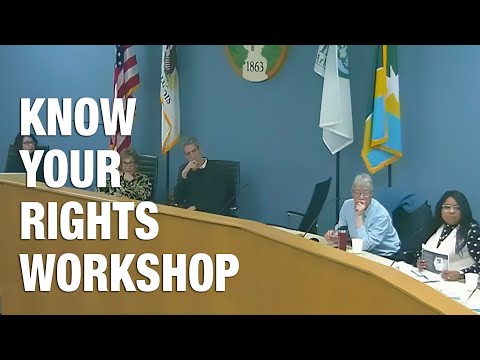
Evanston city officials on Wednesday described a newly updated Welcoming City ordinance and led a bilingual Know Your Rights training for residents worried about federal immigration enforcement.
Mayor Biss opened the event by saying the city must be ready to act "quickly" and in solidarity: "we have a responsibility morally as a community to put our arms around each other, to stand together." Liza Robertson Young, the city's chief legislative policy adviser, said the ordinance update — adopted "a week ago" — tightens protections on data sharing, narrows prior exceptions that allowed cooperation with civil immigration enforcement, and codifies several Evanston Police Department practices into law.
The changes described by Robertson Young include a prohibition on sharing city databases or data-platform information with federal agencies or third-party data brokers for the purpose of civil immigration enforcement unless the third party certifies it will not share the data for immigration purposes. The ordinance also removes prior exceptions that had allowed local cooperation when people were listed in gang databases, charged but not convicted, or had unrelated old felony convictions; the city will continue to comply with valid criminal warrants that meet constitutional probable-cause standards. Robertson Young said the city also extended the prohibition beyond Immigration and Customs Enforcement (ICE) to any federal agents who may be deputized to enforce immigration law and to contractors who manage detention facilities.
The training portion, led by Fred Tsao of the Illinois Coalition for Immigrants and Refugee Rights and Wendy Estrada of Latinas Progresando, reviewed constitutional and practical rights in encounters with federal immigration agents. Tsao emphasized that basic constitutional protections — including the right to remain silent and the right to counsel — apply to everyone in the United States. He explained the legal difference between judicial warrants signed by judges and administrative ICE forms signed by agency supervisors, noting that administrative forms do not by themselves permit forced entry into private spaces.
Speakers provided scenario guidance: in private homes, residents should ask to see a warrant and are advised not to open doors unless they can verify a judge-signed warrant; in traffic stops, people can ask which agency is conducting the stop and are not required to answer questions of ICE or Customs and Border Protection; employers typically may deny access to nonpublic workplace areas without a warrant; and sensitive locations such as schools, hospitals and places of worship are generally treated as off-limits by ICE policy in effect at the time of the training. Presenters repeatedly cautioned that federal policy may change with the incoming administration and urged careful documentation of any enforcement activity.
The program included practical preparation steps for families and households: create a written emergency plan, identify a caregiver and guardian for children, memorize key phone numbers (attorneys, relatives), retain originals of important documents and prepare short-term letters of guardianship and powers of attorney when appropriate. Organizers also urged communities to collect identifying information if a household member is arrested (alien number "A-number," country of birth) and to use ICE's online detainee locator when trying to find someone in custody.
City officials and speakers listed local resources for assistance and reporting. The presenters named a toll-free rapid-response hotline for reporting ICE presence and seeking community assistance, 855-435-7693 (855-HELP-MY-FAMILY). They also pointed attendees to nonprofit legal resources referenced in the training, including the National Immigrant Justice Center and the Midwest Immigrant Bond Fund, and encouraged use of the city's 3-1-1 service for information about local supports. Robertson Young said the ordinance requires the city to develop facility policies limiting immigration enforcement to the greatest extent permitted by law and to provide immigration resource information through the city's 3-1-1 service.
Congresswoman Jan Schakowsky and other elected officials spoke in support of the city’s work. Schakowsky said she would continue work in Washington to "fight back" and encouraged local creative supports — including legal help and community sponsorships — for families at risk of enforcement.
Organizers provided multilingual Know Your Rights cards (English, Spanish, Korean, Polish and other Asian languages) and noted the full presentation materials are posted on the city's website on the Welcoming Ordinance and Know Your Rights pages. Officials also said the city will work with local partners, including hospitals, universities and community legal clinics, to distribute materials and coordinate volunteer legal assistance and rapid-response teams.
The event was framed as both a description of already enacted local policy and as community education in case federal enforcement priorities change. Officials repeatedly distinguished discussion, legal explanation and emergency planning from new formal actions at the event: the ordinance update had already been adopted and the training provided guidance and referral options rather than new legal authority.
Ending: City staff said they will publish templates and translated materials on the city website and encouraged residents to call 3-1-1 or the hotline (855-435-7693) for immediate help or to join local rapid-response and community navigator efforts. The city posted the training slides and handouts online and planned to make additional translated versions and guardianship/power-of-attorney templates available through city channels and partner organizations.