Get Full Government Meeting Transcripts, Videos, & Alerts Forever!
Get email alerts on the Foreign Policy topic
No spam. Unsubscribe anytime.
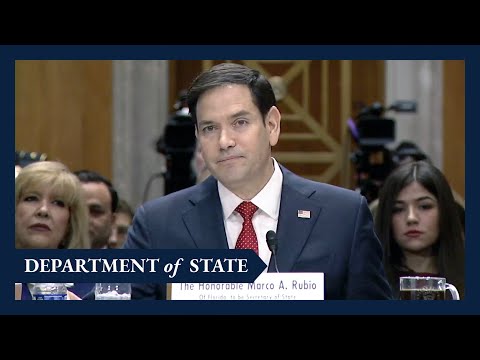
Nominee for U.S. secretary of state says State Department will prioritize U.S. safety, strength and prosperity
Summary
The nominee for U.S. secretary of state said he would make the protection of U.S. national interests the primary test for Department of State programs and spending, declaring that every program and policy must answer one of three questions: does it make 'America safer,' 'America stronger' or 'America more prosperous?'
The nominee for U.S. secretary of state said he would make the protection of U.S. national interests the primary test for Department of State programs and spending, declaring that every program and policy must answer one of three questions: does it make “America safer,” “America stronger” or “America more prosperous?”
The nominee framed the remarks as a response to what he called the erosion of the post–World War II global order, arguing that alliances and free trade once produced stability and prosperity but later harmed some American workers and national security. He criticized the Chinese Communist Party and cited migration, narcoterrorism and hostile states as threats he said the United States must confront.
The speech opened with personal remarks: the nominee noted he had been nominated by President Trump to the post, thanked his wife Jeanette and daughter Daniella for attending, and said his parents arrived from Cuba on May 27, 1956. He also invoked his faith as a guide for the work ahead.
He traced his view of recent foreign-policy history to the post–Cold War period, saying a bipartisan consensus “reached the end of history” and favored an international order that, he argued, prioritized global liberalism over U.S. national interest. The nominee said that emphasis contributed to a shrinking middle class, weakened industrial capacity and vulnerable supply chains.
On specific international threats, he said the People’s Republic of China “took advantage of all of [the global order’s] benefits, and they ignored all of its obligations and responsibilities,” adding that they “repressed and lied and cheated and hacked and stolen their way into global superpower status.” He also accused “narcoterrorists and dictators and despots” in the Western Hemisphere of exploiting open borders to fuel migration and fentanyl trafficking, and cited adversaries in “Moscow, in Tehran, in Pyongyang” as sowing instability.
The nominee framed the State Department’s work under President Trump in terms of a clear directive: “The direction he has given for the conduct of our foreign policy is clear. Every dollar we spend, every program we fund, every policy we pursue must be justified by the answer to one of three questions,” he said. He added, “Under President Trump, the dollars of hardworking American taxpayers will always be spent wisely and our power will always be yielded prudently and towards what is best for America and Americans before anything and everything else.”
He characterized that approach as prudence rather than isolationism and said it would not mean indifference to global suffering: “We will never be indifferent to the suffering of our fellow man,” he said, while reiterating that the State Department’s top priority would be the United States.
The nominee also referenced past U.S. foreign-policy outcomes during President Trump’s prior term, saying American strength was a deterrent and citing the Abraham Accords and the U.S. strike that killed Qasem Soleimani as examples. He said those developments made Americans safer.
He concluded by saying the task ahead is difficult and would require a “strong and a confident America,” and asked for support: “I thank you, and I hope I can earn your support,” he said.