Get Full Government Meeting Transcripts, Videos, & Alerts Forever!
Get email alerts on the Transportation Liability topic
No spam. Unsubscribe anytime.
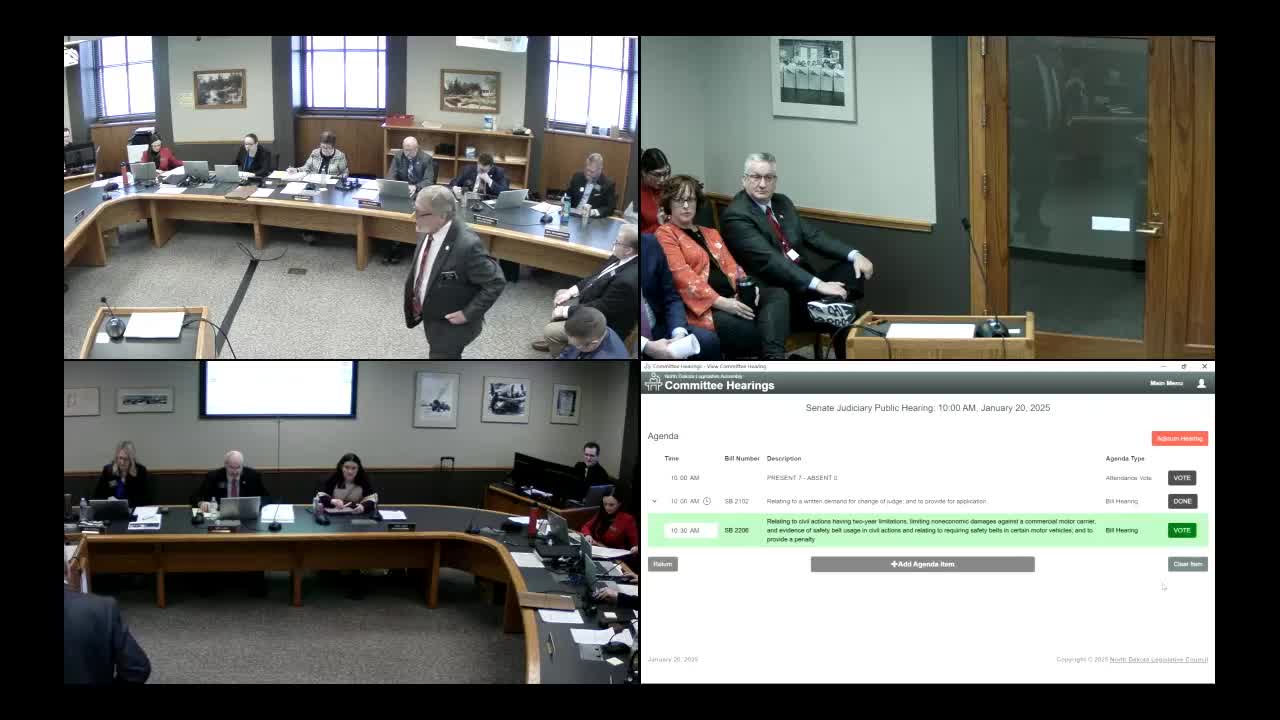
Committee hears hours of testimony on bill to cut statute of limitations, cap non‑economic damages and admit seat‑belt evidence
Summary
Supporters of Senate Bill 2206 told the Senate Judiciary Committee the measure would lower legal exposure for motor carriers by cutting the statute of limitations to two years, capping non‑economic damages at $500,000 and allowing juries to consider seat‑belt use; opponents said the changes would unfairly limit victims and impede full recovery.
Senate Bill 2206 drew lengthy testimony from trucking industry representatives, trade groups and local businesses who said changes are needed to curb so‑called "nuclear verdicts" and stabilize insurance costs, and from trial lawyers, a victims' advocate and family members who said the bill would limit victims' rights and leave seriously injured people without adequate compensation.
Senator Cole Conley (District 12) introduced the bill and said it responded to concerns raised by the North Dakota Motor Carriers Association. Scott Meske, representing the North Dakota Motor Carriers Association, described three principal provisions: a reduction in the statute of limitations for actions against motor carriers from six years to two years (the bill would require only that a case be filed within two years, not resolved), a $500,000 cap on non‑economic damages in covered cases, and a rule allowing juries to consider a plaintiff's seat‑belt use when determining awards. Meske said the $500,000 cap mirrors language already in state law for medical‑malpractice non‑economic damages and argued the cap and other changes would protect small carriers and slow dramatic insurance increases.
David Bauer, vice president of state affairs for the American Trucking Associations, and other industry witnesses echoed the concern that rising jury awards and litigation exposure are hurting North Dakota motor carriers and driving double‑digit insurance increases for some operators. Wally Keller and Melissa Dixon, both from the trucking and insurance industries, described rising premiums and said a combination of shorter filing windows, damage caps and allowing seat‑belt evidence would reduce the number and size of verdicts against carriers.
Opponents included Jackie Hall, executive director of the North Dakota Association for Justice, attorney David Schweigert and several family members of crash victims. Hall told the committee the state's current six‑year limitation provides needed time for claim development in complex cases, including those where medical conditions, multiple insurers or extended investigations delay resolution. She warned the proposal would leave seriously injured people with reduced compensation and remove accountability incentives for carriers.
Trista Dean, who testified in opposition, gave a detailed account of a 2018 crash in which two of her children died and a third was seriously injured. Dean said the grief and administrative burdens following a fatal crash often extend beyond two years and that families need adequate time and remedies to pursue full recovery and accountability. Attorney Dave Schweigert summed up other opponents' arguments, saying caps on non‑economic damages would take decisions away from juries and undermine long‑standing legal protections; he urged the committee not to pass the bill.
Committee members heard technical questions about how other states handle statutes of limitations and seat‑belt evidence. Witnesses disagreed on national norms: industry witnesses said many states have two‑year filing windows and a mix of rules on seat‑belt evidence; opponents said neighboring states and several comparable jurisdictions retain longer filing periods or different hands‑on rules and cautioned against adopting a one‑size‑fits‑all policy.
The hearing closed without a committee vote; the chair said sponsors would have an opportunity to propose amendments and that the committee would not take action until the following Monday.