Get Full Government Meeting Transcripts, Videos, & Alerts Forever!
Get email alerts on the Judiciary topic
No spam. Unsubscribe anytime.
Senate Judiciary Committee votes 'do not pass' on bill to require reasons for judge challenges
Summary
After extended testimony from defense attorneys and a North Dakota Supreme Court justice, the Senate Judiciary Committee recommended that Senate Bill 2102 not pass. Witnesses said the bill would require litigants to state reasons when seeking a change of judge and allow denial of requests not based on "reasonable grounds."
The Senate Judiciary Committee voted to give a “do not pass” recommendation on Senate Bill 2102 after testimony from defense lawyers and a state Supreme Court justice who warned the bill would undermine a longstanding statutory procedure allowing litigants to request a change of judge without stating reasons.
Supporters of keeping the current law said the statute — historically cited as permitting a party to seek reassignment of an assigned judge without publicly accusing the judge of bias — protects litigants and the public perception of the courts. Jesse Walstead, representing the North Dakota Association of Criminal Defense Lawyers, told the committee, “Requiring litigants to disclose their reason for requesting a different judge would create an environment where perceptions of bias, real and imagined, would be publicly expressed to the disadvantage of judges and litigants without any real procedure to test the veracity of those issues.”
Walstead and others described two changes in the bill as harmful: a requirement that the requesting party disclose the reason for the change and a provision permitting denial of a request if the reason is not ‘‘based on reasonable grounds.’’ He argued those changes would produce inconsistency across judicial districts and chill legitimate requests made after confidential attorney–client consultations.
Daniel Crothers, a justice on the North Dakota Supreme Court, also urged rejection. Crothers reviewed the statute's history, saying the 1971 revision removed an earlier affidavit-of-prejudice practice that routinely removed judges from cases without inquiry. Crothers supplied committee data on how often the change-of-judge procedure is used and how it fits into the caseload: the numbers he provided show demands filed in recent years have equaled a small fraction of total cases (roughly one-quarter of 1 percent), and he said the procedure remains a modest administrative task for presiding judges.
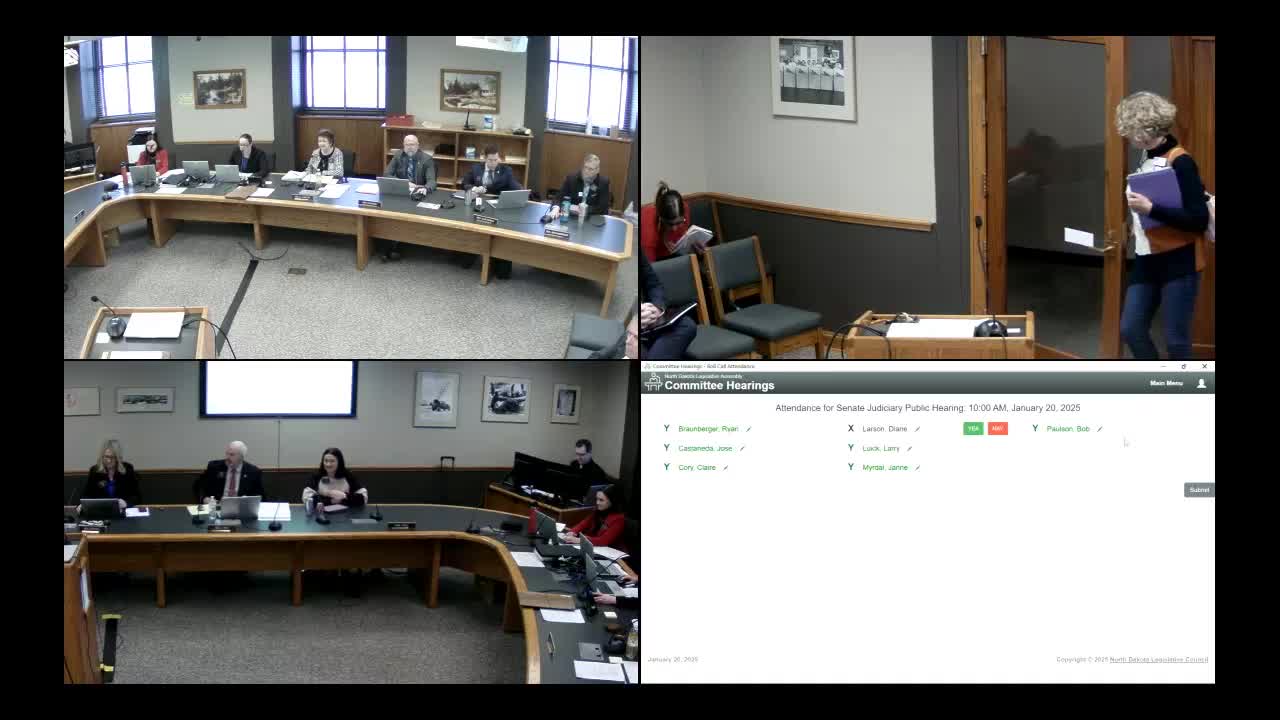
After public testimony the committee considered a motion. Senator Tammy Bridal moved a do-not-pass recommendation on Senate Bill 2102 and Senator Brownberger seconded. The roll call recorded several affirmative votes: Senator Paulson (yes), Senator Castaneda (yes), Senator Cory (aye) and Senator Lueck (yes). The committee chair closed the hearing and announced the do-not-pass recommendation.
The proponents of keeping the statute as written argued the rule fosters efficiency, avoids public accusations against sitting judges, and preserves litigants' confidential deliberations about case strategy. Opponents of the bill said the proposed “reasonable grounds” standard lacks statutory guidance and would invite varied interpretations by presiding judges across districts, producing additional litigation and delays.
The committee formally closed the record on the bill after the vote. The committee's recommendation is advisory to the full Senate and does not itself change law.