Get Full Government Meeting Transcripts, Videos, & Alerts Forever!
Get email alerts on the State Public Health Lab topic
No spam. Unsubscribe anytime.
State public health lab outlines new facility timeline, equipment requests and budget impacts
Summary
Dr. Christy Mason, Laboratory Services Section Director, told the Appropriations Committee the state lab will move into a new facility in 2026, seek one‑time funds for the move and request a decision package for nonfatal toxicology services; she described construction appropriations already made and flagged operating rent and federal authority as
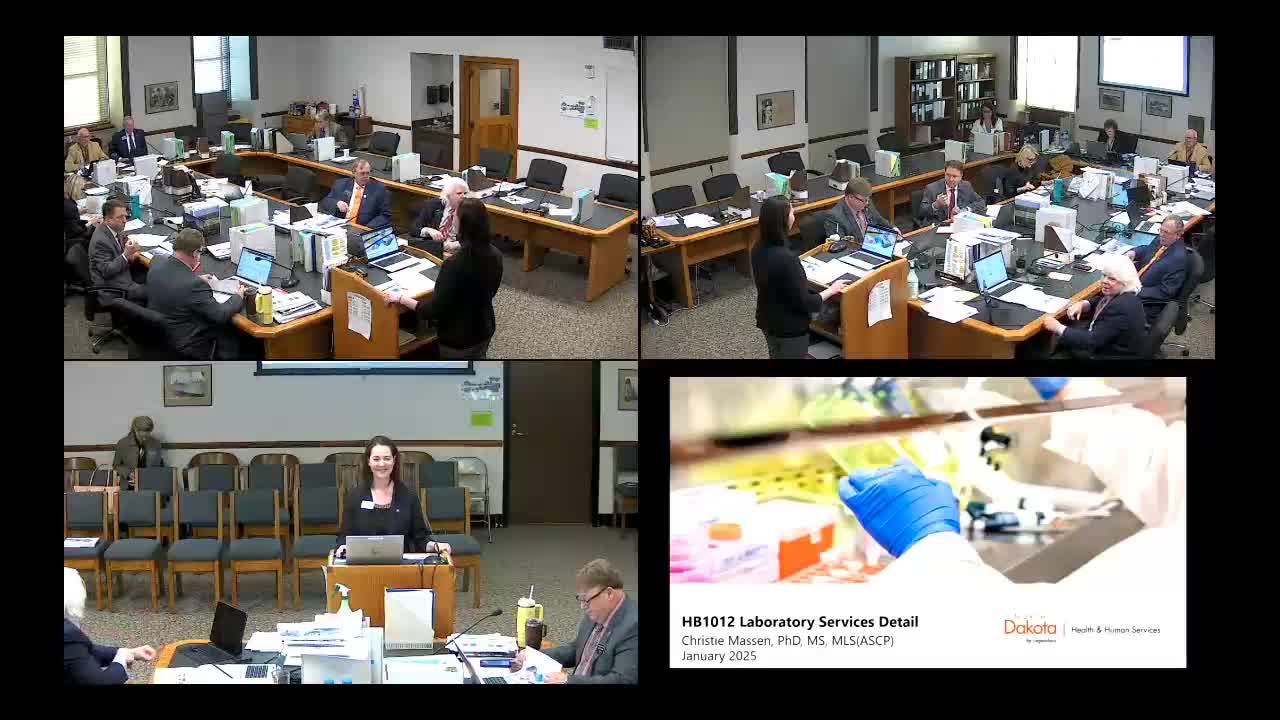
Dr. Christy Mason, Laboratory Services Section Director at the North Dakota Public Health Laboratory, briefed the Appropriations Committee on a planned move into a new state laboratory building, changes to the section's budget and a request for one‑time funding to add nonfatal toxicology services.
"My name is Doctor. Christy Mason and I am the Laboratory Services Section Director for the Public Health Laboratory," she told the committee as she opened the presentation. Mason described the lab's role as a statewide reference laboratory that performs diagnostic and environmental testing, assists in outbreak response, and supports clinical and hospital laboratories and other state partners.
The committee heard that the lab currently employs 24.15 FTEs, four temporary staff and summer student hires. Mason said the laboratory validated 47 new test methods in the last year and performed about 176,000 diagnostic human tests. She summarized the condition of the existing facility (a 1974 building with a 2004 addition) and showed photos of roof leaks and temporary trailers the lab used during the COVID surge.
Mason described funding already provided for the new lab: an initial authorization of $15,000,000 in 2021 and a later appropriation of $55,120,000 in the most recent biennium to complete the project. She said the department expects to begin moving into the new building in the summer of 2026 and complete the move by December 2026: "we are scheduled to start moving in in the summer of 2026, and then we will be finished moving by December of 2026." Carol Redman, assistant CFO, told the committee the projected rent schedule used in the budget reflects OMB's timeline: "that was the date given to us by OMB when we would start paying rent."
On budgetary impacts, Mason said salaries and benefits decline by $2,500,000 in the request because the COVID‑era testing and collection unit and its temporary staff are being dissolved. Operating expenses increase by $33,700,000 primarily to cover Office of Management and Budget (OMB) rent for the new facility for part of the biennium and to reflect federal authority for laboratory supplies tied to grants. Mason said IT services show a $60,000 decrease in the request due to the termination of COVID‑era temporary positions, and capital asset costs were reduced by $250,000 because one planned equipment purchase will be moved into the current biennium.
Mason presented two decision packages the section is forwarding to the committee. The first is a one‑time request of $251,500 to begin nonfatal toxicology services; she said $151,500 of that request would come from the general fund and the remainder from the Public Health Operating Fund (fee‑for‑service special funds). The second request is $2.9 million of one‑time SIF funds to support the physical transition from the old lab to the new facility (moving costs and related one‑time expenses). Mason said DEQ and other agencies have inquired about future use of the old lab building but there is no formal plan yet.
Committee members pressed staff on timing and rent. Representative Nelson questioned why rent appears in the budget before occupancy; Mason and budget staff said the OMB schedule produced the 17‑month rent number used for planning and that timeline may be adjusted if move dates change. Mason said the lab will be able to reduce leased warehouse space once the new building is occupied and expects expanded testing capacity and improved emergency response capability from the new facility.
Budget staff explained funding sources: the operating increases reflected federal authority tied to federal grants (ELC, FEP and other federal public‑health grants), and the Public Health Operating Fund is funded by fee‑for‑service laboratory revenue. Mason said the section will buy a MALDI‑TOF instrument in the current biennium to save costs versus purchasing it later.
The committee did not take action at the hearing; staff will provide follow‑up details on the OMB rent timing and any agency interest in reusing the old lab building. Mason closed by saying the section hopes the new facility will expand wastewater surveillance, increase courier capacity across the state and support additional test methods as public‑health needs evolve.