Get Full Government Meeting Transcripts, Videos, & Alerts Forever!
Get email alerts on the Health Data Modernization topic
No spam. Unsubscribe anytime.
State epidemiologist outlines data modernization, violent‑death reporting and grant plans
Summary
Tracy Miller, North Dakota state epidemiologist and section director for Health Statistics and Performance, briefed the Appropriations committee on the section's staffing, data modernization work, violent‑death reporting (NVDRS), surveys including the Youth Risk Behavior Survey and a new fatherhood survey, and plans to apply for federal grants in
Tracy Miller, the state epidemiologist and section director for Health Statistics and Performance at the North Dakota Department of Health and Human Services, told the Appropriations Committee that her unit will maintain 24 full‑time equivalent positions while continuing data modernization efforts and seeking federal grants to expand surveillance work.
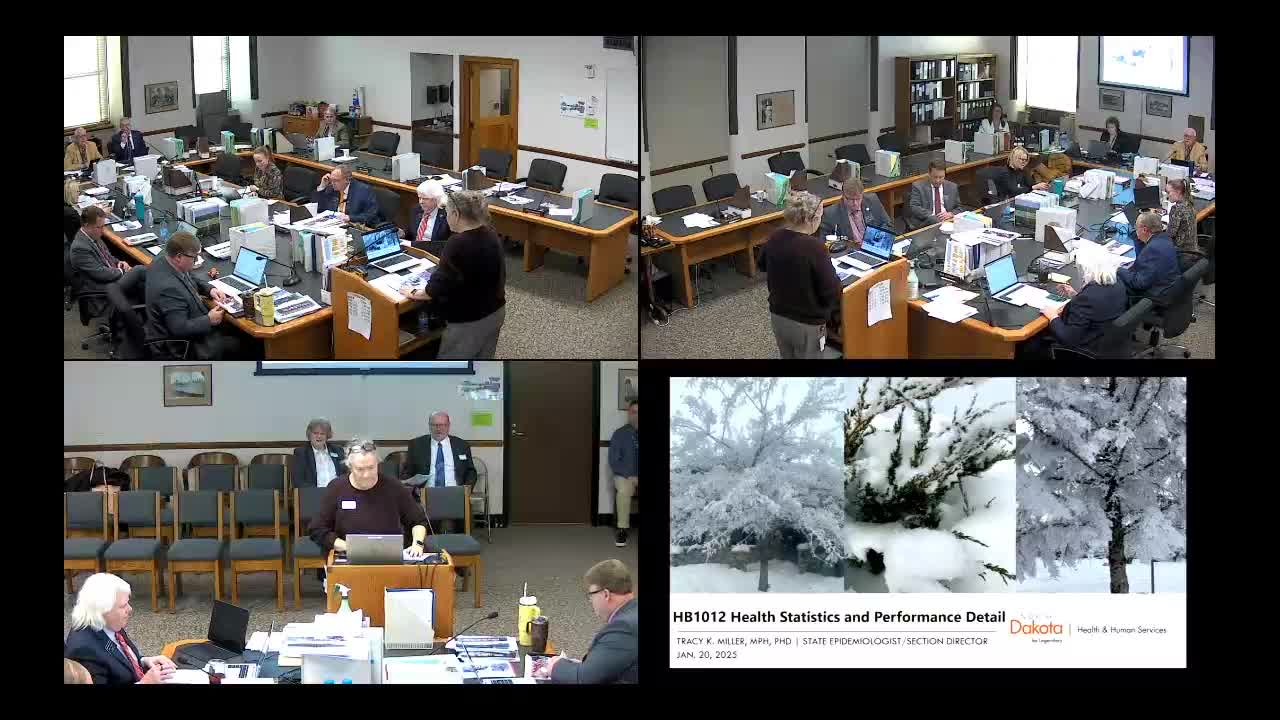
Miller told lawmakers: "I am the state epidemiologist here in North Dakota and I am also the section director for our health statistics and performance." She described four units in the section — data modernization, health statistics/special projects and health analytics, surveillance and data management, and vital records — and summarized staffing, recent projects and near‑term priorities.
The update matters because the section provides the state's core public‑health data services: maintaining birth and death registration, producing analytic reports used by state and local partners, running surveys such as the Youth Risk Behavior Survey (YRBS), and operating the state's violent death reporting system (NVDRS). Funding and federal grant awards will determine whether the section can add temporary staff to complete proposed workload tied to new grants.
Miller said the section's pay‑rolled complement for the upcoming biennium is 24 FTEs plus three temporary positions, with one current vacancy in a CSTE fellowship placement. She listed additional placements funded through outside entities: two full‑time contracted positions, one ASTHO placement, three CDC Foundation placements and three CDC‑funded fellows and placements. Miller also described partnerships with hospitals, coroners, schools, the North Dakota Health Information Network (NDHIN) and university programs used to collect and share public‑health data.
On surveys and new data collection, Miller said the YRBS is administered every other year to middle and high schools (odd years) and that about 200 schools participate; she reported the department began implementing a North Dakota fatherhood survey in 2024 and had received about 500 responses to date. "We are working on dashboards to make that data a little bit more available," she said.
Miller described the North Dakota Violent Death Reporting System (NVDRS) as a mandated reportable condition with data collection beginning Jan. 1, 2019. "Violent deaths are a mandated reportable condition," she said, adding that the program links death certificates, coroner and medical examiner reports, law enforcement records, toxicology and — increasingly — EMS and NDHIN data. She said North Dakota has ranked in the top five nationally for NVDRS data quality and completeness in recent years and noted the program allows up to 18 months to finalize case abstracts when law‑enforcement or toxicology reports are delayed.
Cody Pinks, director of the Surveillance and Data Management unit, fielded questions on toxicology coding and told the committee that the substances shown in NVDRS reports are toxicology results for decedents: "these are just toxicology results on anyone that was identified as a drug overdose death via vital records," she said, and multiple substances are commonly present in single cases.
Miller and staff outlined priority grant opportunities they expect to pursue in 2026: an occupational and injury surveillance program (NIOSH), two blood lead level grants and other federal funding aimed at enhancing surveillance. Miller said the section included temporary staff in its budget request contingent on winning those grants: "maintaining the 3 [temps] that we currently have and then bringing on, for the 4 grants, bringing on 2 for each grant. So 8 new." She and representatives affirmed that hiring would not occur until awards are confirmed.
Budget details presented included an anticipated IT expense increase tied to data modernization (Miller referenced a roughly $782,000 IT increase for modernization work), and use of federal grant authority to fund training, contracts and temporary staff where grants allow. Donna Auckland told the committee the grants Miller described are "all 100% federally funded. There's no match or anything with them," clarifying the department expects those awards to cover the proposed positions and project costs.
Committee members pressed staff on success rates and contingencies. Miller said many of the grants they plan to pursue are offered to all states and that federal partners (CDC and ASTHO) have encouraged North Dakota's applications given recent investments. Donna Auckland and budget staff explained the mechanics of federal indirect cost rates and cost allocation plans for drawing federal funds and noted the department has procedures to submit allocation changes before drawing down funds.
Lawmakers asked staff to add clearer annotations to the budget materials showing which line items are federal authority versus state general fund. Miller and budget staff said those clarifications would be added for subsequent committee review.
Looking ahead, Miller said the section will prioritize completion of the vital records modernization (Evers) and implementing HL7 exchange standards, finishing vital records accreditation work and supporting the multi‑partner health collaborative's data needs. She said improving visibility of existing data, strengthening data exchange with tribal partners and building data literacy across the agency are additional near‑term goals.
For now the committee received the briefing and budget details; staff committed to updating documents to show federal vs. state funding sources and to note hiring will follow successful grant awards.