Get Full Government Meeting Transcripts, Videos, & Alerts Forever!
Get email alerts on the Workforce Safety And Insurance topic
No spam. Unsubscribe anytime.
Committee exempts Workforce Safety and Insurance FTEs from state funding pool
Summary
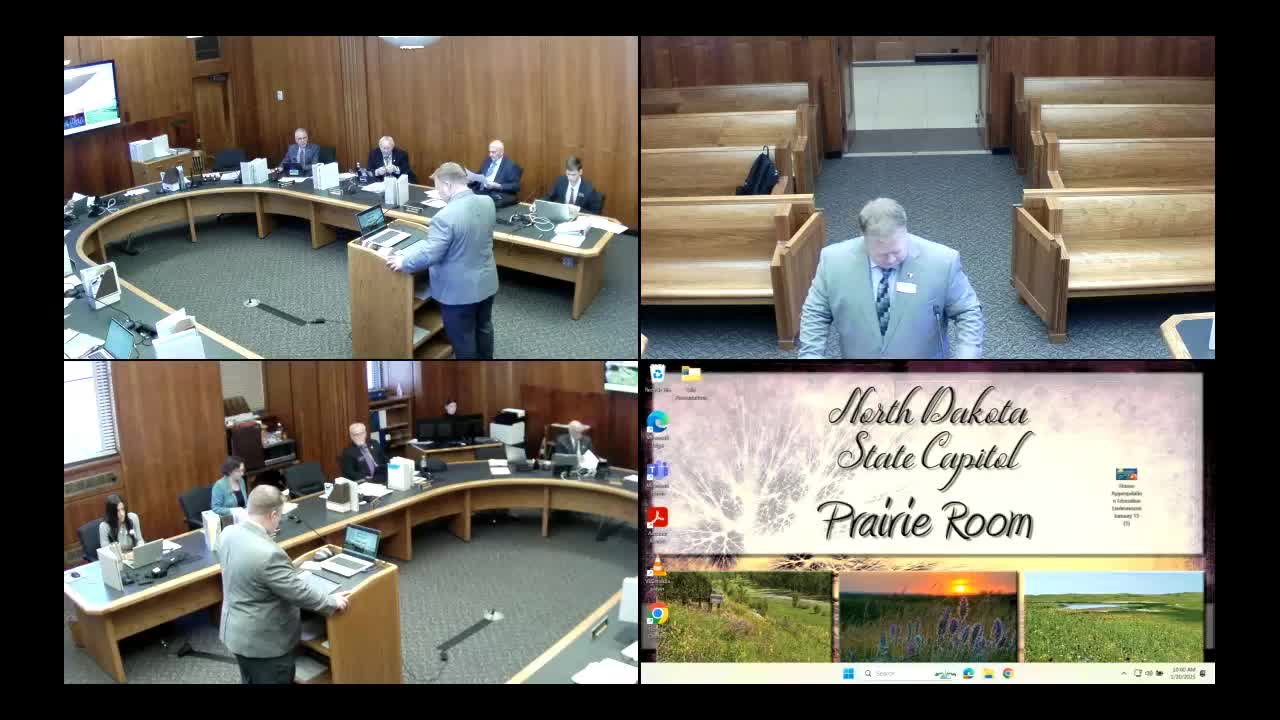
During a hearing on House Bill 1021, the House Appropriations - Education and Environment Division voted 4-1 to exempt the North Dakota Workforce Safety and Insurance agency’s FTEs from the state's vacant FTE funding pool.
During a hearing on House Bill 1021, the House Appropriations - Education and Environment Division voted 4-1 to exempt the North Dakota Workforce Safety and Insurance (WSI) agency’s full-time equivalent positions from the state’s vacant FTE funding pool.
WSI Director Art Thompson told the committee WSI is a special-fund agency funded solely by employer premium dollars and cannot commingle funds with the general fund. “We are a special fund agency, funded solely by employer premium dollars. We do not receive any general fund dollars,” Thompson said, summarizing the agency’s budget request and performance data.
The exemption matter mattered to committee members because WSI operates with its own fund and historically returns unspent authority to that fund rather than to the general fund. Thompson said WSI covers more than 27,000 North Dakota businesses and provides workers’ compensation coverage for over 412,000 North Dakotans, and highlighted the agency’s financial track record, including $1.8 billion in employer dividends over the past 20 years and a roughly 10% average turnback at the end of recent bienniums.
WSI outlined the elements of its executive budget request included with the governor’s recommendation: restoration of the vacant FTE pool authority (about $3,700,000), partial funding for IT rate increases (about $315,000), restoration of roughly $1,600,000 in operating costs that had been subject to a prior 3% budget reduction, and one-time requests of roughly $5,200,000 for continuation of the CAPS claims-and-policy system project, $1,400,000 for a WSI enhancement project, and $2,000,000 for building updates. Thompson also reported investment returns of about 5.9% for 2024 on funds held in the WSI fund.
Committee members asked about how WSI’s fund is structured and how premiums and student-apprentice payrolls are handled. Thompson said WSI writes workers’ compensation premiums for student learners or student apprenticeship programs when the student is paid by an employer through an accredited educational institution; he said premiums are set by job classification and risk rather than by a worker’s age. He also described WSI’s governance: a nine-member advisory board appointed by the governor meets bimonthly and takes positions on legislative proposals that affect the agency.
Thompson described several bills that the WSI advisory board reviewed and took positions on. The board unanimously opposed Senate Bill 2181 (the mental-coverage bill) and recommended a study of other states’ approaches; the board remained neutral on House Bill 1060 (expanding presumption clauses to include corrections officers). Thompson said the agency is also reviewing proposals to increase the maximum death benefit paid after a workplace fatality (from $300,000 to a proposed $400,000 with a $10,000 biennial escalator), to raise the scholarship cap for surviving spouses/dependents, and to adjust caps on home remodels and vehicle adaptations for catastrophic injuries (HB 1423).
During the HB1021 hearing Representative Martin moved that WSI’s FTEs be excluded from the statewide FTE pool on the basis that WSI’s money is held and managed separately; the motion was seconded verbally on the floor. Representative Martin said, "This is all their money. We should actually just give them $1 amount and let them spend it." Representative Richter and others expressed concern about setting a precedent and asked whether any additional oversight or reporting requirements should accompany an exemption. Committee discussion noted other special-fund entities such as the Bank of North Dakota and the Department of Human Services (DHHS) pilot arrangements for salary appropriations; members said similar requests could follow.
The clerk recorded the motion carrying 4 to 1. Committee leadership said Representative Hansen will take the item forward for further presentation at a later date.
The committee closed the HB1021 hearing and adjourned; members noted upcoming hearings on House Bill 1018 (State Historical Society) and House Bill 1002 (Secretary of State) scheduled the next day.
Ending: The committee’s exemption applies to the committee’s action on HB1021; any change to statewide policy or broader application to other agencies would require further legislative action or guidance from the full Appropriations Committee or the Legislature.