Get Full Government Meeting Transcripts, Videos, & Alerts Forever!
Get email alerts on the Tourism Economy topic
No spam. Unsubscribe anytime.
Senate committee backs bill to clarify tourism as a primary‑sector industry
Summary
The Senate Industry and Business Committee gave a unanimous "do pass" recommendation to Senate Bill 2154, a statutory cleanup that explicitly places tourism in the North Dakota Century Code definition of primary‑sector business so tourism operators can access state economic development programs without ambiguity.
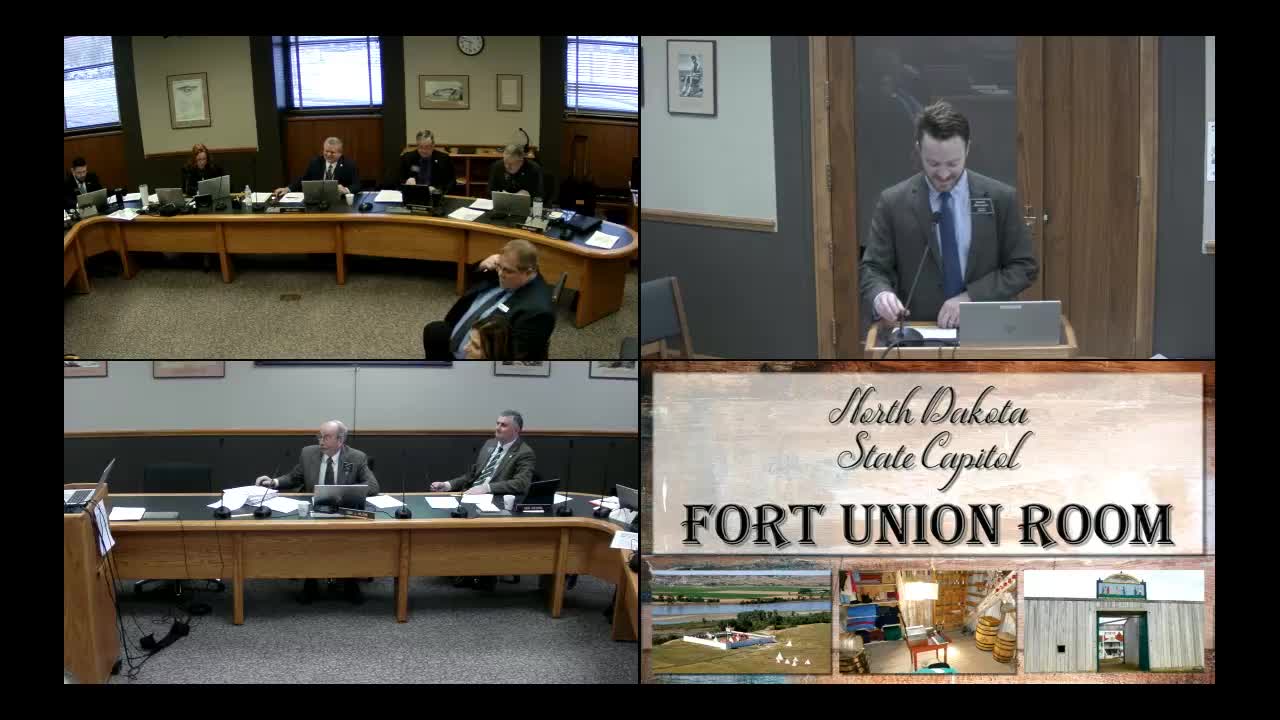
Senate Bill 2154, a bill to clarify how tourism is defined in the North Dakota Century Code, received a unanimous do‑pass recommendation from the Senate Industry and Business Committee after testimony from state commerce and tourism officials.
The bill moves existing tourism language into a single, clearer location in statute and strikes a conflicting definition elsewhere so that tourism is explicitly recognized as a primary‑sector industry used by the state to determine eligibility for economic development programs. Senator Sean Cleary (State Senator, District 35) introduced the bill and asked the committee for a favorable recommendation.
The bill’s sponsor and the Department of Commerce witnesses said the change is primarily a clarification rather than an expansion of benefit access. Sarah Adi Coleman, Director of the Tourism and Marketing Division at the North Dakota Department of Commerce, testified that tourism generates new, out‑of‑state spending and that the department’s research shows tourism produced $3,300,000,000 in visitor spending in 2023 and supports more than 3,100 businesses statewide. Coleman said the proposed language would allow tourism businesses that demonstrate at least 25% of revenue originates from outside North Dakota to apply for a tourism primary‑sector designation and that applicants must report projected revenue sources and operational metrics the certification requires.
Committee members asked whether the statutory change had previously cost the state or applicants federal or private funding opportunities. Commerce staff said they were not aware of a specific denial of funding tied to the inconsistent language; the change followed an internal code review and a recommendation to remove ambiguity. Senators pressed staff on how the 25% out‑of‑state revenue requirement would be measured; witnesses said projections are commonly used for new businesses and that modern payment systems and federal data sources make tracking easier than in the past.
After the testimony and questions, the committee voted on a motion for a do‑pass recommendation. The roll call recorded aye votes from Senator Klein, Senator Kessel, Chairman Barta, Vice Chairman Boehm and Senator Engate. The committee chair indicated Senator Kessel would carry the measure to the floor.
The measure was framed by proponents as a statutory cleanup intended to remove ambiguity that could hinder tourism businesses from accessing existing state incentives; it does not change the certification process or program rules, which remain in agency procedures.
If the Senate advances the bill beyond committee, the certification process and the 25% nonresident‑revenue requirement will remain the mechanism for determining whether an applicant qualifies for tourism primary‑sector status.
No opposition testimony was recorded during the committee hearing.