Get Full Government Meeting Transcripts, Videos, & Alerts Forever!
Get email alerts on the Legislative Budget topic
No spam. Unsubscribe anytime.
Legislative Council seeks $29M for assembly, proposes 25 new staff and chamber accessibility upgrades
Summary
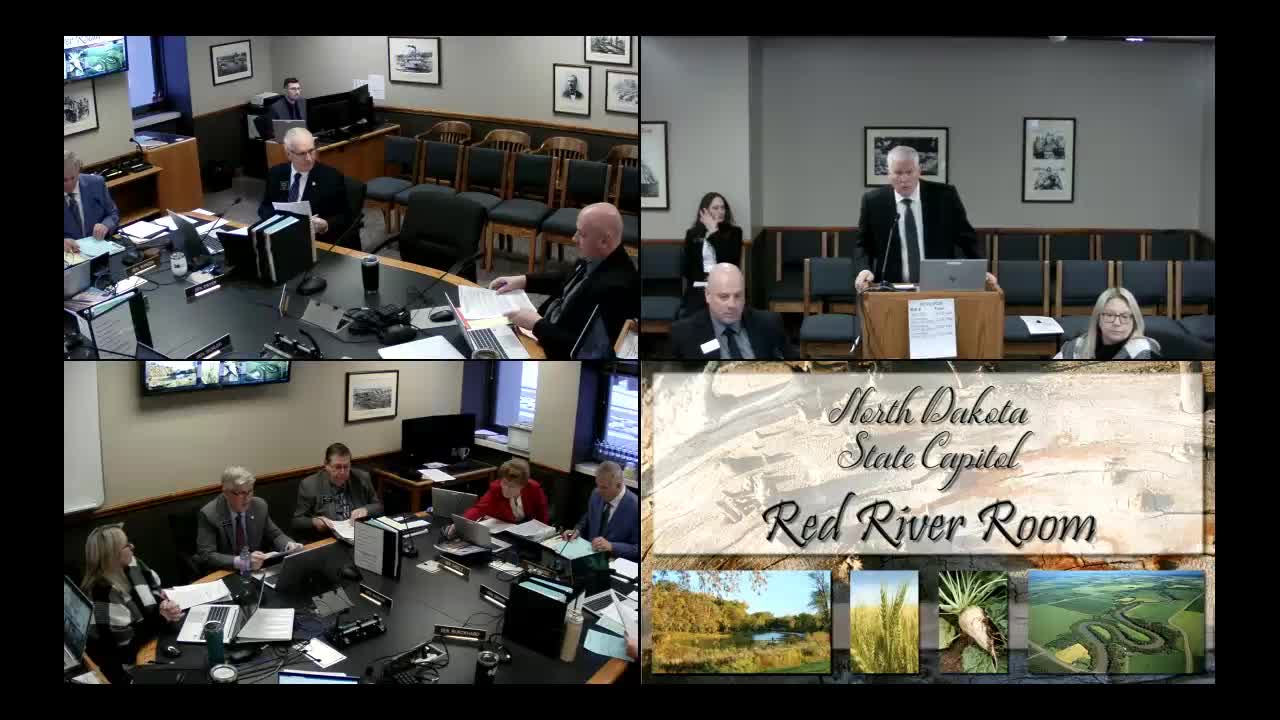
At a hearing of the Government Operations Division of the North Dakota Senate Appropriations Committee, John Bjornson, director of the Legislative Council, presented Senate Bill 2001, the legislative-branch budget request for the 2025–27 biennium.
At a hearing of the Government Operations Division of the North Dakota Senate Appropriations Committee, John Bjornson, director of the Legislative Council, presented Senate Bill 2001, the legislative-branch budget request for the 2025–27 biennium. Bjornson said the recommended appropriation for the legislative assembly totals about $29,000,000 from the general fund and that the legislative management and legislative council appropriation totals about $28,500,000.
The request for the assembly includes nearly $8.4 million in one-time funding for chamber lighting and accessibility upgrades, digital document certification and completion of an upgraded bill-drafting system. Bjornson told the committee, “we are not ADA compliant right now,” and said the legislative procedure and arrangements committee recommended full accessibility work to avoid recurring accommodations for speakers and visitors with mobility impairments.
Why it matters: Bjornson and committee members framed the budget request around two pressures. First, the Legislative Council seeks more in-house capacity—policy analysts, program evaluators and IT staff—to preserve institutional memory as term limits reduce lawmakers’ tenure. Second, the branch is asking for one-time capital spending to finish technology and accessibility work lawmakers say is needed to serve the public and meet federal accessibility obligations.
Key budget details and proposed changes - Assembly appropriation: about $29,000,000 general fund, including roughly $8,400,000 in one-time requests. Bjornson said the assembly’s ongoing general fund increase is $2,200,000 (about 12% more than the 2023 biennium ongoing appropriation). - Salaries and wages: a line item of about $14,600,000 for session employees; legislator pay in the proposal remains $226 per legislative day with a 3% increase in each year of the biennium. Monthly legislator compensation is listed at $610 per month. - Operating and IT costs: increases for software licensing, maintenance of the bill-drafting system, website accessibility work, video streaming, archiving and closed captioning. Bjornson estimated IT software costs at $870,000 and other related IT expenses at about $1,200,000, and $220,000 for enhanced video storage and stream quality. - One-time assembly projects: chamber lighting replacement (halogen to LED), permanent accessibility work with an estimated top-end cost that Bjornson said could reach about $4,000,000 for extensive regrading and a rostrum lift, and bringing legacy bills and documents into the new drafting system for searchable access.
Legislative management and staffing proposal Bjornson described a proposal—requested by legislative leaders and recommended by the legislative proceedings committee—to add staff to the legislative council. The legislative management and legislative council appropriation in the recommendation totals about $28.5 million and includes requests for a total of 70 FTE positions (an increase of 25 positions compared with the 2023 biennium). Bjornson said the plan phases additional staff, with 25 positions proposed initially and 25 more in 2027 under a five-year staffing plan.
Rationale and intended functions: Bjornson said added staff would focus on three areas: policy analysis, program evaluation, and information technology, with supporting administrative and human resources positions and a communications role to share nonpartisan information about legislative work. He argued program evaluation staff would allow the legislature to assess the effectiveness of executive-branch programs without relying solely on agency-provided evaluations.
Costs and logistics: Bjornson estimated the salary, operating and one-time costs for the first 25 positions at about $6,000,000. He told the committee the Legislative Council has prepared job descriptions and would stagger hiring; he also flagged space constraints in the Capitol and said the council is discussing facility options with Facility Management Division and reviewing the state capital building fund as one potential long-term option.
Staffing, turnover and recruitment Bjornson reviewed recent turnover and recruiting challenges. He said the council onboarded 17 employees in 2024 (including three positions previously approved by the emergency commission) and lost about 10 staff over the prior year for reasons including relocation, retirement and reassignments. He described pay and retention efforts begun in prior sessions, including session retention pay and equity adjustments, and said competitive pay remains necessary to attract attorneys, fiscal analysts and IT developers.
Bjornson highlighted an existing law-student internship pipeline: four current attorneys are former interns and the program has helped the council recruit staff. He recommended expanding internship and recruiting efforts for fiscal and IT roles.
IT, archives and litigation costs Bjornson said the legislative branch has continued to invest in streaming and archiving: the budget proposes ongoing capital and storage funding for audio and video archiving and additional licensing and maintenance for the drafting system and Microsoft 365. He also requested increased professional services funding—an added $500,000—to cover consultant work and an outside counsel reserve after recent redistricting litigation that required outside legal resources.
Related bills and items noted to the committee Bjornson referenced related introduced measures and statutory provisions: the recommended bill would include statutory language in section 6 to implement pay changes described in his testimony; he also discussed Senate Bill 2,187, which would raise the state lodging reimbursement rate (he described it as moving state rates closer to the federal GSA rate), a referenced “Senate bill 10 1257” to expand the organizational session to five days (details not specified in the hearing), and House Bill 1408 about annual legislative sessions (details not specified).
Committee outcome and next steps The hearing on Senate Bill 2001 closed with no committee vote recorded. Bjornson and staff (including Legislative Council fiscal and IT staff who attended) answered lawmakers’ questions on hiring timelines, space and interagency cooperation for data requests. Committee members pressed on recruiting strategies, whether proposed legislative positions would duplicate or reallocate executive-branch staff, and the timeline for completing bill-drafting and accessibility projects.
Ending note: Bjornson asked the committee to consider the request in light of term limits and the need to preserve institutional memory; he said the council views the expansion as a way to keep the legislature’s policymaking capacity and nonpartisan analysis in-house rather than shift expertise to executive agencies.