Get Full Government Meeting Transcripts, Videos, & Alerts Forever!
Get email alerts on the Healthy Safe Communities Maternal Domestic Loanrepayment topic
No spam. Unsubscribe anytime.
Healthy and Safe Communities section seeks $2 million for maternal services, highlights WIC, loan‑repayment and domestic‑violence proposals
Summary
The section director described a $2 million general‑fund request to expand maternal and postpartum services, a $2.25 million Community Health Trust Fund decision package for domestic violence and sexual assault programs, WIC and newborn screening updates, and the state loan‑repayment programs thatRecruit and retain clinicians in shortage areas.
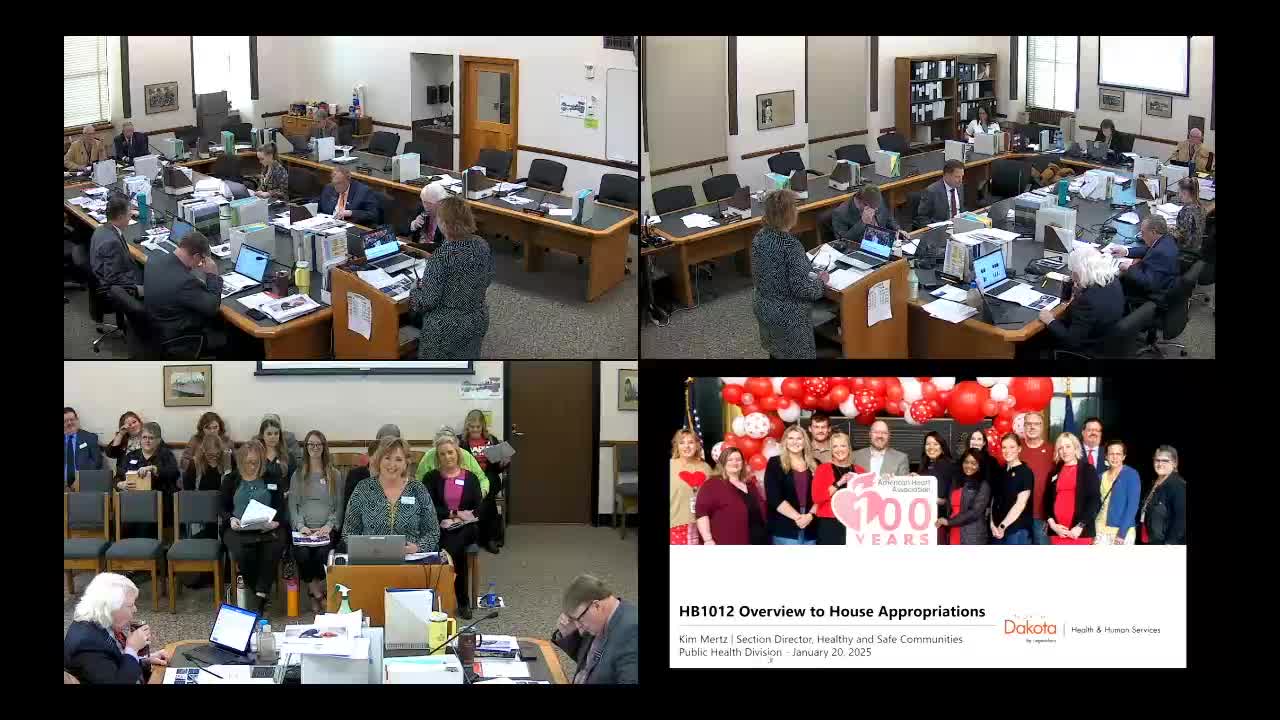
Kim Mertz, director of the Healthy and Safe Communities section, presented program updates and budget requests to the House Appropriations Human Resources Subcommittee, including a $2 million general‑fund proposal to expand maternal and postpartum services and a $2.25 million request from the Community Health Trust Fund to strengthen domestic violence and sexual assault services statewide.
Why it matters: Maternal and child health indicators and social‑service supports are central to early‑life outcomes. Lawmakers asked for data on prenatal care access, breastfeeding disparities and program capacity while the department explained how targeted state investments would be used.
Mertz said the department's maternal and child health performance measures show weaknesses: 80 percent of women received adequate prenatal care (defined as care within the first four months), but other measures — including rising preterm birth and lower breastfeeding initiation among American Indian mothers — remain concerns. The department's executive budget includes $2 million in general funds for maternal and child health services for preconception, prenatal and postpartum support, chronic‑disease prevention, screening and stronger community services.
WIC and newborn screening: WIC served roughly 16,000 participants (2023 data), including about half of newborns in the state, Mertz said, and the agency is applying for federal infrastructure funding to modernize WIC data systems. Newborn screening processes were described as long‑standing (since 1964) and the program now screens for 34 conditions; the department recently applied for a grant (PROPEL) to strengthen data infrastructure and long‑term follow‑up.
Loan repayment and workforce: Natalie Young, director of the primary care office, summarized state and federal loan‑repayment programs under the North Dakota Health Service Corps. She told the committee the Century Code (state) awards are structured over five years and require employer matching contributions for several professions: physicians receive $100,000 (employer match 50%, total $150,000), psychologists $60,000 (employer match 25%), advanced practice providers $20,000 (employer match 10%) and registered nurses $20,000 (employer match 10%). Federal two‑year awards were described separately and can provide up to $50,000 for certain occupations; the department said it currently does not maintain a waiting list for eligible applicants.
Domestic violence and sexual assault: Deanna Askew described services to victims and crisis centers (19 centers statewide) and testified that in 2023 the programs served thousands of victims and impacted more than 4,200 children who witnessed incidents. The department proposed $2.25 million from the Community Health Trust Fund for staffing, transitional housing, mobile advocacy, transportation and prevention services for local providers.
Tobacco and youth nicotine prevention: Neil Sharvat, director of the Tobacco Prevention and Control Program, noted sustained progress in cigarette smoking rates but emphasized youth vaping remains a concern. He told lawmakers roughly one in three high‑school students has ever vaped and about one in five currently vape, and he outlined workforce training and nicotine‑treatment specialist expansion efforts.
Ending: Committee members asked for further cost breakdowns for proposed general‑fund and trust‑fund requests, lists of grantees and more details about program implementation timelines. Staff said they would provide the requested breakdowns and additional grant detail.