Get Full Government Meeting Transcripts, Videos, & Alerts Forever!
Get email alerts on the Childrens Advocacy Centers Confidentiality topic
No spam. Unsubscribe anytime.
Committee advances bill to clarify confidentiality and communications for Children's Advocacy Centers
Summary
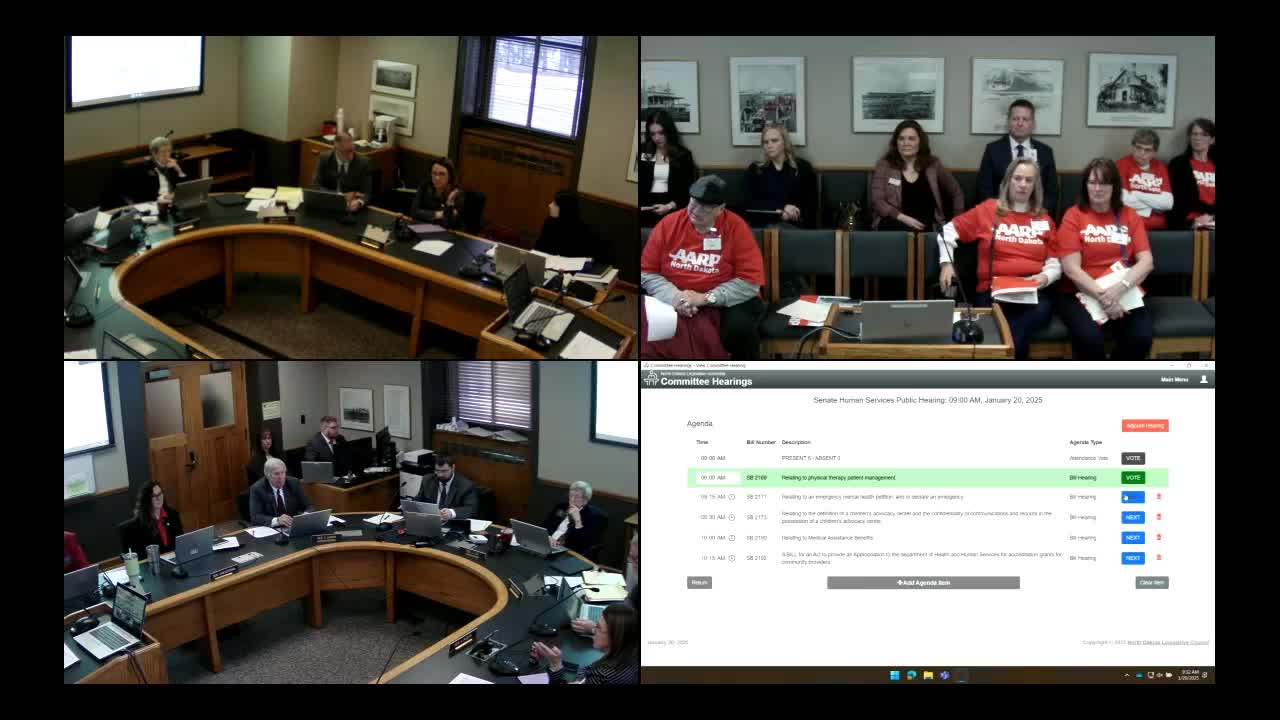
Senate Bill 2173, which updates the definition of children’s advocacy centers and explicitly protects confidential verbal communications among multidisciplinary partners, received committee support and a due-pass recommendation after testimony from CAC leaders, human services zone directors, prosecutors and supporters.
The Senate Human Services Committee voted to give Senate Bill 2173 a do-pass recommendation after hearing testimony from children's advocacy center leaders, human services zone directors and the state's attorneys association.
Greg Kosowski, executive director of the Children's Advocacy Centers of North Dakota, told the committee the bill updates the statutory definition of a children's advocacy center (CAC), replaces the term "full" with "accredited" to align with the National Children's Alliance, and clarifies that confidential communications include both records and verbal communications used during multidisciplinary case discussions. "This addition would be clarifying how verbal communication is confidential," Kosowski said.
Several witnesses, including Chelsea Florie, zone director for Burleigh County Human Service Zone, and Jonathan Byers of the North Dakota State's Attorneys Association, described existing coordination among law enforcement, human services, prosecutors and CACs and supported the bill as drafted. Florie said CACs are used when criminal aspects of a report are present and that legal custodial decisions and court orders remain the authority of human services zones. Byers explained that parents typically receive the results of an investigation but do not automatically receive the identity of the mandated reporter.
One written opposition was recorded; proponents said the bill did not alter consent or referral processes and that the changes would protect victims by allowing confidential multidisciplinary communications and appropriate sharing with prosecutors, courts and other CACs when necessary for continuity of care.
The committee vote to give SB 2173 a do-pass recommendation carried on a recorded voice roll call; the clerk recorded a 6-0 vote in favor (Chairman Lee, Vice Chair Weston, Senators Rohrs, Hogan, Van Osteen and Clemens voted aye). The bill will proceed to the next stage per committee procedure.