Get Full Government Meeting Transcripts, Videos, & Alerts Forever!
Get email alerts on the Deepfakes Csam topic
No spam. Unsubscribe anytime.
Committee examines several bills to criminalize computer‑generated child sexual imagery and to clarify penalties
Summary
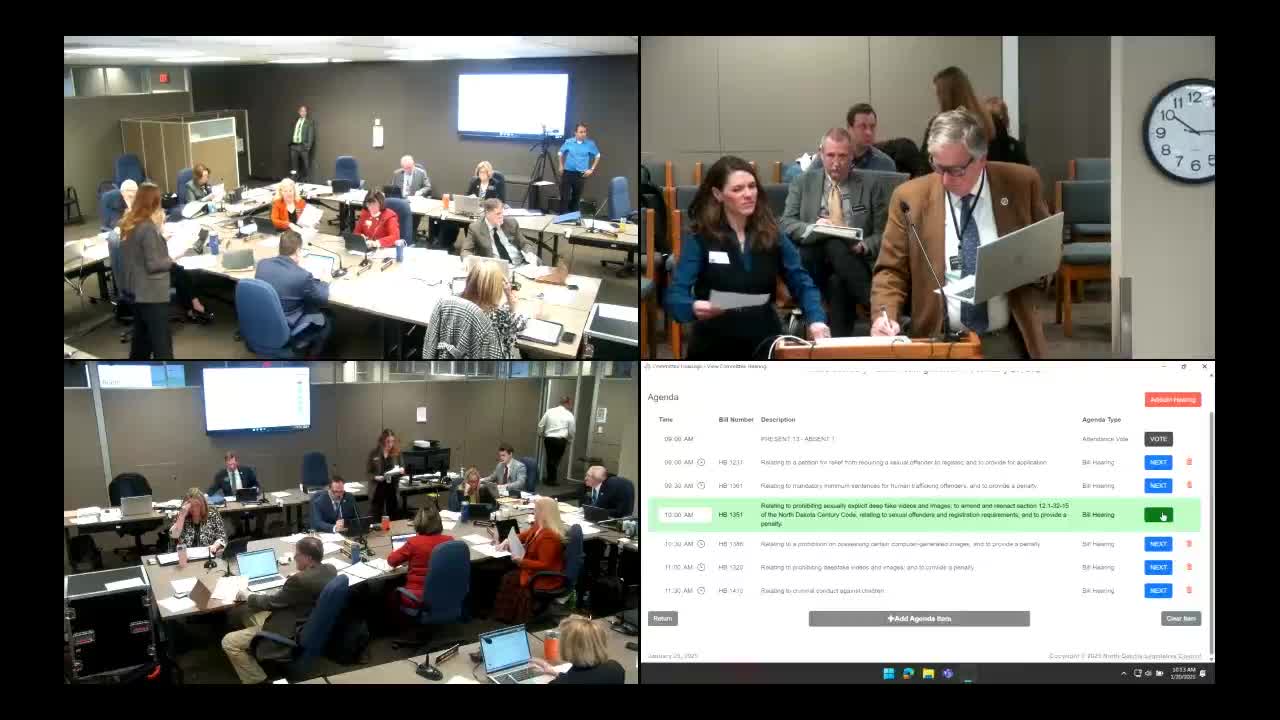
Members of the House Judiciary Committee considered multiple bills that would criminalize computer‑generated sexual images and expand statutes governing child sexual abuse material (CSAM).
Members of the House Judiciary Committee considered multiple bills addressing computer‑generated sexual imagery, commonly described in testimony as "deepfakes," and proposed changes to statutes covering child sexual abuse material (CSAM).
Representative Bernie Satrim and others introduced House Bill 1351 (initial draft) that would criminalize production, possession and distribution of certain computer‑generated images depicting minors engaged in sexual conduct; prosecutor and victims' advocates testified that the draft should be strengthened, including upgrading penalties to felony level and narrowing or eliminating broad affirmative‑defense language. Anna Frizzell, representing Children's Advocacy Centers of North Dakota, recommended elevating the proposed misdemeanor to a class C felony and removing some blanket affirmative defenses that could permit reuse of identifiable minors' images ‘‘without the express and written permission of the minor or their parent or guardian.’'
Tech industry representatives suggested an explicit liability shield for providers of interactive computer services, pointing to 47 U.S.C. §230, and asked committees to avoid unintentionally imposing platform liability. Terry Efertz of TechND proposed model language: "nothing in this section shall be construed to impose liability on the provider of an interactive computer service ..." and asked for a consistent disclaimer across bills.
The chief deputy attorney general, Claire Ness, testified in strong support of House Bill 1386 (version 25.1064.0100000), which would amend statutes including section 12.127.204.1 to ensure prosecutors can charge creation, possession or trade of computer‑generated CSAM and to enhance penalties in the most egregious possession cases. Ness told the committee that tips from the National Center for Missing and Exploited Children (NCMEC) to BCI have grown dramatically—379 in 2019, 585 in 2020 and more than 1,500 in each of the past two years—and argued that technological advances have made computer‑generated material indistinguishable from real imagery.
Witnesses and committee members debated technical and constitutional issues. Several asked whether images generated wholly in software (sometimes called "virtual" CSAM) or morphed images that incorporate an identifiable child should be treated the same. Witnesses noted the 2002 U.S. Supreme Court decision that protected some virtual images then, but said today's AI‑generated images are far more realistic and that obscenity doctrine would not protect obscene CSAM. Lawmakers and TechND representatives also discussed political satire and other First Amendment concerns; tech witnesses warned the broad misdemeanor proposed in House Bill 1320 (deepfake impersonation misdemeanor) could chill parody and surprise lawful uses.
Committee questions focused on definitions (virtual vs. morphed vs. identifiable minor), age thresholds (whether to use ‘‘prepubescent’’ or fixed ages such as under 12), and whether penalties should scale by severity (number of images, presence of sexual violence, infant/toddler victims). The attorney general's office urged enhancements for possession of the most brutal material and possession by registered offenders; Frizzell and other advocates recommended clarifying language to ensure identifiable minors cannot be reused without consent and to align statutory terms (e.g., replace ‘‘****** performance’’ language with "child sexual abuse material" or other modern terminology).
No bill was voted on; the committee closed the hearings and accepted written testimony.
Why it matters: Rapid improvements in AI make previously theoretical harms practicable; the bills aim to ensure prosecutors can charge and penalize creation and possession of computer‑generated CSAM. Tech industry and civil‑liberties witnesses urged narrowly targeted language to avoid chilling legitimate speech and to protect intermediaries that are not the source of illicit content.
What’s next: Sponsors and stakeholders indicated willingness to work on definitions, penalty levels and platform liability language before committee action.