Get Full Government Meeting Transcripts, Videos, & Alerts Forever!
Get email alerts on the Immunizations Vaccines Rsv Ndis topic
No spam. Unsubscribe anytime.
Lawmakers hear that kindergarten vaccination rates have fallen as state seeks funds to buy RSV and hepatitis B doses for birthing hospitals
Summary
Health officials told the appropriations subcommittee kindergarten immunization coverage has declined and exemption rates have risen; the department proposed a decision package to buy hepatitis B and RSV monoclonal antibody doses for birthing hospitals using public health operating funds and discussed immunization system modernization.
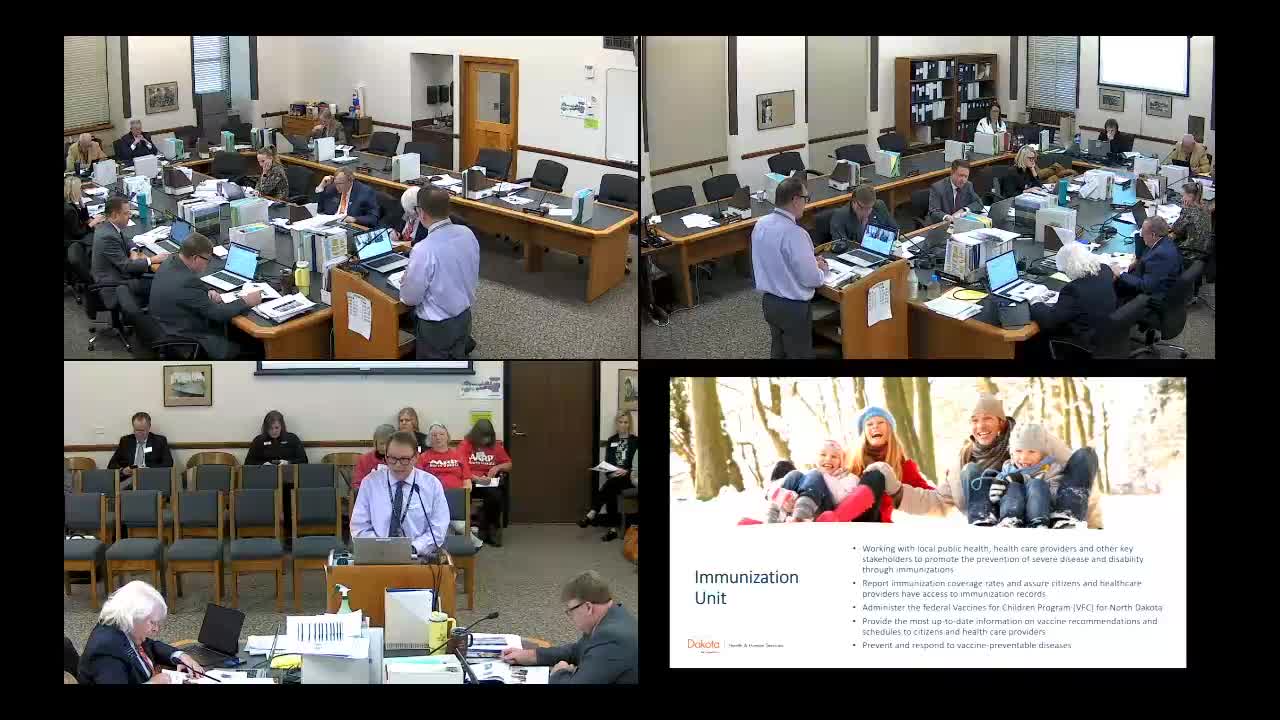
Health and Human Services officials told the House Appropriations Committee Human Resources Subcommittee that kindergarten immunization coverage in North Dakota has been slipping and philosophical and moral exemptions are increasing, prompting a mix of operational and budget requests aimed at boosting protection for young children.
Why it matters: Declining routine childhood vaccine coverage raises the risk of outbreaks of highly contagious diseases such as measles and polio. Committee members heard proposals to expand access to RSV protection for newborns and to help birthing hospitals supply hepatitis B vaccine to infants before discharge.
“This first year that we had the immunization coverage available for infants — either the monoclonal antibody or vaccinating the mom during pregnancy — we estimate that we had close to 55 percent coverage,” Kirby Krueger, director of Disease Control and Forensic Pathology, said of the initial RSV protection rollout. He said 2024 preliminary estimates showed greater than 70 percent protection for the highest‑risk infants.
Molly Howell, immunization director for HHS, told the committee kindergarten coverage for core childhood vaccines has declined in recent years and that exemption rates — particularly philosophical/moral exemptions — have increased, eroding herd immunity in places. Howell noted measles requires roughly 95 percent coverage to prevent outbreaks and polio experts recommend at least 80 percent coverage.
The department's executive decision package requests about $2.2 million from the public health operating fund (Fund 370) to coordinate immunization access at birthing hospitals, which would include purchase and distribution of hepatitis B vaccine and RSV monoclonal antibody (nirsevimab) doses for infants at discharge. Stephanie Rasmussen of the agency finance office confirmed that the proposed immunization access funding would be paid from Fund 370.
HHS staff also described a recent modernization of the state immunization information system. Krueger said the North Dakota Immunization Information System (NDIS) modernization went live Nov. 18, 2024; the department reported 75 interoperable connections, impacted vaccination sites and more than 700,000 immunization records served in the last biennium. The department asked for continued IT and modernization funding to support NDIS and related interoperability work.
Other public‑health details presented to the committee included increases in pertussis (preliminary 151 cases in 2024, with 13 infants and eight infant hospitalizations) and a 2024 infant Hemophilus influenzae type b meningitis case in an unvaccinated infant. The witnesses emphasized the role of provider outreach, school record enforcement and reminder/recall systems in improving routine vaccination coverage.
Ending: Committee members asked for follow‑up data at county and school district levels and requested that the department provide more detail on the proposed Fund 370 purchase plan and on how the immunization access package would be administered at birthing hospitals.