Get Full Government Meeting Transcripts, Videos, & Alerts Forever!
Get email alerts on the Fuel Inspection Fees topic
No spam. Unsubscribe anytime.
Committee backs bill to send petroleum inspection fees to DEQ operating fund
Summary
Senator Tom Thomas proposed redirecting motor-fuel inspection-fee revenue to the Department of Environmental Quality to restore and expand fuel sampling and testing.
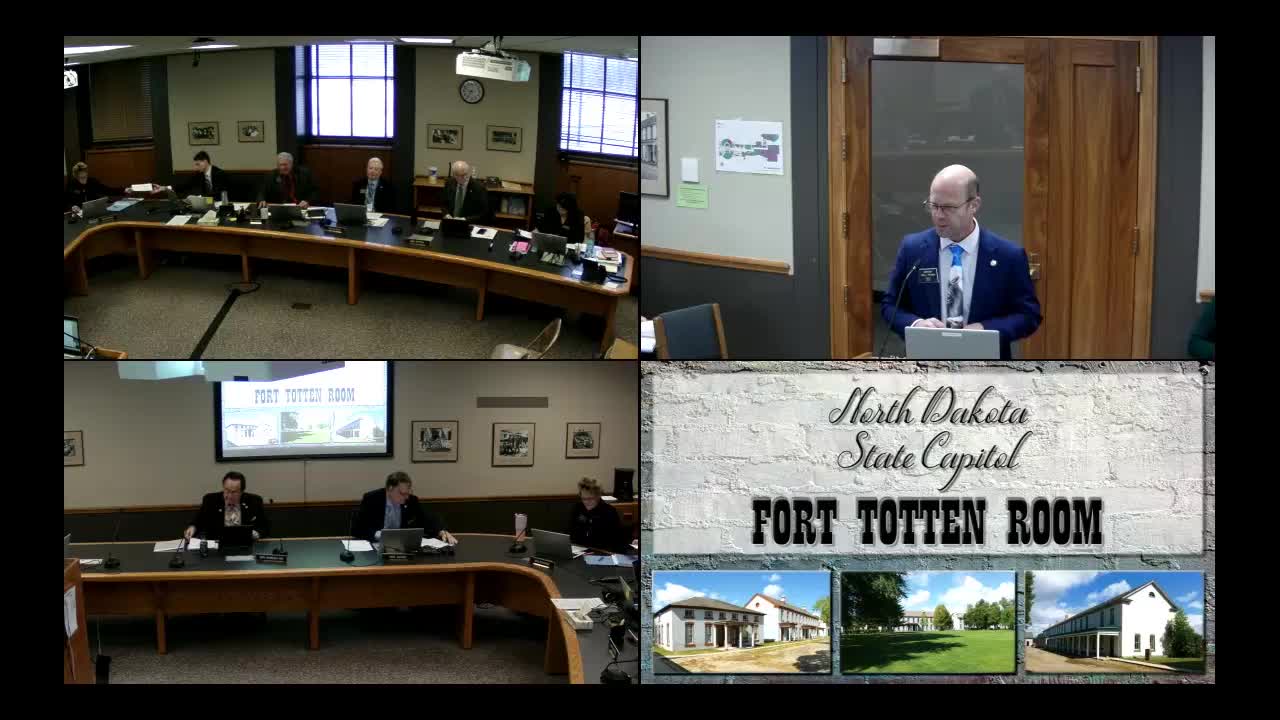
Senator Tom Thomas introduced Senate Bill 2179 to the Finance and Taxation Committee, saying the bill would move inspection-fee revenue from the State General Fund to the Department of Environmental Quality (DEQ) operating fund to support fuel sampling and testing.
"This just moves that inspection fee money into the Department of Environmental Quality, which is actually doing that service for us as consumers and the petroleum retail marketers," said Senator Tom Thomas.
Why it matters
Supporters said the fee is paid by petroleum retailers and should fund the fuel-sampling program that verifies fuel octane and ethanol blends at retail pumps. Mike Rood, president of the North Dakota Petroleum Marketers Association, urged a Do Pass recommendation and said marketers have been paying the fee while sampling levels have declined over two decades.
State testing capacity and costs
Dave Lott, director of the Department of Environmental Quality, described a long-running program that has fallen from roughly 800 samples per year to about 270 over a seven-month sampling window. He said current costs to support expanded sampling are significant: moving to 800–1,000 samples a year would require additional staffing and laboratory work, a potential full-time staff position and roughly half a million dollars more over the biennium in his estimate.
"That cost, just to give you a little background for that, 270,000 dollars averages about $115,000 a year, So about $230,000 of biennial," Lott said, adding that outsourcing some testing to commercial labs could cost approximately $400 per sample in certain cases.
Support and neutral testimony
Retailers and trade groups, including the North Dakota Petroleum Marketers Association, testified in favor. Diane Sivalisen, chair of NDPMA and a Fargo retailer, said the fee already funds the program and her association prefers the DEQ receive the funds rather than the fee being eliminated.
Lott said the program provides consumer protection by verifying fuel meets posted octane and ethanol blends. He described the testing process and a desire for faster turnaround so violations can be addressed before the product cycles out of a pump.
Committee action
Senator Wallin moved a Do Pass recommendation and asked that the bill also be re-referred to the Appropriations Committee. Senator Patton seconded. In a roll-call vote the committee recorded the following: Chairman Weber — Aye; Vice Chair Grama — Nay; Senator Marsali — Yes; Senator Patton — Yes; Senator Powers — Yes; Senator Wong — Yes. The committee moved the bill forward with a recommendation to re-refer to Appropriations. Senator Wallin agreed to carry the bill to the floor.
Ending
The committee closed testimony after neutral and supporting witnesses described the program's reduced sampling levels, the lab upgrade needs and the estimated costs to restore testing. The bill passed the committee vote and will move to Appropriations for the fiscal portion of its implementation.