Get Full Government Meeting Transcripts, Videos, & Alerts Forever!
Get email alerts on the Human Trafficking Sentencing topic
No spam. Unsubscribe anytime.
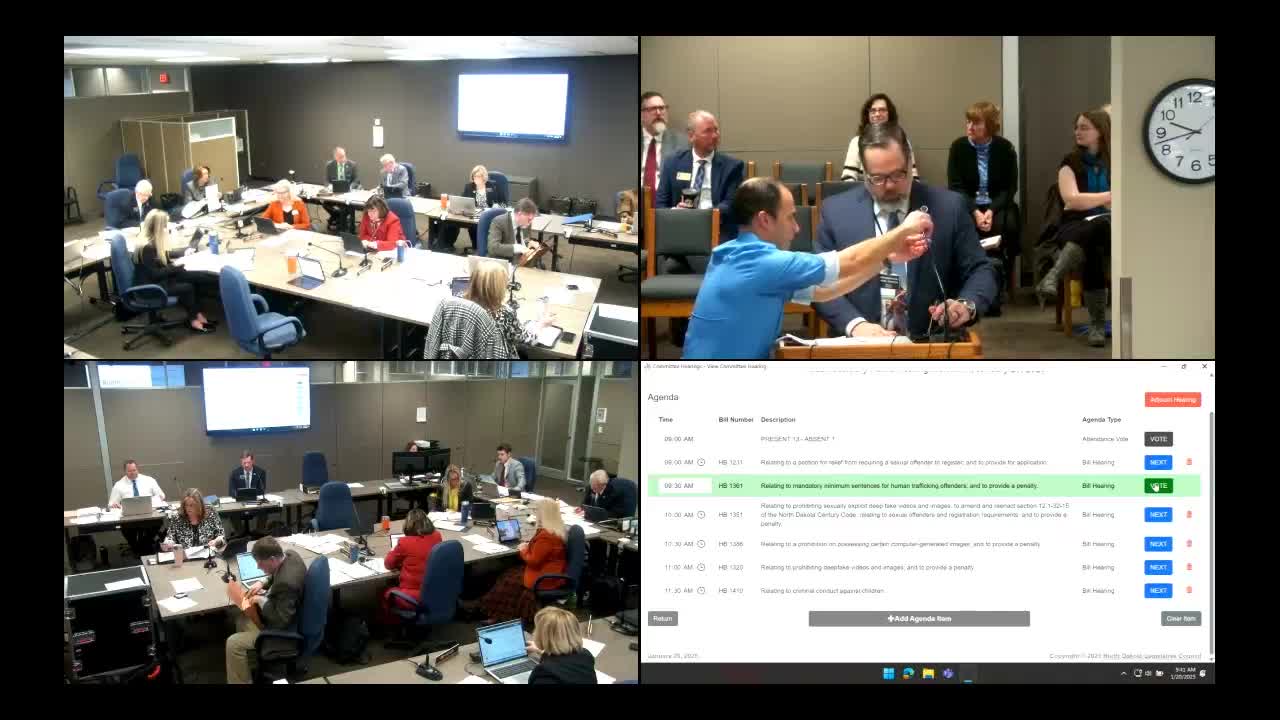
Committee hears bill seeking stricter mandatory minimums for human trafficking offenses
Summary
Representative Johnston presented House Bill 1361 to create mandatory minimum sentences for human trafficking offenses. Supporters said tougher penalties will deter traffickers; some lawmakers and witnesses questioned whether mandatory minimums reduce trafficking or hinder investigations and cooperation with prosecutors.
The House Judiciary Committee opened testimony on House Bill 1361, which the clerk read as "a bill for an act to create and enact a new section to chapter 12.141 of the North Dakota Century Code relating to mandatory minimum sentences for human trafficking offenders and to provide a penalty."
Representative Johnston (District 24) told the committee he introduced the bill because he views human trafficking as an ‘‘epidemic’’ and said the bill’s mandatory minimums would send a deterrent message. Johnston described proposed minimums as follows: for a class B trafficking offense the minimum would be three years less than the maximum for that felony; for a class A offense the minimum would be five years less than the current maximum (20 years); and for a class ‘‘double A’’ offense the bill would set a 40‑year minimum, described by the sponsor as intended to dissuade traffickers from operating in North Dakota.
Several advocacy and survivor‑service witnesses urged passage. Jacob Thompson, policy analyst with North Dakota Family Alliance Legislative Action, asked the committee to grant HB 1361 a do‑pass, citing the North Dakota Human Trafficking Task Force’s count that about 700 victims were served between 2016 and 2022 and warning traffickers will follow economic booms. Piper Bjornson, identified as a survivor and participant in a survivor mentorship program, described being trafficked in Williston and said her trafficker later received a 20‑year sentence; Bjornson said stronger sentencing would support survivor safety and prosecution.
Todd Fuseta, founder of Archangel Ministries and an advocate with extensive experience working with trafficking victims, told the committee harsher sentences are needed because of the brutality and organized nature of many trafficking operations. Tyler Merkel of the 318 Project and other local service providers also testified in support of stronger penalties and described survivor services and outreach work.
Committee members pressed the sponsor and witnesses on proportionality and effectiveness. Representative Satrim asked whether a 40‑year minimum might be disproportionate compared with other crimes and whether mandatory minimums are shown to deter trafficking; Johnston and testimony providers acknowledged limited direct evidence of deterrent effects, but argued the bill would create a strong legal signal. Representative Sasser warned mandatory minimums can reduce prosecutors’ ability to secure cooperation from defendants, which in turn can impede dismantling trafficking networks; Johnston said prosecutors can still plea and downgrade counts in exchange for cooperation.
No formal action was taken during the hearing. Members heard written opposition submitted online but did not hear in‑person opponents.
Why it matters: Witnesses framed trafficking as severe and growing—advocates say longer mandatory sentences protect victims and send a message to traffickers; some lawmakers and witnesses urged caution, citing research questions about deterrence and concerns that mandatory minimums can reduce incentives to cooperate with law enforcement on larger investigations.
What’s next: The committee closed the hearing to consider testimony and any proposed amendments.