Get Full Government Meeting Transcripts, Videos, & Alerts Forever!
Get email alerts on the Registries Reentry topic
No spam. Unsubscribe anytime.
Committee hears bill allowing rehabilitated low‑risk registrants to petition for removal from public registry
Summary
Lawmakers and witnesses debated House Bill 1231, which would let rehabilitated, low‑risk registrants petition a court to remove their names from the public registry after seven years of compliance. Supporters described housing and employment barriers; law enforcement described assessment and registration procedures and current timeframes.
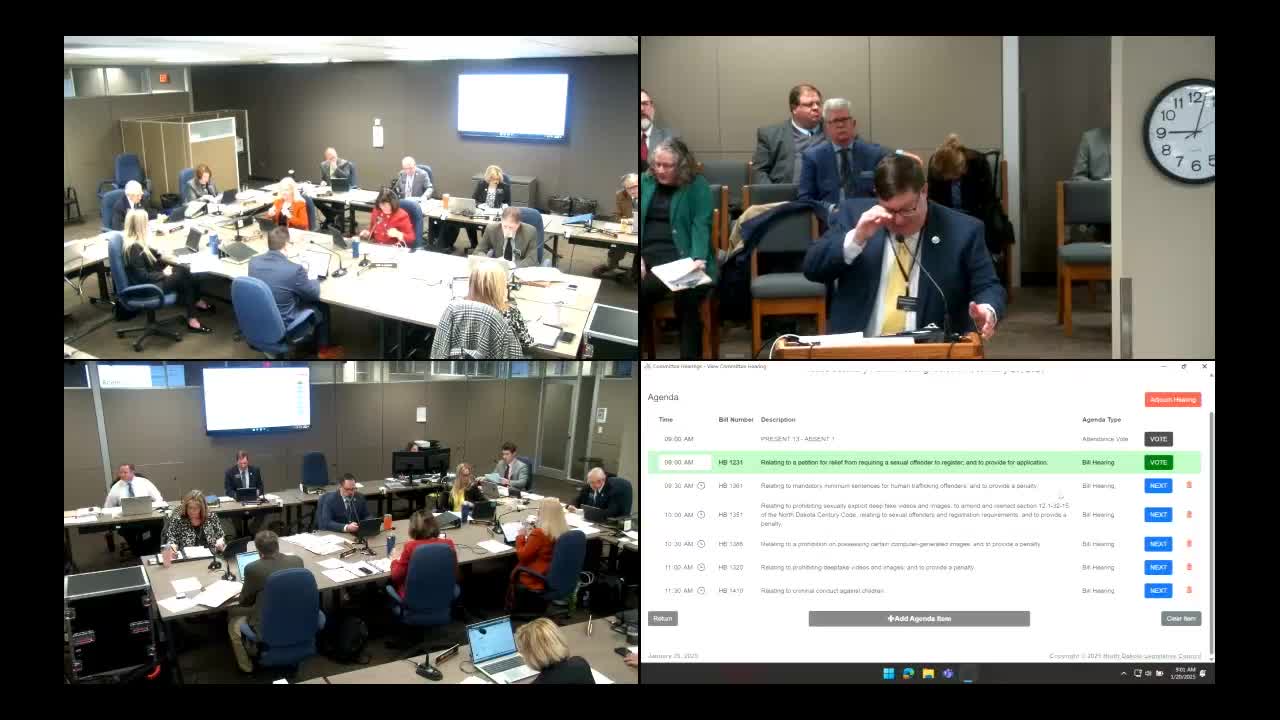
House Judiciary Committee members on the morning agenda heard testimony on House Bill 1231, a proposal ‘‘to create and enact section 12.13215.1 of the North Dakota Century Code relating to a petition for relief from requiring a ****** offender to register and to provide for application,’’ the clerk read.
Representative Jason Doctor, District 7, told the committee HB 1231 would allow a ‘‘rehabilitated, low risk, compliant ****** offender the opportunity to petition the court for removal of the registry,’’ and he said the bill modeled relief available in more than 40 other states. Doctor said the bill targets people who have completed incarceration, probation or parole, completed treatment and ‘‘successfully registered for at least 7 years’’ and remain labeled on the public list despite those steps.
The proposal drew multiple supporters who described practical barriers to reentry. Sister Kathleen Atkinson, director of Ministry on the Margins, said: "This legislation allows a man or a woman to petition the court for removal from that public registration based on the determination that a person is no longer a threat to the community." Atkinson and Nate Mickelson, Prison Reentry Manager at Ministry on the Margins, gave examples—including difficulty obtaining housing, loss of employment and restrictions on school property access—that they said persist even after people complete supervision and treatment.
Brad Peterson, legal director of Protection & Advocacy, described a case involving an elderly registrant with cognitive decline and said HB 1231 would provide a court option short of asking an entire conviction to be set aside: "At least it would have been a chance to go into the registry to seek that option. That's what this law does is an option or an opportunity. It's not automatic." Peterson said courts would likely scrutinize petitions closely.
Casey Miller, chief agent with the North Dakota Bureau of Criminal Investigation, provided procedural detail about how risk levels are set and how long registrants remain required to register. Miller said the state uses a committee—the sex offender risk assessment committee (SORAC)—that reviews criminal history, psychological testing and other information to assign a level. He said low‑risk registrants generally face a 15‑year registration requirement, moderate 25 years and high risk lifetime registration; he noted some low‑risk registrants can also have lifetime registration based on complicating factors. Miller gave current counts, saying there were about 523 low‑risk registrants subject to time‑limited registration and approximately 110 low‑risk registrants subject to lifetime registration in North Dakota.
Committee members asked several clarifying questions. Representative McLeod asked why the bill sets the petition window at seven years; Representative Van Winkle confirmed the bill would apply to registrants of any age, not only juveniles. Representative Olson and others sought detail on how ‘‘risk’’ is determined; witnesses described a multi‑factor assessment process independent of the charging document.
Members also raised procedural questions that could affect victims and public notice. Representative Vedder asked about a provision allowing a petition hearing to be closed to the public; supporters said the court should retain discretion because public hearings can lead to harassment and that closing a hearing could protect a rehabilitated low‑risk registrant from additional harm. Opponents were not present in person but written opposition was noted as submitted online.
The committee took only testimony and did not vote on the bill during the hearing. Chairman Clamine closed the testimony and indicated the committee would consider written submissions and the record during later deliberations.
Why it matters: Supporters framed the bill as a reentry and public‑safety tool that could reduce housing and employment barriers for people assessed as low risk; law enforcement witnesses cautioned the assessment process is multi‑step and that a petition is not an automatic removal mechanism.
What’s next: The committee held the hearing and said it would review written testimony and data before any committee action.