Get Full Government Meeting Transcripts, Videos, & Alerts Forever!
Get email alerts on the Judiciary Budget Sb2002 topic
No spam. Unsubscribe anytime.
Judiciary requests pay raises, 22 FTEs, guardianship office and AI filing tools in $167M biennial budget ask
Summary
Chief Justice John Jensen and State Court Administrator Sally Halloway presented the judicial branch budget (Senate Bill 2002) to the committee, requesting judicial salary increases to national averages, roughly 22 new FTEs, an Office of Guardianship and Conservatorship, AI‑assisted clerk filing, and expanded guardian ad litem staffing.
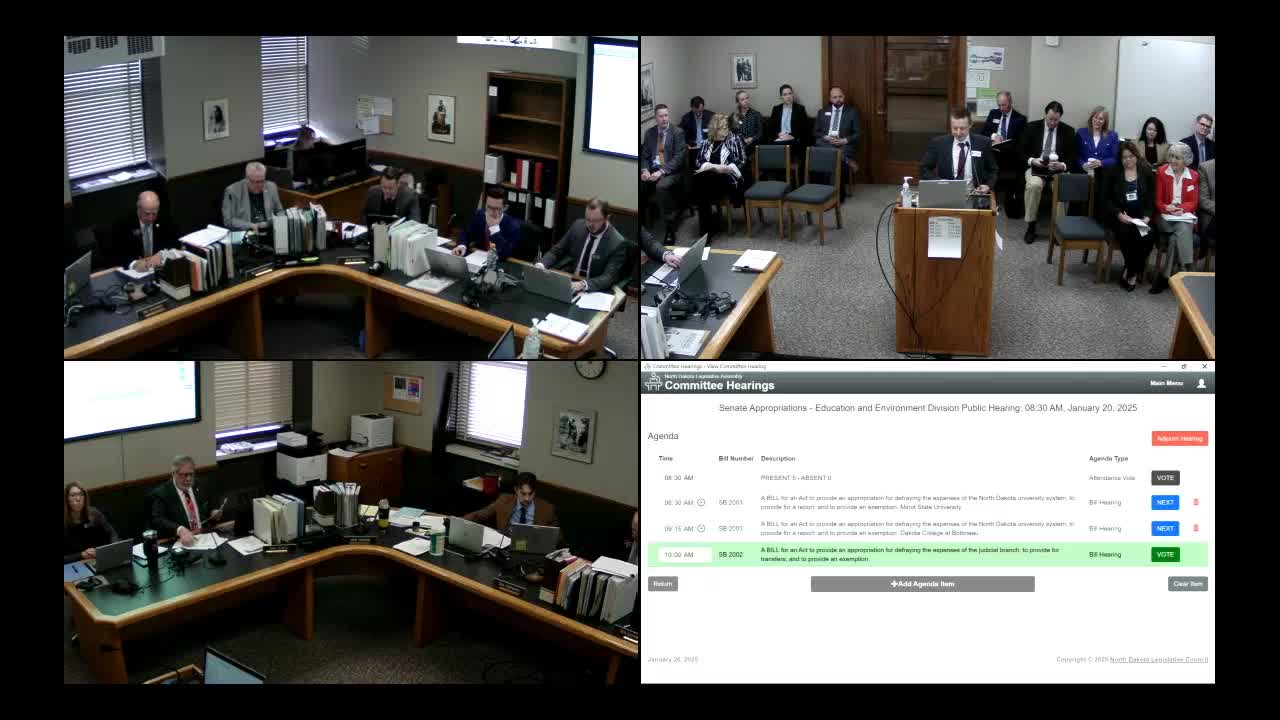
Chief Justice John Jensen and State Court Administrator Sally Halloway told the Appropriations - Education and Environment Division that the judicial branch’s 2025–27 budget request centers on raising judicial salaries, adding staff across district operations and court services, and upgrading technology to improve case processing.
The branch requested approximately $166.9 million for the next biennium (an increase of roughly $37.2 million over base), citing personnel costs, IT maintenance and several new programs including an Office of Guardianship and Conservatorship, a pilot court‑navigator position and an allied legal professional pilot.
The budget matters because court officials said salaries and staffing shortfalls are increasing turnover in clerk offices, straining juvenile and adult court services, and limiting the courts’ ability to handle growing demand for self‑help resources and specialist dockets.
Chief Justice John Jensen opened the presentation and asked the committee to consider several priorities, including judicial salary increases and expanded personnel. He said the legislature’s addition of three judgeships in the prior session “are greatly helping us with our excess workload in those two districts,” and thanked members for that prior action.
State Court Administrator Sally Halloway walked through the budget line items and the branch’s priorities and made a blunt plea on staffing: “Please give us some money. Don’t ask any questions,” she said, then immediately proceeded to explain the line‑by‑line need. Halloway told the committee that personnel are 83 percent of the branch’s budget and that the request includes funding for a 4%/3% salary adjustment (first/second year) for employees, a roughly $2.0 million request to bring judicial salaries to the national average and a separate 3% adjustment to the judicial pay grid.
Specific proposals included:
- Judicial salary increases to bring the state’s pay closer to the national average: Halloway and finance staff presented a one‑time adjustment that would increase the Chief Justice’s pay to the national average (an example number presented in testimony: Chief Justice salary rising to approximately $214,896 and other increases to comparable midpoints). Officials said the increase would be implemented in the first year of the biennium.
- New positions and staffing support: the request included roughly 22 FTEs statewide, targeted to juvenile court administrative support, deputy unit administrators, juvenile probation officers, IT programmers and network analysts, additional staff attorneys for the self‑help center and Supreme Court administration, and temporary coordinators for problem‑solving dockets.
- Office of Guardianship and Conservatorship (OGC): a proposed new division under the Supreme Court, with five FTEs and a request of approximately $1.5 million. The OGC is intended to consolidate administration and oversight of guardianship and conservatorship funds and functions that the branch said currently total about $19 million annually across the state; the bill that would create the office is Senate Bill 2029, which the committee and witnesses referenced during the hearing.
- Court navigator and allied legal professional pilots: the branch requested funding for a court navigator — an attorney to assist self‑represented litigants with forms and court procedures — and a pilot Allied Legal Professional program that would license non‑lawyer legal professionals to perform specified legal services in limited areas. The court navigator request was priced at about $330,000 (one staff attorney and operating) and the Allied Legal Professional proposal at roughly $385,000 (one staff attorney and operating).
- Technology investments: requests included a roughly $1.2 million AI‑driven filing initiative to automate clerk file compliance checks (vendor product via current e‑filing vendor), a $980,000 digital evidence management system, a $780,000 problem‑solving court case management module, and migration/hosting costs tied to cloud‑based case management and public access systems. The branch asked for $7.3 million in capital or one‑time IT equipment funding to update servers, courtroom audio/video systems, jury selection equipment and other infrastructure.
- Guardian ad litem program expansion and family mediation: the branch proposed an increase of roughly $935,000 to move YouthWorks’ lay guardian ad litem roster toward more stable full‑time positions and to fund post‑disposition monitoring; the Family Mediation Program asked for a smaller increase (~$138,200) to handle additional demand.
Don Wolf, judicial finance director, summarized the line items and said the executive recommendation included staff salary and insurance adjustments added by the governor’s office and reiterated the branch’s IT and program priorities. Wolf and Halloway also flagged high turnover among deputy clerk of court positions statewide — they reported 39 separate vacancies in the first 18 months of the current biennium across 99 deputy clerk positions — and said part of the request for additional clerical and juvenile administrative positions is intended to reduce pressure on probation officers and on judges.
Committee members asked for priorities and for more detail on projected cost savings or efficiencies from the AI and case‑management investments. Witnesses said the AI filing tool is intended to automate routine compliance checks (clerical in nature) and that the branch expects to contract with a vendor (current e‑filing vendor has a product) rather than build its own system. On the allied legal professional pilot, witnesses said the model is intended to increase access to justice by training and certifying a tier of professionals who can handle routine civil matters at lower cost than a full attorney.
No formal votes were taken during the hearing. Senators and witnesses agreed the proposals will require additional briefings, and several members asked for staffing studies and cost/benefit analyses for IT initiatives and the OGC proposal before making appropriation decisions.
Ending: The committee left the hearing with a directive to schedule follow‑up briefings and to consider staffing‑study findings and vendor proposals before advancing any of the new program appropriations into conference or budget language.