Get Full Government Meeting Transcripts, Videos, & Alerts Forever!
Get email alerts on the Appropriations topic
No spam. Unsubscribe anytime.
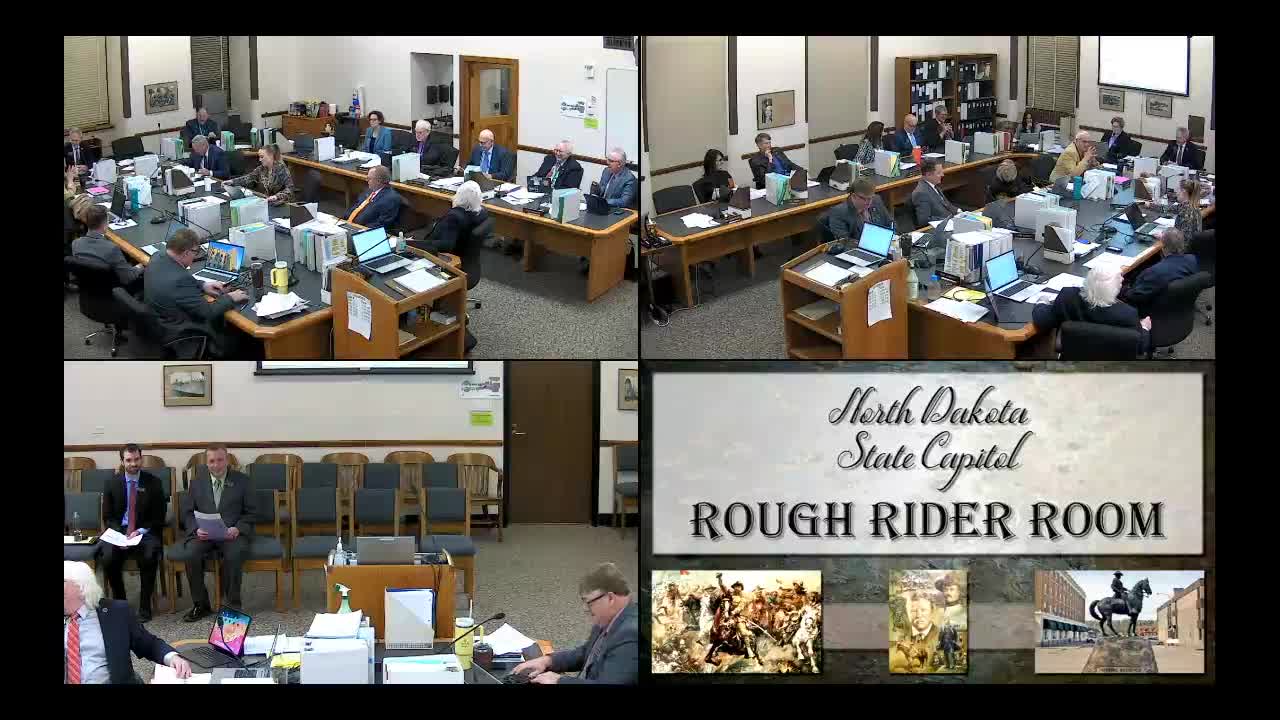
House Appropriations Committee adopts preliminary state revenue forecast
Summary
The House Appropriations Committee voted to adopt a preliminary revenue forecast based on an average of the Armstrong executive budget and an S&P Global baseline; the motion passed on a roll-call vote. Analysts outlined key adjustments for current law, oil-and-gas assumptions and fund balances.
The House Appropriations Committee voted to adopt a preliminary state revenue forecast on a motion from Representative Munson, seconded by Representative Steaman, authorizing Legislative Council to adjust budget status reports to reflect the adopted base-level revenues.
The vote, taken by roll call, was recorded as 20-0 in favor. The motion directs Legislative Council staff to track appropriations against the adopted preliminary revenue numbers as the session proceeds.
The committee heard the forecast presentation from Adam Mattek, legislative council fiscal analyst, who framed the recommendation as a preliminary step ahead of a final revenue forecast in March. "This is just a very high level summary," Mattek said as he walked members through a multi-page memorandum showing comparisons among the Armstrong executive budget, the S&P Global baseline and the committee's proposed figures.
Mattek explained the committee's proposed forecast method: average the first four major tax-type forecasts between the Armstrong executive budget and S&P Global, while carrying the Armstrong figures for smaller tax categories unless current law required a different treatment. He said the proposed forecast makes several adjustments to reflect current law rather than executive budget proposals—for example, keeping current-law oil-and-gas allocations at $460,000,000 rather than the $500,000,000 level proposed in the Armstrong budget.
Mattek also summarized the numerical differences: about a $21,000,000 downward adjustment for the 2023-25 biennium and approximately $77,000,000 for the 2025-27 biennium between the committee's proposed forecast and the Armstrong executive forecast. He reported a proposed general fund beginning balance of roughly $1,100,000,000 under the adopted approach and noted the appendix shows about $800,000,000 less revenue in 2025-27 compared with 2023-25 under the committee's price-and-production assumptions.
On energy assumptions, Mattek said the proposed forecast mirrors the Armstrong executive forecast for oil price and production: prices finishing the current biennium at $62 per barrel and a modest decline in production across the next biennium. He described production numbers as stated in the materials (for example, 1.15, referenced in the presentation) and tied the appendix to how those price and production scenarios flow into fund allocations under current law.
Representative Murphy asked about the Strategic Investment and Improvements Fund balance; Mattek replied, "I believe it's around $1,200,000,000; I'd have to double check, but around 1,200,000,000." Mattek also noted a typographical error in the handout: a parenthetical that listed an SIF limit as $460,000,000 should have read $400,000,000 in that line, although he said the amounts shown elsewhere on the page were correct.
Committee members discussed methodology and precedent. The chairman, Chairman Viggasoff, reminded newer members that the committee has historically averaged forecasts from two forecasting agencies (Moody's and S&P) and said the averaging approach had produced reasonable results in past bienniums. He also cautioned about past experience with revenue shortfalls, noting, "Last session at crossover, we were $1,600,000,000 upside down based on what we had adopted for a revenue forecast."
Before the vote, Mattek pointed to a motion printed at the bottom of the memorandum authorizing Legislative Council to adjust the budget status reports to reflect the adopted base-level revenues. Representative Munson moved to adopt the report as given; Representative Steaman seconded. The clerk took the roll and members voted yes, approving the motion.
After the adoption, committee staff described how the fiscal office will produce side-by-side comparison sheets showing differences between the Burgum and Armstrong proposals and how "purple sheets" (Armstrong) and existing green sheets (Burgum) will be used while agencies and divisions continue hearings. Staff cautioned that some agency purple sheets would not be immediately available due to the compressed schedule.
The committee will finalize a statutory or administrative final revenue forecast in March after additional months of data; the adopted preliminary forecast is intended to guide appropriations tracking and bill work in the interim.
The committee did not take action on specific appropriations in this meeting beyond adopting the preliminary forecast; subsequent hearings and votes will reference the adopted numbers as the baseline.