Get Full Government Meeting Transcripts, Videos, & Alerts Forever!
Get email alerts on the Higher Education Capital Workforce topic
No spam. Unsubscribe anytime.
Minot State, Dakota College at Bottineau outline workforce, capital and housing requests to legislative appropriation panel
Summary
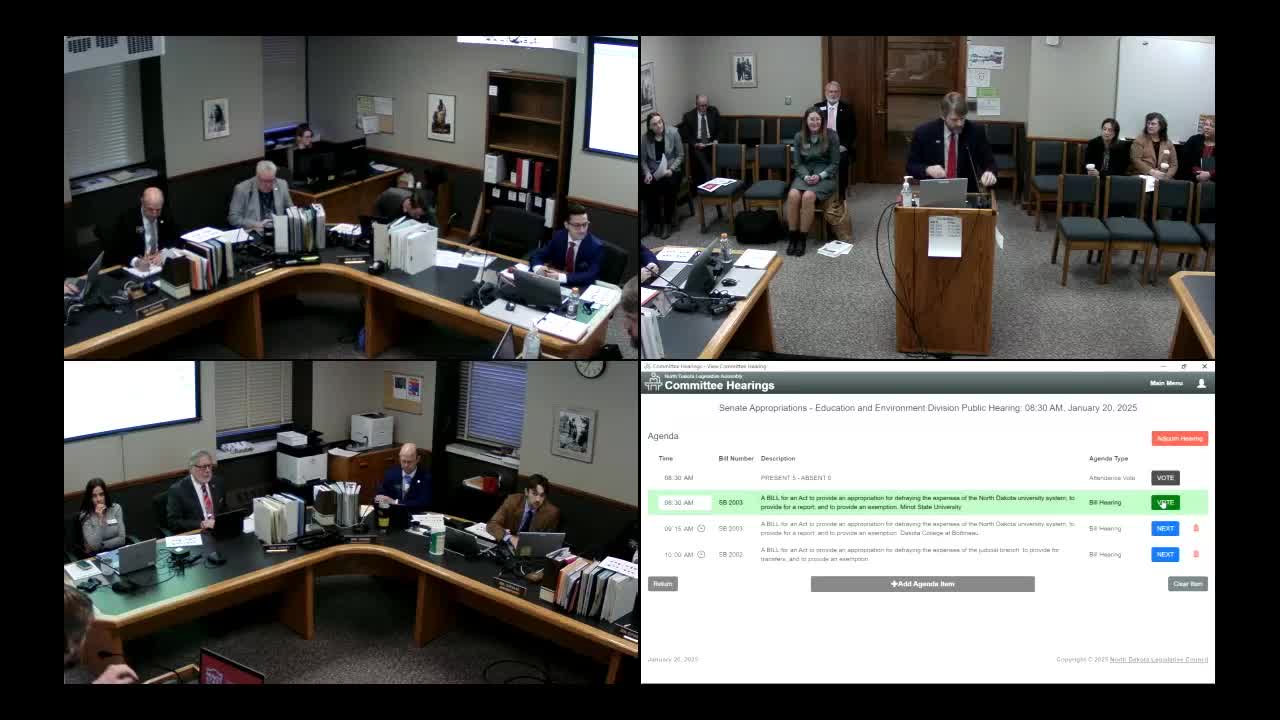
Minot State University President Steve Shirley and Dakota College at Bottineau Campus Dean Carmen Simone told the Appropriations - Education and Environment Division that their institutions need targeted state support for health‑care workforce training, campus maintenance and student housing.
Minot State University President Steve Shirley and Dakota College at Bottineau Campus Dean Carmen Simone told the Appropriations - Education and Environment Division that their institutions need targeted state support for health-care workforce training, campus maintenance and student housing.
Shirley and Simone presented program and budget details and asked for capital funding to acquire an existing downtown Minot health facility and to address aging residence halls at Bottineau, along with routine operating and formula adjustments for the next biennium.
The requests matter because both campuses say they are trying to grow health-care and teacher pipelines while coping with long-term enrollment declines, inflation on construction projects and competition for employees. The institutions told the committee that targeted capital investments — especially a downtown health sciences building that would be shared by Minot State University (MSU) and Dakota College at Bottineau (DCB) — would expand clinical training capacity in a region that local health systems and the college say needs more trained staff.
Shirley, president of Minot State University, summarized the institution’s emphasis on workforce programs and recent fundraising: “We raised $55,000,000,” he said of MSU’s multi‑year capital campaign, adding that most gifts are earmarked for scholarships and academic programs. He told the committee MSU’s largest undergraduate major is nursing, and that MSU has expanded programs recently in cybersecurity, data science and exercise science to address regional workforce demand.
Krista Lambert, MSU vice president for administration and finance, gave the committee a short fiscal snapshot for fiscal year 2024: grants and contracts were the largest revenue category (driven by ARPA funds recognized for the Hartnett Hall remodel), state appropriations made up about 31 percent of revenues, and tuition and fees about 19 percent. Lambert said roughly $13 million of the roughly $26 million in grants and contracts in FY24 was tied to the Hartnett Hall project.
On capital projects, Shirley detailed a joint proposal with Dakota College at Bottineau to purchase an existing Trinity Health building in downtown Minot and convert it to a regional health sciences institute. He said the assembly request being advanced for the project was roughly $12.35 million for MSU and DCB together, and that roughly $8–8.5 million would be for purchase of the building with the remainder for simulation equipment and furnishings. Shirley said the facility is largely turnkey and would cost about one‑third of comparable new construction. He noted operating costs — including hiring faculty — would likely need additional revenue sources and pointed members to pending bills that could provide high‑demand workforce funding.
Simone described DCB’s campus priorities and the most urgent capital need on her campus: student housing. She presented photos and condition reports showing that three residence halls on the Bottineau campus date from 1959–1971 and have failing infrastructure. Simone said the college is asking for funding to demolish Gross Hall and build a new, four‑story, 160‑bed residence hall; the estimate she presented for that project was about $29.8 million (a figure that would include abatement and demolition of older halls). She told senators DCB currently houses about 140 students and that the new hall would replace aging facilities that are damaging recruitment and retention.
Simone also reminded the committee that DCB’s revenue mix is heavily state‑supported (about 48 percent of operating revenue in her slide), with tuition and auxiliary revenues making up most of the remainder; she explained the college relies on housing revenue to support operations and therefore cannot repurpose housing revenue to pay bond debt without creating a budget hole.
Both institutions also reviewed recent successes and near‑term program plans: MSU described the completed Hartnett Hall remodel, accreditation visits in teacher education and nursing, a 60‑year partnership with Minot Air Force Base and plans to add graduate nursing coursework. DCB highlighted steady enrollment growth, completion of an Old Main renovation, a newly operational downtown site that hosts dental assisting and medical coding cohorts, and plans to seek accreditation for a dental hygiene program planned to open fall 2025.
Shirley and Simone told the committee that construction bids have come in substantially higher than prior estimates, and that some projects include unexpected site work — for example, MSU described century‑old tunnels under Dakota Hall that must be shored before demolition. Shirley said MSU needs an additional roughly $635,000 above earlier demolition estimates for Dakota Hall because of those subsurface conditions.
Both institutions also described partnerships and workforce programs: MSU highlighted its National Security Agency/Department of Homeland Security designation as a Center of Academic Excellence in cyber defense and a “grow‑your‑own” teacher preparation pipeline; DCB described its three nursing sites, its dental assisting inaugural cohort and regional dual‑credit partnerships with more than 50 rural high schools.
The hearing produced no committee votes. Both campuses were asked to provide detailed cost estimates and schedules for capital projects and to confirm dates when presidents and deans could return for follow‑up hearings. Members repeatedly asked for prioritized lists of staffing and capital requests if the full package cannot be funded in a single biennium.
Shirley, Lambert and Simone provided the documents and slides used in the presentation and said more detail would be provided if the committee asks for it.
Ending: The committee deferred final decisions about the capital proposals and took no immediate action. Members asked staff to schedule follow‑up briefings and to include the institutions’ cost breakdowns and timelines in future hearings.