Get Full Government Meeting Transcripts, Videos, & Alerts Forever!
Get email alerts on the Pregnancy Related Accommodations topic
No spam. Unsubscribe anytime.
Senate hears SB 5217 to expand pregnancy accommodations; bill would require paid lactation break time and broaden employer coverage
Summary
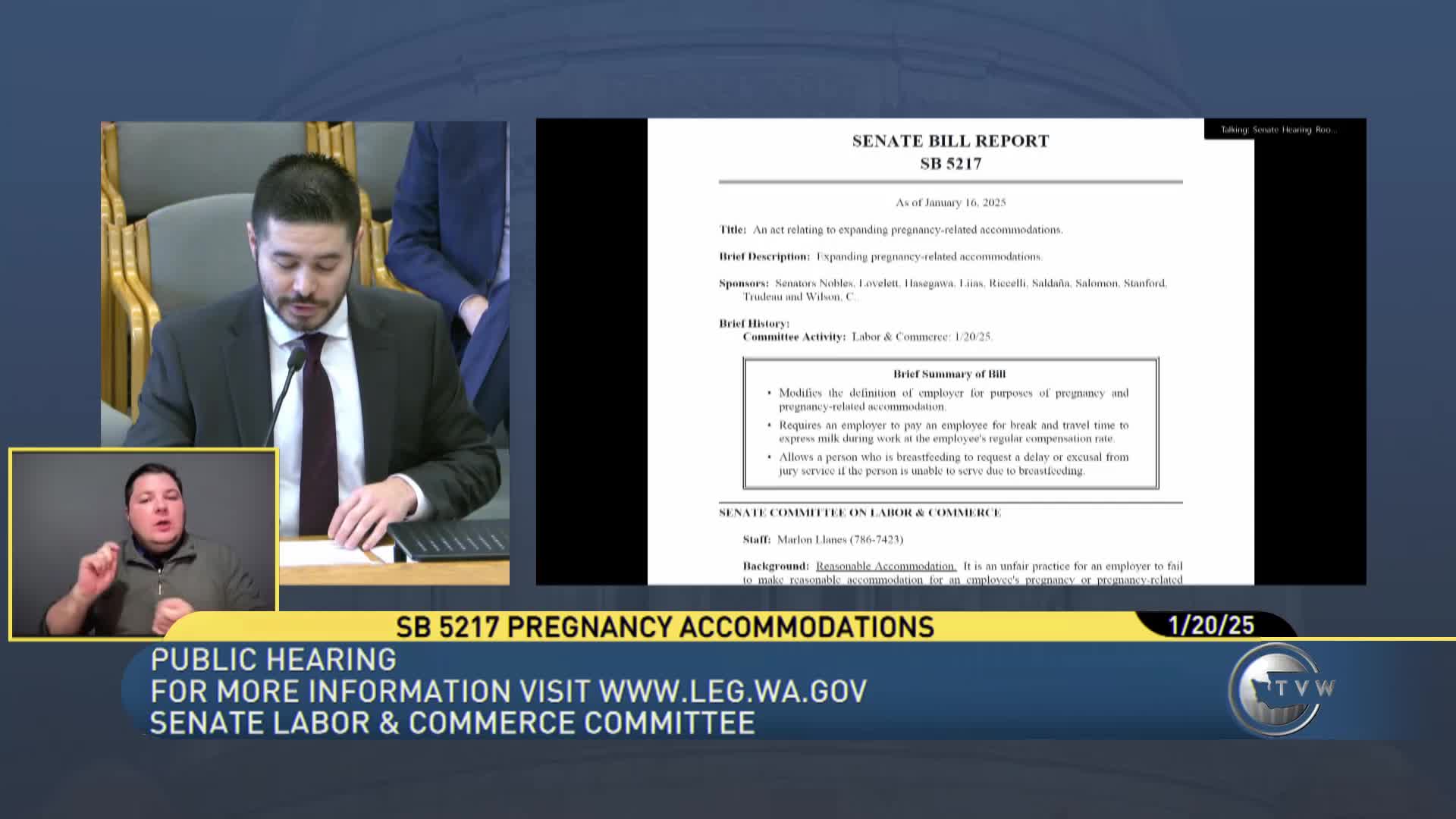
SB 5217 would expand pregnancy‑related reasonable accommodations to employers of any size, require paid time for expressing breast milk during work at the employee’s regular rate, and permit breastfeeding parents to seek delay or excusal from jury duty, the Senate Labor & Commerce Committee heard.
Senate Bill 5217 drew testimony in the Labor & Commerce Committee on measures to expand pregnancy‑related workplace accommodations, including paid lactation break time and a jury‑service accommodation for breastfeeding parents.
Committee staff explained current law requires reasonable accommodations for pregnancy for employers with 15 or more employees and requires break time and a private non‑bathroom space for expressing milk; SB 5217 would require that employers pay employees for break and travel time to express milk at the employee’s regular rate, prohibit employers from forcing employees to use paid leave for pumping time, and expand the employer definition to include any employer with at least one employee (including nonprofit religious organizations). The bill would also allow breastfeeding individuals to request a delay or excusal from jury service. The sponsor, Senator Tijuana Nobles, said the measure builds on existing law and modeled lactation pay language on a Georgia statute signed in 2020.
Supporters described practical problems and health risks when accommodations are unavailable. Ellie Klein described jury duty logistics that made pumping infeasible and unsanitary rooms she encountered; Haley Bano and Brooke Iverson from Teamsters Local 174 described drivers who currently pump from unsanitary vehicle spaces or lose wages when forced to drive to a pumping location. Maggie Humphreys (MomsRising) and other advocates argued that paid lactation time and reasonable accommodations improve maternal and infant health and should not be limited by employer size.
Opponents and small‑business representatives raised concerns about implementation for very small employers and asked for additional lead time and agency alignment for education and enforcement. Patrick Connor (NFIB) asked for a Jan. 1, 2026 effective date to give agencies time to educate very small employers and suggested shifting some enforcement/education duties to the Department of Labor & Industries. Grocery and retail associations requested additional clarity about how small employers with minimal staff would meet break and coverage requirements.
Ending: The committee closed testimony for SB 5217 after hearing proponents and small‑business concerns; sponsors and stakeholders signaled further work on implementation timing and agency roles.