Get Full Government Meeting Transcripts, Videos, & Alerts Forever!
Get email alerts on the Youth Hope Act Isrb topic
No spam. Unsubscribe anytime.
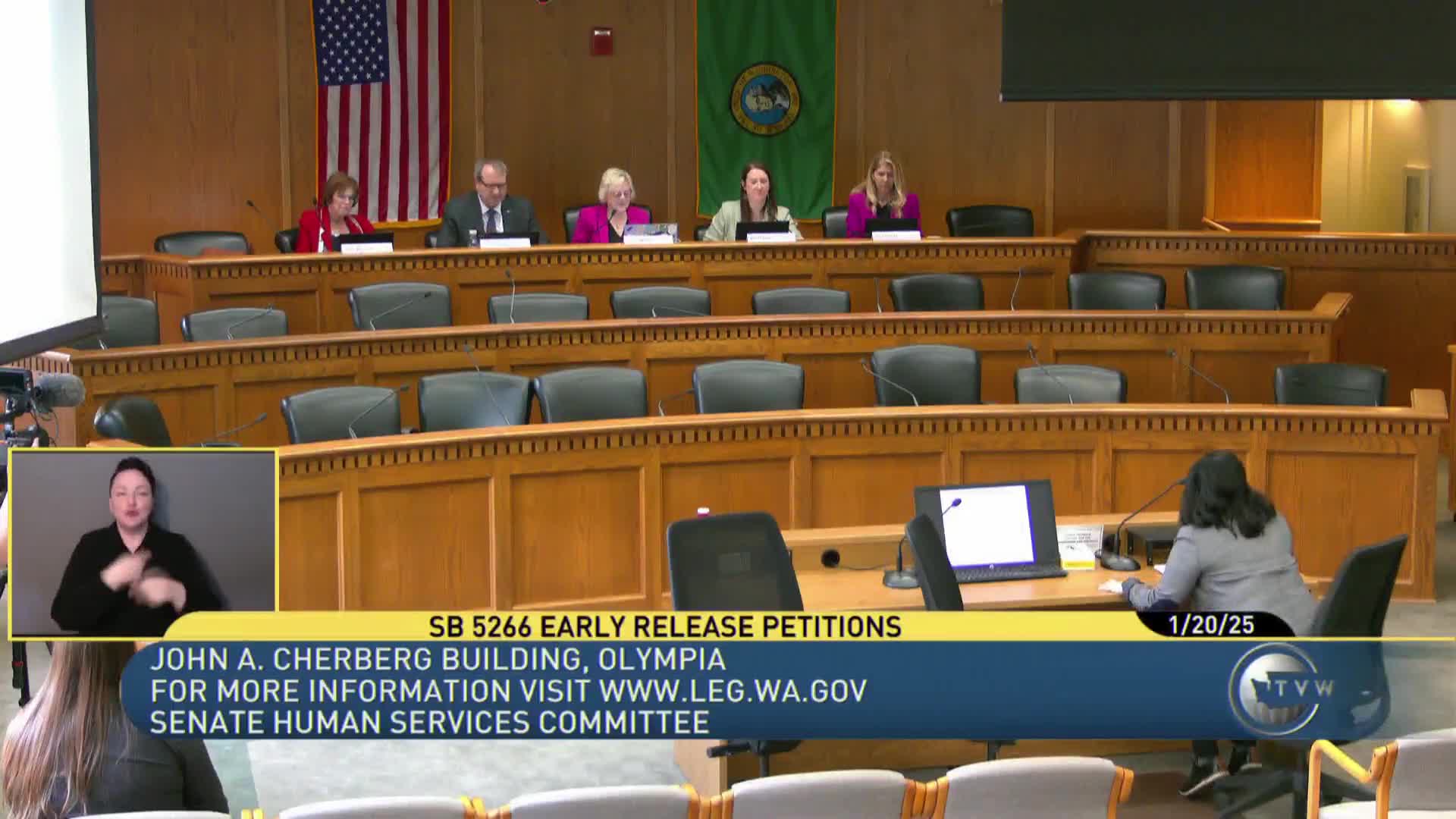
Youth Hope Act receives broad testimony; bill would let some people petition ISRB at 24 and cap petitions
Summary
Senate Bill 5266 (Youth Hope Act) would permit some people who committed crimes as juveniles to petition the Indeterminate Sentence Review Board (ISRB) at age 24 rather than wait 20 years, impose a cap of 70 petitions per year through 2035 with prioritization for those under 25 and in DCYF custody, and authorize rental vouchers and data collection on recidivism.
Senate Bill 5266, the Youth Hope Act, drew a lengthy hearing in which lawmakers heard both support and concern from formerly incarcerated people, residents of juvenile rehabilitation (JR) facilities, advocates, judges, prosecutors and victim advocates.
For the record, Kelsey Ann Fung, committee staff, briefed the panel that the Indeterminate Sentence Review Board (ISRB) currently has jurisdiction over individuals sentenced for crimes committed before age 18 who received terms of confinement longer than 20 years; petitioners may now ask ISRB for early release after serving no less than 20 years. SB 5266 would change eligibility so that a person may petition ISRB at age 24 provided the person has not been convicted of a crime in the 12 months before filing and has not committed a disqualifying serious infraction in the 12 months before filing. The bill leaves unchanged the exclusion for people serving certain offenses, including first-degree aggravated murder and other specified crimes.
The bill would also allow the Department of Corrections (DOC) to provide rental vouchers to successful petitioners where rental assistance would support safe release and would require DOC to gather data on whether rental vouchers reduce recidivism. It would limit ISRB and DOC to reviewing no more than 70 petitions per year from individuals newly eligible under the act until July 1, 2035, and prioritize petitioners under age 25 and those in DCYF custody.
Senator Noelle Grama, prime sponsor, told the committee she supports giving young people “a chance” to be reviewed sooner than the current 20‑year wait, arguing the change would create incentives for rehabilitation and acknowledge adolescent brain development through age 25. Grama and Senator Claire Wilson recounted meetings with incarcerated young people who requested an earlier review opportunity.
Young people currently in JR facilities testified in support. Testimony from residents at Green Hill and Echo Glen emphasized rehabilitation achievements—degrees, vocational certificates, peer-mentoring programs and leadership roles—and described how the possibility of earlier review motivates participation in education and programming. Examples included recipients of associate and bachelor’s degrees and participants in mentorship programs and peer counseling.
Several advocacy organizations and legal practitioners testified in support. Alisa Cozad, a staff attorney at TeamChild, said SB 5266 gives “a critical opportunity to take a second look at these young people to understand the growth and change that has happened while they're incarcerated and transition them back to the community instead of to adult prison.” Judge Sharonda D. Amamillo, Thurston County Superior Court, speaking for the Sentencing Guidelines Commission, urged support and cited research that lengthy sentences do not promote rehabilitation in a vacuum, saying the ISRB is the appropriate entity to balance accountability and rehabilitation.
Opposition and concerns were raised by the Washington Association of Prosecuting Attorneys, represented by Executive Director Russell Brown, who said his organization has concerns about the mechanism and timeline when serious offenses are involved and warned that short timeframes between offense, sentencing and a review hearing could be perceived as minimizing severe harms. Tiffany Attrill, a former homicide victim advocate, testified in opposition and described the trauma of re-contacting victim families when resentencing or review hearings are scheduled.
Supporters countered that the ISRB’s review is a hearing mechanism, not an automatic release, and noted the ISRB uses a structured, evidence-based framework that prioritizes public safety and victim services. Committee staff confirmed the bill does not change ISRB’s standard that the Board must order release unless the preponderance of evidence shows the person is more likely than not to commit future crimes despite conditions; petitioners can be denied and victims have opportunities to provide statements during hearings.
Committee members asked about administrative capacity; sponsors said they worked with ISRB to set the 70‑petition annual limit and expect resources to accompany any added workload. No vote took place in the hearing; the committee closed the record for SB 5266 following extensive testimony.
Votes and formal actions recorded in the hearing transcript were limited to earlier procedural matters (a five-day notice waiver to allow hearing of SB 5199).